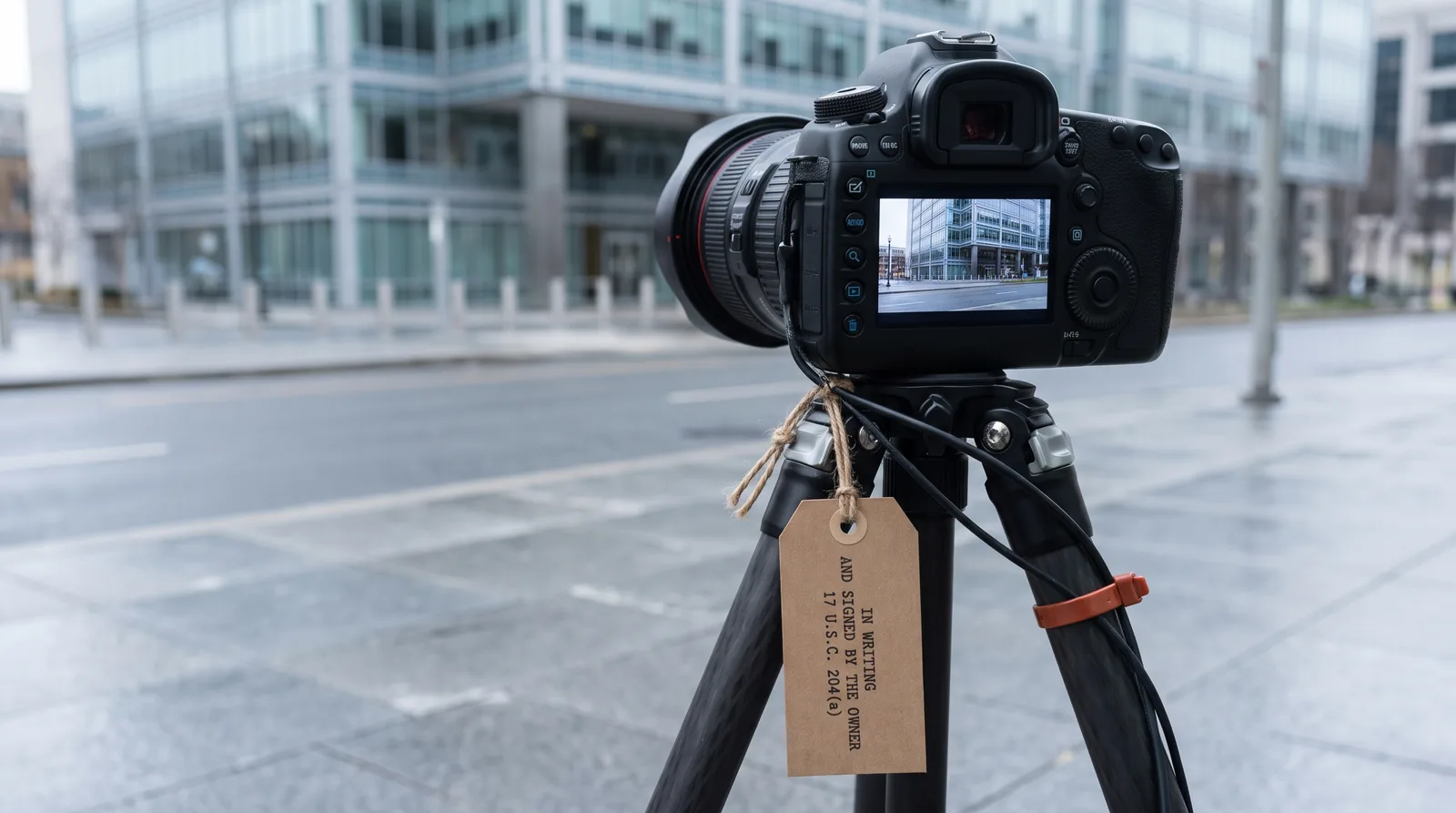
You commissioned the photographs of your listing, you paid the invoice, and you almost certainly do not own them. That is the short answer on commercial real estate listing photos, and it holds whether the images sit in your offering memorandum, on your brokerage's website, or on the property microsite you built for the deal.
Copyright vests in the person who pressed the shutter. Moving it to you takes a specific document that most photographer engagements never produce. And the question of what that costs when it goes wrong has two answers from the same appeals court, three orders of magnitude apart, because two panels read the same sentence of the damages statute and disagreed about whether a property's photo set is one thing or many things.
Who owns commercial real estate listing photos
The photographer, unless you have their signature on a transfer.
17 U.S.C. 201(a) is one sentence: "Copyright in a work protected under this title vests initially in the author or authors of the work." The author is the photographer. Not the person who hired them, not the person who chose the angles, and not the person who paid.
There are exactly two ways that changes. The photographer is your employee and shot the building within the scope of that employment, or you hold a signed writing transferring the copyright. Almost no brokerage has the first. Very few have the second, and the reason they think they do is a phrase that does not mean what it sounds like.
Why "work made for hire" almost never covers a listing photograph
This is the trap, and it is written into the definitions section of the Act.
17 U.S.C. 101 gives "work made for hire" two prongs. The first is a work "prepared by an employee within the scope of his or her employment." An independent photographer sending you an invoice is not that.
The second prong is where people assume they are covered, and it is much narrower than its reputation. It reaches only "a work specially ordered or commissioned for use as a contribution to a collective work, as a part of a motion picture or other audiovisual work, as a translation, as a supplementary work, as a compilation, as an instructional text, as a test, as answer material for a test, or as an atlas," and then only "if the parties expressly agree in a written instrument signed by them."
Count the categories. Nine. A photograph of a commercial building is none of them. Photographs appear in the Act in a different definition entirely, as "pictorial, graphic, and sculptural works."
The one argument that could bridge the gap is that your offering memorandum or your website is a "collective work" and the photograph is a contribution to it. We looked for a court that has accepted that reasoning for commissioned marketing photography and did not find one. The Copyright Office points the other way: its own group registration rule for published photographs states that such a group "is not considered a compilation or a collective work."
So a work-for-hire clause in a photographer's contract is not useless, but it is not doing the job you think. It is evidence of what the parties intended. It is not, by itself, a transfer.
What actually transfers ownership is one sentence
A transfer of copyright ownership, other than by operation of law, is not valid unless an instrument of conveyance, or a note or memorandum of the transfer, is in writing and signed by the owner of the rights conveyed or such owner's duly authorized agent.
Signed by the owner of the rights conveyed. That is the photographer, not you. An assignment they never signed is not an assignment, and the size of the invoice is irrelevant to the analysis.
The same writing requirement covers an exclusive licence, because the Act treats an exclusive licence as a transfer. A non-exclusive licence is the exception: it needs no writing at all and can arise by implication, which is what most brokers actually have without knowing it. The Ninth Circuit's formulation in Asset Marketing Systems, Inc. v. Gagnon, 542 F.3d 748 (2008), is that non-exclusive licence grants "need not be in writing, and may be granted orally or by implication."
An implied licence is real protection for the use everyone contemplated. Its edges are where the litigation happens, and the case law does not agree on where those edges are. The Eleventh Circuit in Latimer v. Roaring Toyz, Inc., 601 F.3d 1224 (2010), works from a fixed test built around what the commissioning party requested. The Southern District of New York in Jose Luis Pelaez, Inc. v. McGraw-Hill, 399 F. Supp. 3d 120 (2019), asks instead whether "the totality of the parties' conduct" supports a licence. Neither answers whether your licence survives the listing expiring, the property selling, or the same photographs being used again three years later on a re-listing. We found no case that does.
The damages question has two answers from the same court
Here is the part worth your attention, because the exposure is not set by the rate. It is set by the unit.
17 U.S.C. 504(c) lets a copyright owner elect statutory damages "with respect to any one work" of "not less than $750 or more than $30,000," rising to $150,000 where infringement was willful and falling to $200 where the infringer "was not aware and had no reason to believe" they were infringing. The same paragraph contains the sentence everything turns on: all the parts of a compilation constitute one work.
So is a property's photo set one work, or is each photograph its own work? Two Ninth Circuit panels, same statute, same test, opposite answers.
Citation
Precedent?
The unit
Award
| Adams v. Agrusa | VHT, Inc. v. Zillow Group, Inc. | |
|---|---|---|
| Citation | No. 16-56170 (9th Cir. 3 July 2017) | 69 F.4th 983 (9th Cir. 7 June 2023) |
| Precedent? | No. Marked not for publication | Yes. Published and binding |
| The unit | One. The photos were "all part of the same marketing compilation for the subject residential property" | 2,700. The photos had "independent economic value separate from the database" |
| Award | $250 | $1,927,200 |
Adams is the fact pattern brokers actually live. An owner ended one listing agreement and hired a different brokerage. Someone at the new firm pulled the photographs off the MLS, removed the copyright markings, and used them in the new listing. The court found infringement, found the salesperson an innocent infringer precisely because the notice had been stripped before she saw the images, and treated the whole set as a single infringement. The award was about what the shoot had cost.
Two things stop that from being the comforting answer. It is a memorandum disposition that says on its own face it "is not appropriate for publication and is not precedent except as provided by Ninth Circuit Rule 36-3." And the plaintiffs argued it themselves, without counsel.
VHT is the published one. On the photos Zillow used outside the listing platform, the court held that "the infringed works were not the database but instead were the 2,700 individual photographs, and VHT is entitled to an award for each of the 2,700 infringements." On remand the district court set $800 per image for 2,312 of them and the $200 innocent-infringer minimum for the other 388. Total: $1,927,200.
That figure is worth stating carefully, because the number in circulation is wrong. The original 2017 jury returned more than $8.27 million. It was cut to roughly $4 million after post-trial motions, and landed at $1,927,200 after a bench trial on remand. The $8.27 million headline is the one that survived online. It is not the outcome.
The distinguishing fact is independent economic value. VHT's photographs were a professional inventory licensed and relicensed across many properties. One shoot of one building is a harder case for the multiplier. But the decision that carries precedential weight in that circuit is the one that multiplies, and the decision that does not is the one a broker would want to rely on.
The defence that saved LoopNet and Zillow does not travel to your website
Both of the big platform wins in this area turn on passivity, and that is the part brokers should not borrow.
In CoStar Group, Inc. v. LoopNet, Inc., 373 F.3d 544 (4th Cir. 2004), LoopNet escaped direct liability for user-uploaded photographs because it was "simply the owner and manager of a system used by others who are violating CoStar's copyrights and is not an actual duplicator itself." In the 2019 round of VHT, Zillow won on its main listing platform for the same structural reason: VHT could not show Zillow "exercised control," "selected any material for upload," or "instigated any copying."
A broker choosing a photograph and putting it into an offering memorandum is doing all three of those things on purpose. That is the definition of selecting material.
We should be precise about the limits of this point. No court has held, in a case against a brokerage, that the volitional conduct requirement is unavailable to an active publisher. This is a reading of the test's own wording rather than a holding anyone has written down. But the test is stated in terms of control, selection and instigation, and a brokerage website is not a passive conduit for anything.
Where commercial is genuinely different
In residential, the photograph travels through the MLS. That is how the images in Adams moved from one brokerage to another, and MLS and association rules do a lot of the governing.
Commercial has no MLS. So your photographs travel through subscription contracts instead, and the terms are not symmetrical.
On CoStar's imagery, the Media Rights Terms are blunt: "any license to CoStar Group Media granted to a CoStar Group Customer ceases at the time such person is no longer a CoStar Group Customer." Photographs CoStar shot for your listing stop being usable when you stop paying. On imagery you supplied, CoStar's licence agreement runs the other way and says you retain your rights "even following termination of this Agreement."
Crexi's terms of service take a broad grant on upload, describing a licence that is "perpetual, irrevocable" among other things. LoopNet's grant back to you is "limited, revocable, and non-sub-licensable" and tied to your listing. None of the five platform documents we loaded states its own effective date on the page, so treat any version you read as undated and check your executed agreement rather than the public page.
Where a Commercial Information Exchange operates, NAR's suggested rules for one do address this directly, which surprised us. They cover the licence a participant grants on submission, the Board's ownership of the compilation itself, removal of a departing participant's filings, and a mandatory notice procedure before one participant can sue another "over the alleged unauthorized use and display of listing content." Those are suggested rules for local adoption, so read the ones your exchange actually adopted.
New York wrote a rule about this, and it is not a copyright rule
Most states say nothing. New York says something specific, and it lands on exactly the page we build.
19 NYCRR 175.25(b)(2)(c):
Proprietary information. Photographs of property that are posted on a real estate broker's website shall not be used or reproduced without written permission from the copyright holder of such photographs.
Note where it sits. It is inside the advertising regulation, under "Placement of advertisements," in the subsection headed "Authorization," directly beneath the rule against advertising another broker's exclusive listing. The same regulation defines advertising to include "websites, e-mail, electronic bulletin boards."
That placement is the point. In New York, lifting a photograph from another broker's site is not only a federal copyright problem. It is an advertising violation under the licence law, answerable to the Department of State, on top of whatever the copyright owner does about it. Two regulators, two sets of consequences, one act.
We checked four other states and found nothing equivalent. Texas resolves the adjacent question as private contract: its commission's own FAQ answers "Do I get to take my listings with me?" with "No. A listing agreement is a private contract between a real estate broker and a property owner and is not promulgated by TREC." California's Department of Real Estate and Illinois both came back empty on photograph ownership. We could not open Florida's advertising rule text, so we make no claim about Florida.
Photographing the building itself is not the problem
One thing you can stop worrying about. The architect's copyright in the building does not reach your photograph of it.
17 U.S.C. 120(a) says the copyright in a constructed architectural work "does not include the right to prevent the making, distributing, or public display of pictures, paintings, photographs, or other pictorial representations of the work, if the building in which the work is embodied is located in or ordinarily visible from a public place."
Two limits worth knowing. The building has to be constructed and ordinarily visible from a public place, so this does nothing for interiors or for a building screened from any public vantage. And architectural works only became protectable for works created on or after 1 December 1990, so for anything older there is generally no architectural copyright to worry about in the first place.
What to actually do
Get the signature. A short assignment that satisfies 204(a), signed by the photographer, is the entire fix, and it costs nothing to add to an engagement you are already paying for. If the photographer will not assign, get a written licence that names the uses you actually need: your website, your offering memorandum, the microsite, third-party platforms, and continued use after the listing closes.
Register what you own. The Copyright Office charges $55 to register a group of up to 750 published photographs taken by the same author in the same calendar year, or $65 for a standard single-work electronic filing. Registration is not optional if you want the statutory damages regime: 17 U.S.C. 412 withholds statutory damages and cost recovery unless registration preceded the infringement or followed first publication within three months.
Audit what is already live. The photographs on your site from listings that closed years ago are the ones with the weakest paper trail, and an implied licence for marketing an active listing is exactly the licence whose survival no court has confirmed.
And never take an image off a platform, a competitor's site, or an old MLS record. That is the Adams fact pattern, and the only reason it ended at $250 was an unpublished decision won against a pro se opponent.
Who publishes advice about this, and what they sell
Worth saying plainly, because it shapes what you find when you search this yourself.
Almost every guide to real estate photo copyright is published by someone with a position. Photography companies favour the answer that the photographer owns everything. Law firms favour the answer that the area is complex. Trade associations favour the answer that reassures members. The listing platforms publish terms, not advice, and those terms are drafted to maximise the platform's own control.
The sources with nothing to sell here are the statute, the Copyright Office, and the courts, and they are silent on most of the questions a broker actually has. Nobody has published data on how often brokerages receive demand letters over listing photographs or what those claims settle for. We searched SSRN and Google Scholar for it. The nearest work studies image infringement litigation generally, not real estate, and no study surfaced where we could look.
We build brokerage websites and property microsites, which is a commercial interest of exactly the kind described above. So everything here is sourced to a document you can open and check for yourself.
Live matter, and this post is the most perishable on this blog. CoStar's copyright case against Crexi, No. 2:20-cv-08819-CBM-AS in the Central District of California, is unresolved. The copyright claims survived summary judgment in June 2025 and the DMCA safe harbour was rejected for the images at issue. The Supreme Court denied certiorari on the parallel antitrust track on 23 March 2026, Crexi's counsel was disqualified on 13 July 2026, and Crexi's request to pause the copyright case pending appeal of that disqualification was denied in August 2026. There is no verdict and no settlement. Docket checked 2026-09-07.