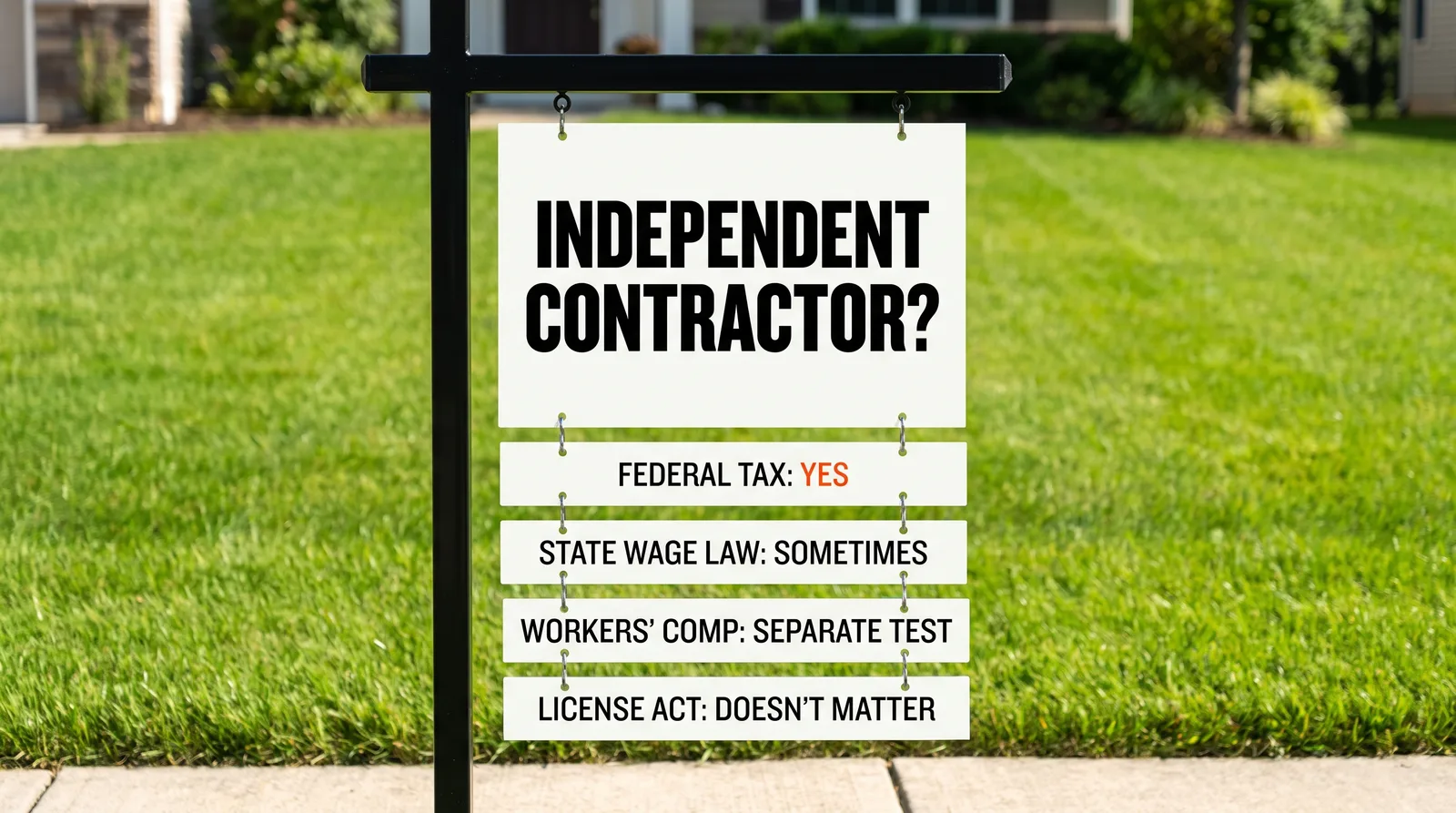
Are real estate agents independent contractors? For federal tax, yes, if three conditions hold. That answer is real, it is written into the Internal Revenue Code, and it has been there since 1982.
It also settles about a quarter of the question.
The statute that gives real estate agents their safe harbor, 26 U.S.C. 3508, opens with six words that fence it in: "For purposes of this title." Title 26 is the tax code. Three other bodies of law ask whether your agents are employees, they use different tests, and they can reach different answers about the same person in the same state on the same day. Your written agreement decides one of the four.
Here is the split, and then each one from the rule text.
Federal tax
State wage and unemployment law
Workers' compensation
Supervision and liability to the public
| Question | Who decides | Does your contract control? |
|---|---|---|
| Federal tax | 26 U.S.C. 3508 | Partly. It is one of three required conditions |
| State wage and unemployment law | State statute, varies widely | In some states yes, in others not at all |
| Workers' compensation | A separate state statute, often a different test | Usually not |
| Supervision and liability to the public | The real estate license act | Never |
The federal answer, and the fence around it
26 U.S.C. 3508(a) is short:
For purposes of this title, in the case of services performed as a qualified real estate agent or as a direct seller, (1) the individual performing such services shall not be treated as an employee, and (2) the person for whom such services are performed shall not be treated as an employer.
A "qualified real estate agent" under 3508(b)(1) is someone who meets all three of these:
- (A) "such individual is a licensed real estate agent"
- (B) "substantially all of the remuneration (whether or not paid in cash) for the services performed by such individual as a real estate agent is directly related to sales or other output (including the performance of services) rather than to the number of hours worked"
- (C) the services are performed "pursuant to a written contract between such individual and the person for whom the services are performed and such contract provides that the individual will not be treated as an employee with respect to such services for Federal tax purposes"
The section has exactly one limitation, at (b)(3), and it is narrow: the rule does not apply for purposes of subtitle A where the individual is treated as an employee under section 401(c)(1), which concerns retirement plans for the self-employed.
Two things worth noting about its age. It was added in 1982 and amended once, in 1996, and the 1996 amendment did not touch the real estate agent definition at all. It expanded the separate direct-seller category. So the three conditions above have read the same way for over forty years.
The IRS restates it on its own statutory nonemployees page: direct sellers and licensed real estate agents "are treated as self-employed for all federal tax purposes, including income and employment taxes," on those conditions.
That is a genuinely strong protection. It is also, by its own first clause, a tax rule.
The condition that breaks quietly
Of the three conditions, (A) takes care of itself and (C) is a document you sign once. Condition (B) is the one that can lapse without anyone noticing, because it is about how you pay people, and how you pay people changes as a brokerage grows.
"Substantially all" is not defined in the statute. Neither is the boundary between pay that is "directly related to sales or other output" and pay that is related "to the number of hours worked."
So what happens if you offer an agent a draw against commission, a guaranteed minimum for their first six months, or a small base while they build a pipeline? These are ordinary recruiting tools, and a new brokerage competing for agents will be asked for one.
Nobody has published an answer. Across two research passes we looked for an IRS revenue ruling, a Tax Court decision, a private letter ruling, and an IRS audit techniques guide addressing draws or guaranteed minimums under 3508(b)(1)(B). The only ruling located on point was a 1990 private letter ruling applying the section to workers paid on straight commission, which is the easy case. On draws specifically, nothing surfaced where we could look.
That absence matters more than it would in most topics, because several states have written the stricter version of this rule down, and a broker who satisfies the federal test can still fail theirs:
Federal
| Jurisdiction | Pay standard | Applies to |
|---|---|---|
| Federal | "substantially all" tied to output | Federal tax |
| Wisconsin | "Seventy-five percent (75%) or more" | Workers' compensation |
| Pennsylvania | "remunerated on a commission-only basis" | Workers' compensation |
| Connecticut | "solely by way of commission" | Unemployment compensation |
"Substantially all" leaves room for a draw. "Commission-only" and "solely by way of commission" do not, on their face. Wisconsin at least tells you the number.
If you are going to offer a draw, that is a conversation to have with a tax adviser before the recruiting conversation, not after.
State wage law asks a different question
Most states test worker classification with either an ABC test or a multi-factor economic reality test, and neither one cares what your contract says. Real estate is frequently carved out of those tests, but the carve-outs are narrow and they are not uniform.
California is the clearest example of a carve-out that is real and bounded. Labor Code 2778 opens: "Section 2775 and the holding in Dynamex do not apply to the following, which are subject to the Business and Professions Code," and (c)(1) sends real estate licensees to Bus. & Prof. Code 10032(b). That section in turn says a broker and salesperson "may contract between themselves as independent contractors or as employer and employee, for purposes of their legal relationship with and obligations to each other."
Read the qualifier. With and obligations to each other. The same statute then hands classification for tax withholding and unemployment to the Unemployment Insurance Code, and workers' compensation to Labor Code section 3200 and following. And it opens by saying the license law's obligations apply "regardless of whether" the parties called it independent contractor or employment.
New Jersey went further and a court tested it. N.J.S.A. 45:15-3.2(b) provides that "notwithstanding any provision of R.S.45:15-1 et seq. or any other law, rule, or regulation to the contrary, a business affiliation between a broker and a broker-salesperson or salesperson may be that of an employment relationship or the provision of services by an independent contractor."
In Kennedy v. Weichert, decided 13 May 2024, the New Jersey Supreme Court held that "the parties' agreement to enter into an independent contractor business affiliation is enforceable under N.J.S.A. 45:15-3.2, and Kennedy, as an independent contractor, was not subject to the WPL." The trial court and Appellate Division had applied the ABC test. The Supreme Court said the license act's notwithstanding clause wins.
Connecticut's carve-out is narrower than either. Conn. Gen. Stat. 31-222 excludes "service performed by an individual as a real estate salesperson, if all such service is performed for remuneration solely by way of commission," and that exclusion sits in the unemployment compensation chapter. It answers one question, not the general one.
Illinois is the case where the absence is the answer. The Illinois Employee Classification Act has no real estate carve-out, and it does not need one: the Department of Labor's own page describes it as covering "individuals performing services for construction contractors." Brokerage sits outside its scope entirely. The Illinois Real Estate License Act separately contemplates both arrangements, requiring that "every broker who employs licensees or has an independent contractor relationship with a licensee shall have a written employment or independent contractor agreement."
Workers' compensation is a third question
This one surprises people, because it is where a state that gave you contractual freedom for wage purposes takes it back.
California's Bus. & Prof. Code 10032 explicitly routes workers' compensation to Labor Code 3200 and following, which means the multi-factor test, not your agreement. Wisconsin excludes licensees from the Act only if a written agreement says they are not employees for federal and state tax purposes and 75 percent or more of compensation is tied to brokerage services performed. New Mexico excludes qualified real estate salespersons "for the purposes of the Workers' Compensation Act" on similar conditions.
Pennsylvania is the strictest of the four, and its own Department of Labor and Industry spells out the stack: an employer is excluded from insuring workers' compensation liability only if all workers fall into the listed categories, one of which is licensed real estate salespersons or associate brokers "affiliated with a licensed real estate broker ... under a written agreement, remunerated on a commission-only basis and qualifying as independent contractors for State tax purposes or for Federal tax purposes."
Note what Pennsylvania did there. It borrowed the federal tax status as one ingredient and then added its own conditions on top. Passing 3508 is necessary and not sufficient.
What the label never buys you
Whatever you write in the agreement, you are still the broker.
Florida says it in one sentence. Fla. Stat. 475.01(2) recognizes the independent contractor relationship and then closes the door: "The existence of such relationship shall not relieve either the broker or the sales associate of her or his duties, obligations, or responsibilities under this chapter." Florida separately disciplines a broker who has "failed, if a broker, to direct, control, or manage a broker associate or sales associate."
Texas is the most explicit anywhere we looked. 22 TAC 535.2(a) makes a broker "responsible for the authorized acts of the broker's sales agents," while noting the broker "is not required to supervise the sales agents directly." Then subsection (m) removes the ambiguity entirely: "This section is not meant to create or require an employer/employee relationship between a broker and a sponsored sales agent."
Responsibility, without employment. That is the whole point in one rule.
North Carolina ties supervision to license status rather than employment: G.S. 93A-2(a2) requires that a provisional broker "must be supervised by a broker-in-charge when performing any act for which a real estate license is required." California makes the designated officer of a corporate broker responsible for supervision "of the activities conducted on behalf of the corporation by its officers and employees," expressly including "the supervision of salespersons licensed to the corporation" (Bus. & Prof. Code 10159.2).
Four states, four different drafting styles, and not one of them conditions the duty on employment status.
Liability to the public is messier, and the courts split
Supervision duty is one thing. Whether you write the check when an agent defrauds a customer is another, and it turns on agency law rather than on tax status.
The Ohio Supreme Court, in a 2014 decision summarized by the court's own news service, sent a case back for trial because "to impose vicarious liability, a jury first has to make a factual determination that the agent was acting within the scope of her agency when she committed the torts at issue," and it rejected the opposite rule too: "We cannot endorse this bright-line rule. The fact that a broker eventually received a commission from an agent's sale does not mean that every action the agent took prior to the sale was within the agent's scope of authority as a matter of law."
A California appellate court went the other way on its facts in Kaplan v. Coldwell Banker: "Absent a showing that Coldwell Banker controlled or had the right to control the day-to-day operations of Marsh's office, it was not liable for Marsh's acts or omissions as a real estate broker."
Both turn on control and scope of agency. Neither turns on whether the agent filed a Schedule C.
The federal wage rule is moving right now
Everything above about state law sits alongside the Fair Labor Standards Act, and the FLSA does not carve out real estate at all.
The Department of Labor's rulemaking page shows the 2024 final rule, effective 11 March 2024, applying a totality-of-the-circumstances economic reality analysis. On 26 February 2026 the Department announced a proposal to replace it, published at 91 FR 9932, with comments closing 28 April 2026. As of the date we checked, 23 August 2026, no final rule has issued and the 2024 rule remains operative. Real estate agents are not named or exempted in either.
Which is exactly why there is a bill. H.R. 3495, the Direct Seller and Real Estate Agent Harmonization Act, would amend the FLSA's definition of employee to exclude "any direct seller or qualified real estate agent (as such terms are defined in section 3508(b) of the Internal Revenue Code of 1986)." It was introduced 19 May 2025 by Rep. Kevin Kiley, reported out of the House Education and Workforce Committee, and placed on the Union Calendar on 11 February 2026. It has not passed the House.
Read the mechanism, because it is the argument of this whole post made by Congress. The bill works by importing the tax code's definition into wage law. That is only necessary because the tax definition does not currently reach there.
One footnote for anyone reading NAR's material on this. NAR's issue brief points readers to "H.R. 5419," which was the bill number in the previous Congress and expired with it. The live vehicle is H.R. 3495. Worth knowing if you go looking.
Who is telling you this
Almost everyone writing about this question sells into exactly one of the four domains, and it shows.
We counted. Across both research passes, 19 non-primary pages on real estate worker classification were opened and read: law firm alerts, trade association guidance, insurers, payroll and workplace-compliance commentary. Five of the 19 distinguished at least two of the four domains from each other. The other fourteen treated "independent contractor status" as a single yes-or-no answer, most often by describing the federal tax safe harbor and then writing as though it settled state employment law too.
That is not usually dishonesty. A tax specialist writes the tax answer, an employment lawyer writes the wage answer, and a workers' compensation carrier writes the third one. The reader is the only person in the transaction who needs all four.
NAR is a slightly different case and deserves naming plainly. It states that it "supports the protection of, and efforts to further secure, the right of real estate sales people to work as independent contractors," and that it "strongly opposes any erosion of this protection." That is an advocacy position, held openly, and it is a legitimate one. It is not a description of what the law currently is, and its own brief blends the two in a single paragraph.
One thing we could not tell you. We wanted to give you a number for what misclassification actually costs a brokerage. The best-known example, a 2016 California class settlement, is widely reported on class-action news sites and we could not confirm it on any court or government host, so it is not in this post. We also could not find a single misclassification enforcement action against a real estate brokerage documented on a government host with a dollar figure attached. The exposure is real and well described in the statutes. The price tag is not something we can show you.
What to actually do
Get the written agreement right, because it is a condition and not a formality. 3508(b)(1)(C) requires a contract stating the agent will not be treated as an employee for federal tax purposes. Missing that sentence costs you the federal safe harbor on its own.
Decide about draws before you need one. Nobody has published whether a draw breaks the federal pay condition, and at least three states use stricter wording than the federal statute does. This is the single most likely way for a compliant brokerage to drift out of compliance while growing.
Ask your state's four questions separately. Tax, wage and unemployment, workers' compensation, and license-act supervision. A carve-out in one is not a carve-out in the others, and California proves it inside a single statute.
Do not buy workers' compensation advice from your tax adviser, or the reverse. Pennsylvania requires federal or state tax IC status as one ingredient among several. Getting the tax answer right is where that analysis starts, not where it ends.
Never treat the label as liability protection. Florida says the relationship does not relieve you of your duties. Texas says its broker responsibility rule is not meant to create employment. Your supervision obligation is attached to your license, not to your payroll.
Re-check the federal position before you rely on it. There is a proposed rule pending at the Department of Labor and a bill on the House calendar, either of which could move.
That is the part we cannot help with. What we do is build the websites and recruiting pages new brokerages open with, which is a different job from structuring the firm behind them. If you are setting one up, tell us what you are opening. For the decisions next to this one, we have written up commission splits, trust account requirements by state, and how to recruit agents to a new brokerage.
The short version
Are real estate agents independent contractors? For federal tax, yes, on three conditions in 26 U.S.C. 3508, unchanged since 1982. That statute begins "For purposes of this title," and the title is the tax code.
State wage law asks separately. California exempts real estate licensees from the ABC test and hands the question to a statute that lets the parties choose, for purposes of their obligations to each other. New Jersey's statute says the same thing with a notwithstanding clause, and its Supreme Court enforced it in 2024. Connecticut's carve-out reaches unemployment compensation only.
Workers' compensation asks a third time, usually with a stricter test. Pennsylvania wants commission-only pay and tax IC status. Wisconsin wants 75 percent.
The license act never asks at all. Florida says the label does not relieve you of your duties. Texas makes you responsible for your agents' authorized acts and then says the rule is not meant to create employment.
The most useful thing we can tell you is a gap rather than a rule: no published authority says whether a draw against commission breaks the federal pay condition, and several states write that condition more strictly than Congress did.