Nobody has ever measured what a 3D tour does for a commercial building. Not once. If you are weighing a commercial property 3D tour for a listing, that is the honest starting point, and it is not what the people selling them will tell you.
This is the same answer we got when we asked whether a dedicated property microsite does anything, and it arrives the same way. Two research passes across SSRN, Google Scholar, RePEc, NBER and the main real estate finance journals turned up three credible studies. All three are residential. All three are about houses and condominiums. Not one looks at an office floor, a retail unit or an industrial building.
What they did find is worth your attention anyway, because the single statistic the entire industry repeats turns out to have a second half that nobody quotes.
Commercial property 3D tours: the number every vendor quotes
You will meet these figures within about ninety seconds of searching: listings with a 3D tour sold up to 31 percent faster and for up to nine percent higher. They appear on the site of nearly every company selling tours, usually credited to an "academic statistical analysis" of 143,575 listings.
The study is real, and it deserves to be described accurately rather than dismissed.
It is an analysis by Kelley Anderson, then a doctoral candidate, and K.T. Manis of Texas Tech University's Jerry S. Rawls College of Business Administration. It covered 143,575 listings from November 2016 to November 2019, of which 3,935 had a 3D tour. It was published on Matterport's own blog on 25 February 2020.
Three things about that page are worth reading closely.
The numbers are ceilings, not averages. The page says "up to" nine percent and "up to" 31 percent, "depending on the market." The 31 percent figure is the South market specifically. Vendors drop the qualifier.
Over 90 percent of the tours studied were Matterport's own product, on a page published by Matterport.
The page does not say whether the analysis was peer reviewed, and it does not say who funded it. We are not asserting that it was funded by anyone. We are pointing out that the page a whole industry cites as academic evidence is silent on both questions.
The paper the same researchers published two years later
Here is the part that changes the picture.
In 2022, Kelley Cours Anderson, Julia Freybote and Kerry T Manis published "The Impact of Virtual Marketing Strategies on the Price-TOM Relation" in the Journal of Real Estate Finance and Economics. Accepted 16 May 2022, peer reviewed, 34,359 single-family transactions.
Two of the three authors are the same people.
Their finding, verbatim: "The use of virtual tours has no effect on the sales prices of vacant homes."
For occupied homes the result is more complicated, running through an interaction with time on market rather than a clean price premium. But the headline is a null, it is peer reviewed, and in two passes of searching we did not find a single vendor page citing it.
The same researchers. One number on a vendor's blog, one in a journal. Only one of them travels.
What the other neutral studies found
Two more, both residential, both pointing the same direction.
NBER Working Paper 33204 (Soleymanian and Qian, November 2024) examined 197,345 attached-home transactions in Vancouver. Tours raise price by about one percent, and the paper is explicit that "the effect has declined over time, particularly post-COVID," and is "less impactful for highly differentiated properties." It was funded by Canada's Social Sciences and Humanities Research Council, a public body with nothing to sell.
Harvard Business School researchers examined 75,178 Los Angeles-area sales and found the effect "insignificant" once photo and caption quality were controlled for. That control matters more than it sounds: it suggests part of what looks like a tour effect is really a "this listing had money spent on its marketing" effect.
The pattern across all three is consistent. The more carefully the study controls, the smaller the effect gets.
And a commercial building is not a house. A tenant rep touring 40,000 square feet for a ten-year lease is not a couple browsing on a Sunday. The reasoning may transfer. Nobody has checked.
The company that decides your listing's prominence now owns the tour company
This is the part specific to commercial, and it follows directly from why commercial has no MLS.
In residential, listings are shared through a cooperative feed. In commercial they are not, so exposure is bought rather than shared, and CoStar is who you buy it from.
On 28 February 2025, CoStar Group completed its acquisition of Matterport for approximately $1.6 billion.
So the company whose platform decides how prominently your listing appears now also owns the dominant product for making that listing immersive. We are not alleging anything improper. We are saying that a broker deciding whether to buy a 3D tour should know that the decision sits inside the same commercial relationship as the decision about listing exposure, and that relationship is already the subject of live antitrust litigation.
Who owns the tour when you stop paying
The listing photo question again, in a new medium, and the answer is worse.
Matterport's Cloud Subscription Agreement, dated 17 November 2020, is unusually clear. You own quite a lot on paper:
You will own all Exportable Files, including all digital copies thereof and copyrights therein
You will own the copyrights in all Raw Sensor Data
Then read what happens next. Matterport owns all digital copies of the Raw Sensor Data. And on expiration or termination, your "access to the Matterport Cloud will be deactivated," Matterport "will have the right to continue to host and display any Spaces and VR Spaces," and it has "no further obligation to deliver to You, or make available for download, any portion of Your Spaces."
Owning a copyright you cannot reach a copy of is a thin kind of ownership.
The practical instruction is one line: export everything before you cancel, because the contract says nothing has to be handed to you afterwards. The same trap caught brokers on CoStar's image licence, where the right to use imagery ends the day you stop being a customer.
California just moved the rule, and commercial leasing lands somewhere odd
Two bills, both now signed.
AB 723 was approved on 10 October 2025 and chaptered as Chapter 497, Statutes of 2025. It added Business and Professions Code section 10140.8, requiring anyone advertising real property for sale to disclose a "digitally altered image" and link to the unaltered original. A digitally altered image is one changed "through the use of photo editing software or artificial intelligence to add, remove, or change elements," which reaches a virtually staged room and plainly reaches a rendering. Ordinary lighting, cropping and colour correction are excluded.
Note what the section does not contain: the words "residential" and "commercial." On its face it reaches a commercial sale listing by any California licensee. The penalty is not in that section either. It comes from Business and Professions Code 10185, under which a willful violation is "a misdemeanor punishable by a fine not exceeding ten thousand dollars ($10,000), or by imprisonment in the county jail not exceeding six months."
AB 2025 rewrites that section. It passed the Senate 37 to 1 and cleared Assembly concurrence 78 to 0, and the Governor signed it on 27 September 2026 as Chapter 572, Statutes of 2026. It carries no urgency clause, so it takes effect on 1 January 2027.
From 1 January 2027, two things change that matter to a commercial broker.
First, most commercial leasing drops out of 10140.8. The amended section adds: "This section does not apply to an advertisement or other promotional material for a leasehold exceeding one year's duration." Nearly every commercial lease exceeds a year.
Second, the duty does not disappear. It moves somewhere nobody would look for it. AB 2025 adds a new Civil Code section 1940.11, requiring the same disclosure for advertising "for rental of real property." The words "residential," "dwelling," "commercial" and "tenant" appear nowhere in it, and Civil Code 1940(d) says a provision of that chapter is confined to dwelling units only if it is "so limited by its specific terms." It is not.
So the disclosure rule for a commercial lease listing will sit in the Civil Code's landlord and tenant chapter rather than in the Real Estate Law, and section 1940.11 routes a violation straight back to your licence anyway. There is a genuine tension here worth knowing about: the Assembly committee analysis describes the bill as a rental housing measure protecting California's renters, while the words it actually enacts say "real property."
Until 1 January 2027, section 10140.8 applies as AB 723 wrote it. From that date, the version above applies.
What we built, and what it cost
We built one, so that this post is not another opinion about other people's products. It is a Sacramento office concept: an invented building, no real address, owner, tenant or availability.
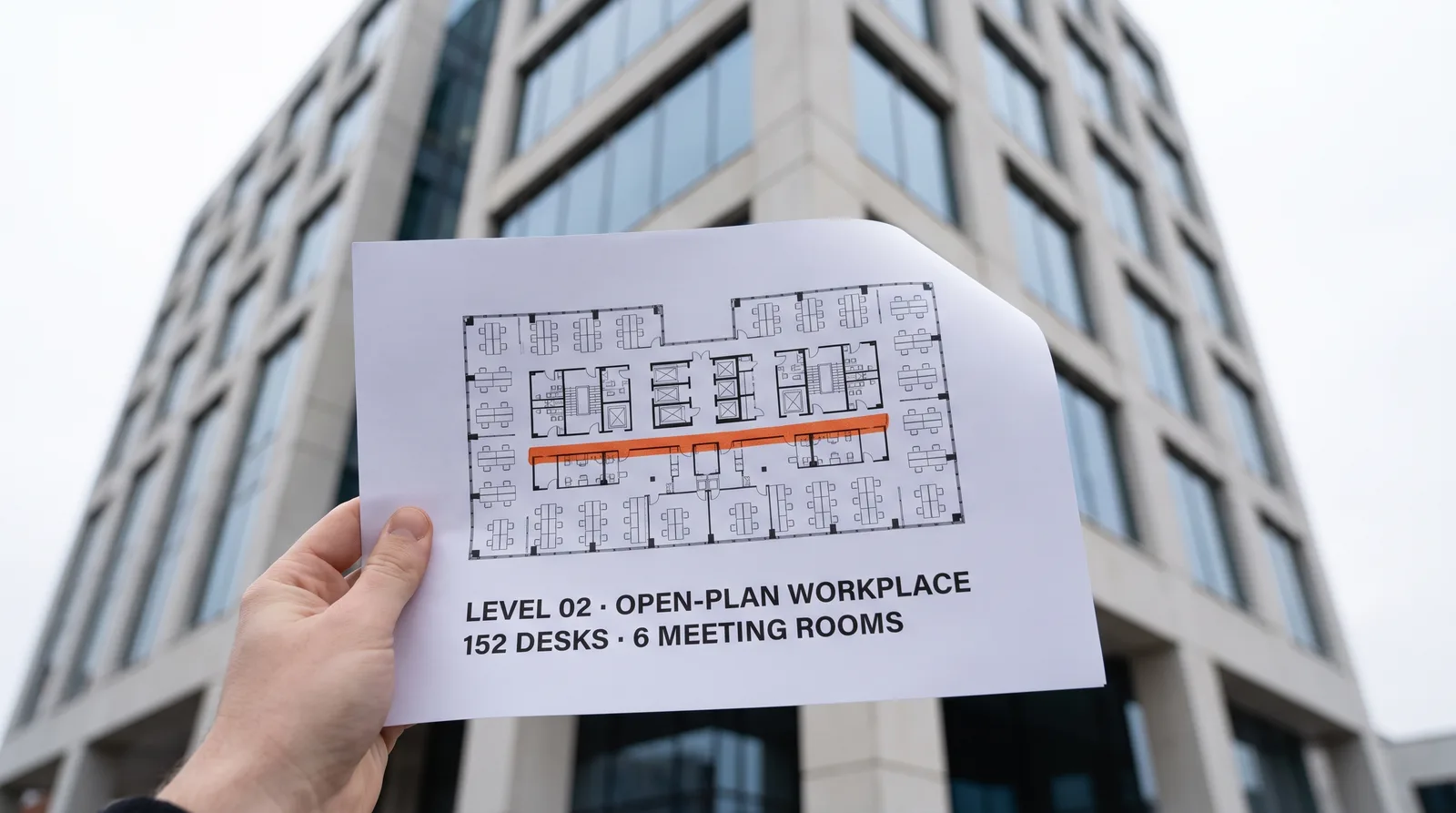
Four floors, 317 desks and 28 meeting rooms. You can orbit the exterior, cut away the levels, drop to a floor plan, or walk inside with the keyboard and ride the elevator between floors. You can move the furniture, and a shared layout link carries the arrangement in 158 characters rather than storing anything about you.
Six things are worth reporting honestly, because they are what building it actually taught us.
A tour that runs at 4 frames per second is worse than no tour. The first version's camera interpolated per frame, never settled, and kept the renderer awake permanently. It is time-based now, and the building draws about 2,500 calls on the first frame and then zero while you are not touching it.
Furniture editing has to refuse things. Turning a meeting room table across its own doorway is rejected with the reason shown on screen. An editor that lets you build an impossible room teaches the tenant nothing.
The people are modelled in code, not downloaded. They rendered white until their appearance was applied to the instance colours, which is the kind of bug you only meet by looking.
The sky was wrong twice. A 32-segment dome showed its own triangles, and the camera's far plane sliced it into an arc.
It has to survive not working. With WebGL unavailable the page falls back to the floor plan with a retry, and it holds up at 375, 768 and 1440 with no horizontal overflow.
And the activity is labelled as fiction inside the product, not just in this post: "Illustrative building activity, not measured traffic or an occupancy forecast." We have no evidence a tour produces leases, and we are not going to imply otherwise about our own demo.
Two things we have not verified: the frame rate on a real phone GPU, and the touch controls under an actual finger rather than synthetic pointer events.
What to ask before you buy one
Five questions, all answerable before you sign.
"What happens to the tour if I cancel?" Get the export path in writing. The contract may let them keep hosting it while owing you nothing.
"Can I display this on a competitor's site?" In commercial this is the portability question again, and it has been publicly disputed between platforms.
"What is your evidence?" If the answer is 31 percent faster, you now know it is a ceiling from a 2020 vendor blog post, and that two of the same researchers later published a peer-reviewed null.
"Does this work on a phone, on a bad connection?" A tenant rep opens your listing between meetings.
"Is anything in this image altered?" If it is staged or rendered, California already requires you to say so on a sale, and is about to change where that duty lives for a lease.
None of this means do not build one. We built one. It means buy it for a reason you can state out loud, which is that a tenant can understand a floor they have not visited, rather than because a number on a vendor's page promised you 31 percent.
If you want to talk about what this would look like for an actual building, that is a conversation we are happy to have. We build these, which is a commercial interest of exactly the kind this post has spent two thousand words flagging, so everything above is sourced to a document you can open.
Updated 2026-10-05: AB 2025 was signed on 27 September 2026 as Chapter 572, Statutes of 2026, and takes effect on 1 January 2027. The signed text contains the leasehold exclusion and Civil Code section 1940.11 exactly as quoted above. Everything else was checked 2026-09-10.