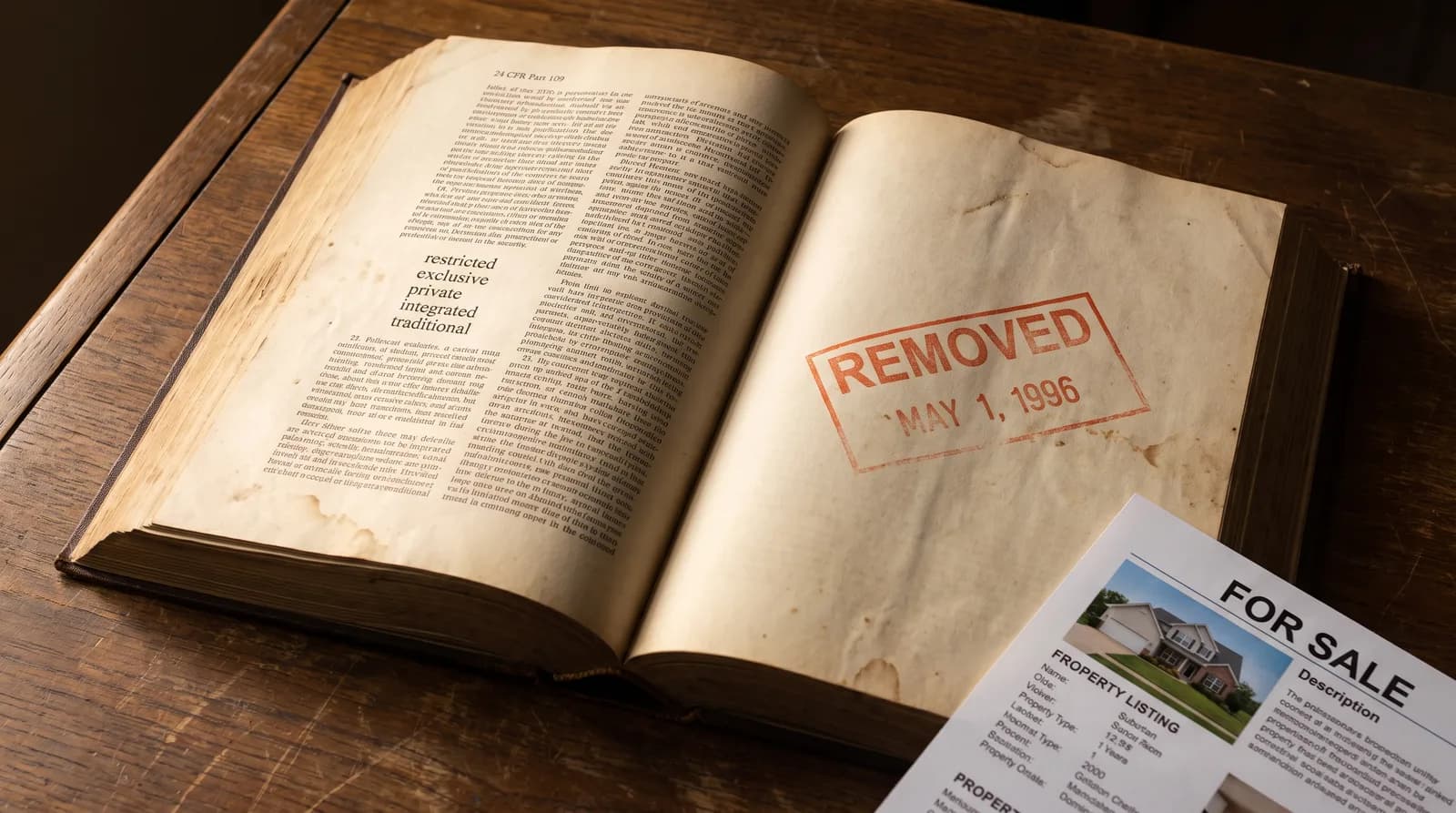
Search for fair housing words to avoid and you will find the same list on thirty different sites: restricted, exclusive, private, integrated, traditional, walking distance to church, master bedroom. Almost none of those pages tells you where the list came from.
Here is where. It was 24 C.F.R. Part 109, a real HUD regulation that really did name words. It was removed from the Code of Federal Regulations effective May 1, 1996. No federal regulation published since lists prohibited advertising words, and no federal agency publishes one today.
The part almost nobody quotes is better. A year before the repeal, HUD's own head of fair housing wrote a memo complaining that Part 109 was being read, by people outside HUD, to create liability where none belonged. That memo is still the agency's most specific surviving guidance on advertising language, and it says master bedroom is fine.
Everything below was read from primary sources on September 5, 2026. Where the answer is that no authority exists, this article says so rather than repeating the list.
The fair housing words to avoid list was real, and HUD repealed it
Part 109 existed and it was specific. Section 109.20 was headed "Use of words, phrases, symbols, and visual aids" and it opened:
The following words, phrases, symbols, and forms typify those most often used in residential real estate advertising to convey either overt or tacit discriminatory preferences or limitations.
It then listed them, including under "Catch words":
Words and phrases used in a discriminatory context should be avoided, e.g., restricted, exclusive, private, integrated, traditional, board approval or membership approval.
That is the ancestor of every listicle in this category. The regulation was published at 54 FR 3308 in 1989 and removed from the CFR effective May 1, 1996.
So when a compliance page tells you "HUD says avoid the word exclusive," it is quoting, usually without knowing it, a regulation that has not existed for thirty years.
HUD complained about the over-reading before it repealed the list
This is the document that should end the argument, and it is almost never cited.
On January 9, 1995, Roberta Achtenberg, then HUD's Assistant Secretary for Fair Housing and Equal Opportunity, issued a memorandum titled "Guidance Regarding Advertisements Under 804(c) of the Fair Housing Act." Its purpose was to tell HUD's own intake and enforcement staff when not to accept a complaint. It says:
Recently, the number of inquiries involving whether or not potential violations of the Act occur through use of certain words or phrases has increased, and these issues cannot, in some situations, be answered by referring to decided cases alone. In some circumstances, the Advertising Guidelines, published at 24 C.F.R. Part 109, have been interpreted (usually by persons outside of HUD) to extend the liability for advertisements to circumstances which are unreasonable.
Read that again. In 1995, HUD's own fair housing chief wrote that people outside HUD were over-reading the word list. A year later the regulation was gone. The over-reading continued anyway, and it is what you find when you search today.
What the memo actually permits
The memo is not a list of banned words. It is closer to the opposite. On its own terms:
- "Use of the term master bedroom does not constitute a violation of either the sex" discrimination provisions or the race discrimination provisions.
- "Complaints over use of phrases such as master bedroom, rare find, or desirable neighborhood should not be filed."
- On disability: "Advertisements containing descriptions of properties (great view, fourth-floor walk-up, walk-in closets), services or facilities (jogging trails), or neighborhoods (walk to bus-stop) do not violate the Act."
- Also lawful: "Advertisements describing the conduct required of residents ('non-smoking', 'sober') do not violate the Act."
One honest caveat, and it matters. This memo is internal guidance from 1995. It is not a regulation, it never was, and HUD does not appear to host it on its own site today. We read it from a scan on fair housing nonprofit letterhead showing the original HUD memorandum. It tells you what HUD told its staff thirty years ago, which is a great deal more than the listicles offer, but it is not a safe harbor.
What the law actually says
The operative rule is short. 42 U.S.C. 3604(c) makes it unlawful:
To make, print, or publish, or cause to be made, printed, or published any notice, statement, or advertisement, with respect to the sale or rental of a dwelling that indicates any preference, limitation, or discrimination based on race, color, religion, sex, handicap, familial status, or national origin, or an intention to make any such preference, limitation, or discrimination.
Three things follow that the word lists obscure.
The test is how an ordinary reader takes it, not which words you used. The controlling articulation comes from Ragin v. New York Times Co., 923 F.2d 995 (2d Cir. 1991): the statute is violated "if an ad for housing suggests to an ordinary reader that a particular race is preferred or dispreferred for the housing in question." The same court warned that the ordinary reader "is neither the most suspicious nor the most insensitive of our citizenry."
Intent is not an element. You can violate 3604(c) without meaning to. That is why a word list feels reassuring and is not.
Pictures count. Ragin was a case about the consistent use of all-white human models in advertising. Images of people carry the same exposure as sentences.
Folklore against authority
Here is what survives when you check each phrase against a real source.
"No children", "adult building", "perfect for a single professional"
"55+" or "adult community" where the community qualifies
"Master bedroom"
"Rare find", "desirable neighborhood"
"Great view", "fourth-floor walk-up", "walk to bus stop"
"Restricted", "exclusive", "private", "integrated", "traditional"
"Good schools", "safe neighborhood"
"No Section 8"
| Phrase | Actually prohibited? | Authority | What kind of rule |
|---|---|---|---|
| "No children", "adult building", "perfect for a single professional" | Yes | 3604(c) familial status, plus the 1995 memo | Law |
| "55+" or "adult community" where the community qualifies | Lawful | 42 U.S.C. 3607(b)(2)(C) | Statutory exemption |
| "Master bedroom" | No | 1995 memo says so explicitly | Style choice only |
| "Rare find", "desirable neighborhood" | No | 1995 memo, complaints "should not be filed" | None |
| "Great view", "fourth-floor walk-up", "walk to bus stop" | No | 1995 memo | None |
| "Restricted", "exclusive", "private", "integrated", "traditional" | Only via a repealed regulation | Part 109, repealed 1996 | No current authority |
| "Good schools", "safe neighborhood" | No | HUD letter, April 24, 2026 | Trade caution only |
| "No Section 8" | Depends on the state or city | State and local law only | Law, but not federal |
The point of that table is not that you should write carelessly. It is that most of what circulates as law is either a repealed regulation, an association's caution, or somebody's house style, and knowing which is which is the difference between writing accurately and writing scared.
The one place "adult" is lawful
The Housing for Older Persons Act carve-out is the nuance the listicles get wrong most often, because it makes an apparently forbidden phrase lawful in defined circumstances.
Under 42 U.S.C. 3607(b)(2)(C), housing qualifies as housing for older persons if it is intended and operated for occupancy by persons 55 or older and:
(i) at least 80 percent of the occupied units are occupied by at least one person who is 55 years of age or older; (ii) the housing facility or community publishes and adheres to policies and procedures that demonstrate the intent required under this subparagraph; and (iii) the housing facility or community complies with rules issued by the Secretary for verification of occupancy.
Meet those and age-restricted advertising is lawful. Miss them and the same words are a familial status violation. The phrase is not the thing being regulated. The community is.
Schools and crime: HUD told the industry it had this wrong
This is the freshest thing in the article and it landed five months ago.
For years the standard advice was that agents must not answer questions about school quality or neighborhood safety, because doing so risks steering. On April 24, 2026, HUD's Assistant Secretary for Fair Housing and Equal Opportunity issued a Dear Colleague letter (HUD No. 26-028) saying the opposite:
Contrary to publicly available materials from industry leaders on steering, real estate agents and brokers do not violate the Fair Housing Act merely by discussing with prospective homebuyers or renters the prevalence of crime or the quality of schools in neighborhoods.
The letter goes further than a clarification. It names the National Association of REALTORS, cites three specific NAR articles from 2020 and 2023 by title and URL, and calls the position they took a "professional gag order." Its legal argument is that steering is intentional discrimination, and it quotes the Seventh Circuit in Village of Bellwood v. Dwivedi, 895 F.2d 1521 (7th Cir. 1990): "A broker determined to 'steer' all customers, of whatever race, to a particular neighborhood is not guilty of racial steering, because he is not treating the races differently."
NAR has since moved. Its current guidance says sharing crime and school information is not a violation "if such information is shared consistently and without discriminatory intent," and it cites the HUD letter by number. NAR keeps one caveat worth keeping with it: subjective commentary and hearsay about schools or crime have been treated as evidence of intent in litigation.
Two honest qualifications before you rely on this. It is a Dear Colleague letter, which is non-binding sub-regulatory guidance, not a rule and not a statute. And it is written in unusually political language for an agency document, criticizing a prior administration directly. We could not find any court citing it, any legal challenge to it, or any state agency declining to follow it, so as of today it stands unchallenged. It is also the kind of document a future administration can withdraw with a notice, which is exactly what happened to the guidance it replaced.
The phrase whose legality changes at a city line
Federal fair housing law protects seven classes and source of income is not one of them. So "no Section 8" is lawful under federal law alone, and unlawful in a great many places under state or local law. Three jurisdictions show the spread:
- California protects it statewide. Government Code 12955 makes it unlawful to discriminate because of "source of income," defined to include "federal, state, or local housing subsidies, including... vouchers issued under Section 8."
- New York protects it twice over. New York City has since 2008 under Local Law 10, and the state amended the Human Rights Law on April 12, 2019 to cover "any form of federal, state, or local housing assistance."
- Texas runs the other way. Local Government Code 250.007 bars Texas municipalities and counties from adopting ordinances that protect voucher holders, with a carve-out for veterans. A Texas city cannot make "no Section 8" unlawful even if it wants to.
If you write listing copy for more than one state, this is the line to put in your template review, because nothing about the phrase itself tells you which regime you are in.
Your listing photos just got a new rule, and it is a website rule
Here is the part that is genuinely new law rather than thirty-year-old guidance, and it arrived while everyone was arguing about words.
California Business and Professions Code section 10140.8, added by AB 723 and effective January 1, 2026:
A real estate broker or salesperson, or person acting on their behalf, who includes a digitally altered image in an advertisement or other promotional material for the sale of real property shall include in the advertisement or promotional material a statement disclosing that the image has been altered and a link to a publicly accessible internet website, URL, or QR code that includes, and clearly identifies, the original, unaltered image.
The definition is broad. A digitally altered image is one changed "through the use of photo editing software or artificial intelligence to add, remove, or change elements in the image," expressly including fixtures, furniture, appliances, flooring, walls, paint color, hardscape, landscape, facade, floor plans, and things visible from the property such as streetlights, utility poles and views through windows. Ordinary adjustments are excluded: "lighting, sharpening, white balance, color correction, angle, straightening, cropping, exposure."
In plain terms: if you virtually stage a room in California, you must say so and you must publish the original somewhere a buyer can reach. That is not a caption. It is a hosted page, a URL or a QR code, which means your website is the compliance mechanism. Our California rules page is where we keep the state's build checklist.
Wisconsin has adopted a narrower version. 2025 Wisconsin Act 69, enacted December 9, 2025, creates a disclosure duty for advertising altered "using technology, including artificial intelligence," where the alteration creates a false or misleading impression. It takes effect January 1, 2027.
Worth being precise about what these statutes are not. They are real estate licensing law, not fair housing law. We found no case, charge or guidance applying 3604(c) to a photograph of a property, as opposed to photographs of people. Two separate bodies of law now touch your listing images and they do not reference each other.
Who else's rules bind your listing
Three layers sit on top of the statute, and none of them is federal law.
NAR, if you are a member. Article 10 of the 2026 Code of Ethics prohibits denying equal professional services on the basis of the protected classes, and NAR's list is longer than the federal one: it includes sexual orientation and gender identity. Standard of Practice 10-1 says REALTORS "shall not volunteer information regarding the racial, religious or ethnic composition of any neighborhood, however, REALTORS may provide other demographic information."
Your MLS. NAR's MLS Policy Statement 8.1 requires MLSs to "implement a process for identifying potential violations of fair housing laws, advising participants and subscribers to remove or correct potential violations." Individual MLSs have adopted it, and some say plainly what happens next. MLSListings tells participants that "the MLS monitors listing content" and that failure to correct "may subject the listing to immediate removal from display." MLS PIN reserves the right to refuse or remove a listing in its "sole and exclusive determination."
What no MLS publishes is what actually trips the flag. The screening exists, it is in the rules, and the trigger logic is not disclosed anywhere we could find. If your remarks get pulled, you will be told after the fact.
Your state's advertising rules, which are a separate problem from fair housing and catch far more new brokerages. Those are covered in what your brokerage website must legally carry, and the platform side is in real estate social media rules.
What we would actually do
Stop working from a word list. Write the property, not the buyer. Almost every genuine violation in this area describes who should live somewhere rather than what is there, and that test catches more than any vocabulary check.
Then, in order of how likely each is to bite a new brokerage:
- Check your source of income language against the state you are in. This is the one that varies, and it is the one with real enforcement behind it.
- Disclose altered images if you sell in California, and build the page that hosts the originals before you need it rather than after.
- Answer school and crime questions consistently, factually, and the same way for everyone, which is what both HUD and NAR now say.
- Keep familial status in mind on anything age-related, unless the community actually qualifies under the 55+ exemption.
- Leave "master bedroom" alone unless your MLS or your brand has decided otherwise, which is a fine reason, just not a legal one.
If you want the disclosure page, the listing templates and the state checklist built into the site rather than bolted on, tell us about your brokerage. If you would rather see pricing first, build your package in about two minutes.
How we checked this
Part 109's text is from the Library of Congress CFR archive and its repeal from the Federal Register. The 1995 memorandum is a scan of the original HUD memorandum on HUD letterhead, hosted by a fair housing nonprofit; HUD does not appear to host it today, and we say so above. The April 2026 Dear Colleague letter is a PDF on hud.gov, which we extracted and read in full. NAR's current position is from nar.realtor. Statutes are from the legislatures' own sites, including California B&P 10140.8 from leginfo and Wisconsin Act 69 from the Wisconsin Legislature. MLS rules are from each MLS's own published rules. Everything was read on September 5, 2026.
What we could not establish, stated plainly. We found no HUD charge, DOJ action or state agency determination from 2015 to 2026 where the words or photographs of a property listing were themselves the conduct at issue. We searched for it specifically across two research passes. Enforcement in this area is overwhelmingly about ad targeting, occupancy policies, appraisals and accommodation denials. That absence is not permission, since a private plaintiff can sue under 3604(c) without any agency involved, but it is the honest shape of the risk. We also found no state real estate commission that has published its own list of prohibited advertising words, so the vacuum HUD left in 1996 is still a vacuum.