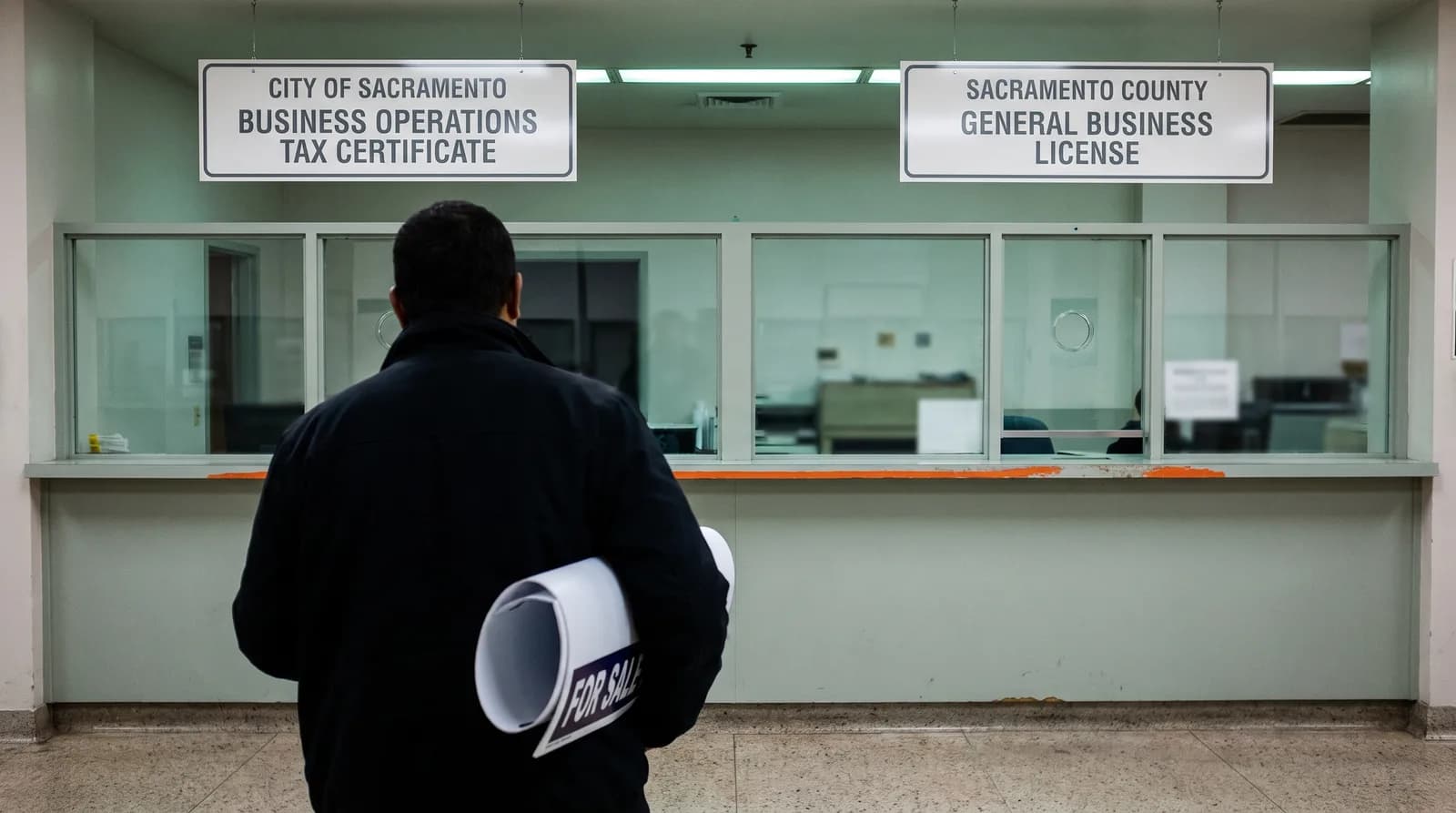
To open a real estate brokerage in Sacramento you need one state license and a short stack of local registrations. The state part is the same here as it is in Fresno. The local part is not, and it turns on something almost no guide mentions: Sacramento County holds seven incorporated cities plus a large unincorporated area, and they do not agree with each other about what you file, what you owe, or how big your yard sign may be.
A ten agent brokerage pays $8 a year for a business license in Elk Grove, about $87 a year in the unincorporated county, and $400 a year in the City of Sacramento, which does not issue business licenses at all and taxes you per agent instead. That is roughly a fiftyfold spread for the identical firm, decided by an office address usually chosen for rent and commute.
Everything below was read on September 3, 2026 from the state's own pages, the city code as published through Supplement No. 4 of July 2026, the county zoning code, and the county Department of Finance. Where a price is not published, or where the county publishes two, this article says so rather than picking one.
What you file to open a real estate brokerage in Sacramento, in order
- Form the company with the Secretary of State, if you are using one. California will not license a limited liability company as a brokerage at all, which is the trap covered in brokerage entity licensing.
- License the company with the Department of Real Estate. Forming and licensing are two filings at two agencies, and the second is the one that lets you trade.
- Fix your office address, because it decides steps 4 and 5.
- Register locally. A business operations tax certificate in the City of Sacramento, or a General Business License in the unincorporated county.
- File your fictitious business name with the county if you are trading under anything other than the licensed name, then publish it.
- Apply to MetroList, and to the association if you want it.
Steps 1, 2 and 6 are statewide or regional. Steps 3, 4 and 5 are the Sacramento specific ones, and they are most of this article.
The state licenses the company, and pins it to an address
The Department of Real Estate charges $450 for an original broker license and $450 for a corporation license, plus a $49 fingerprint processing charge paid to the live scan provider if you are in California, or to the Department if you are not.
The address matters more than the money. The Department's branch office page is explicit:
A broker/corporation is authorized to conduct business only at the address listed on his/her license.
and
If the broker/corporation maintains more than one place of business within the State, he/she shall apply for and procure an additional license for each branch office so maintained.
and
The branch office address must be a physical California address, not just a Post Office Box or a Private Mail Box.
One useful thing here: the Department's fee schedule lists no charge for a branch office license, and neither does the branch office page. A second Sacramento location is a form, not an invoice. What that office has to physically contain is a separate question, answered in broker office requirements, where the short version is that most states are really asking where your records live.
Inside the city, there is no business license
The City of Sacramento does not issue business licenses. It levies a business operations tax and issues a certificate. City Code 3.08.010 frames it as a prohibition rather than a permission:
It is unlawful for any person, either for himself or for any other person, to commence, transact, engage in or carry on any business, trade, profession, calling, occupation or gainful activity in the city without having paid the applicable business operations tax and procured a valid business operations tax certificate.
The certificate is the thing you hold. The tax is what you pay for it.
Outside the city, there is, and it is $262.60
Sacramento County has seven incorporated cities: Sacramento, Folsom, Galt, Isleton, Citrus Heights, Elk Grove and Rancho Cordova. Everything else is unincorporated, and an unusually large share of the county's population lives there.
If your office is in the unincorporated area, the county's rule is the inverse of the city's:
All businesses based in the unincorporated area require a General Business License except for the following, which are EXEMPT: Financial Institutions... Residential Facilities... Churches... Libraries... Agriculture...
That exemption list has exactly five items. It names banks, savings and loans and credit unions, apartments and rooming houses, churches, libraries, and farms. Real estate brokers are not on it, and neither are state licensed professionals as a class. Operating without the license is a misdemeanor "punishable by a fine of up to $500.00 and six (6) months in jail."
The county's schedule, effective July 1, 2026:
General Business License, new
General Business License, renewal, home based
General Business License, renewal, commercial
Special Business License, new
| Unincorporated county business license | Amount |
|---|---|
| General Business License, new | $262.60, valid 3 years |
| General Business License, renewal, home based | $124.30 |
| General Business License, renewal, commercial | $252.48 |
| Special Business License, new | $237.87, valid 1 year |
Each includes the $4.00 state charge required by Government Code 4467.
The spread across one county is about fiftyfold
Now put a third jurisdiction beside those two. Elk Grove charges $16 for a two year general business license, which its own site breaks out as a $12.00 license charge plus the $4.00 state disability access charge required by SB 1186. There is no broker specific rate. It is a flat number, and it is the same $16 whether you are a sole broker or a fifty agent firm.
Run one brokerage through all three:
Elk Grove
Unincorporated county
City of Sacramento
| Ten agent brokerage, office in | Annual local cost |
|---|---|
| Elk Grove | $8 (a $16 license every two years) |
| Unincorporated county | about $87 (a $262.60 license every three years) |
| City of Sacramento | $400 ($100 plus $30 for each of ten agents, every year) |
Same firm, same ten agents, same county, and a spread of roughly fifty to one depending on which side of a line the office door sits on. None of this is large money against a brokerage's other costs. It is worth knowing anyway, because it is decided permanently by a choice most new brokers make for reasons of rent and commute, and because it is the clearest evidence that "Sacramento" is not one regulatory place.
Folsom is different again in kind rather than degree: it taxes on gross receipts, and its code excludes from a real estate broker's taxable receipts "the sales price of real estate sold for the account of others except that portion which represents commission." So Folsom taxes your commission income, not the sale price. We could not retrieve its current numeric rate table, which is set by resolution rather than printed in the code chapter.
Citrus Heights, Rancho Cordova, Galt and Isleton all require a business license too. We could not open any of their code text or current rate schedules directly, so this article does not print a number for them. That is a gap, and it is named again at the end.
Sacramento taxes a brokerage by the head, not by the dollar
This is the part general Sacramento business guides get wrong for brokerages, because they quote the general rate.
The general rate is City Code 3.08.170: thirty dollars a year up to $10,000 of gross receipts, then thirty dollars plus four hundredths of a cent for every dollar above that, capped at $5,000. Read its opening line, though. It applies to "every person not falling within the categories described in Sections 3.08.180, 3.08.190, 3.08.200, and 3.08.205."
A brokerage falls within 3.08.180. Subsection B, headed "Professionals-Brokers", reads:
Every person engaged in the business of real estate broker, insurance broker, or stockbroker, whether full or part-time, shall pay an annual business operations tax of one hundred dollars ($100.00) for the principal broker or broker of record plus thirty dollars ($30.00) for each employee, agent, representative or independent contractor subject to supervision by a principal broker or broker of record who devotes time to handling of rents, listing property, collecting or selling property, soliciting or writing insurance policies or working as a salesperson or floorperson.
Subsection C caps any one firm at $5,000 a year.
So the tax is per head, and it is indifferent to what those heads produce:
Broker of record, no agents
Broker plus 5 agents
Broker plus 20 agents
Broker plus 50 agents
| Sacramento brokerage | Annual city tax |
|---|---|
| Broker of record, no agents | $100 |
| Broker plus 5 agents | $250 |
| Broker plus 20 agents | $700 |
| Broker plus 50 agents | $1,600 |
A one agent brokerage closing forty million dollars owes $130. A twenty agent brokerage closing eight million owes $700. Volume never enters the calculation, which is worth knowing before you recruit, and it is a different shape from the commission math that decides whether those agents pay for themselves.
Two smaller notes on the same section. Subsection D says that as to state licensed people the chapter "shall be construed as existing for revenue purposes only" and gives the city no regulatory power over them, so this is a tax and not a second layer on top of the duties the license act already imposes. And the tax follows the roster you actually supervise, which means the agent page you publish is the roster the city can count.
Voters were asked to raise it in 2024 and said no
Those numbers look old because they are. A city staff report dated June 22, 2010 said flatly that "the City's BOT has not been updated since 1991," and in the current code the broker subsection carries no amending ordinance at all, only the note "(Prior code § 23.04.402)". Its neighbor 3.08.170 carries "Ord. 2010-020 § 4". The general rate has been touched since. The broker rate has not.
The most recent attempt to change that was Measure C, on the March 5, 2024 ballot, which asked voters to modernize the business operations tax, "setting new flat tax rates for professionals ($684)" with "yearly cost-of-living adjustments." It was defeated on certified results, 60,778 to 37,993, or 61.53 percent against to 38.47 percent in favor.
So the $100 and the $30 stand. They are also the likeliest figure in this article to move, and not only because a city that has asked once tends to ask again. Sacramento's Law and Legislation Committee took up the question again on May 20, 2025, under file 2025-01006, where staff wrote that "the BOT has not been updated since 1991 and since that time City expenses have increased, while the $5,000 annual BOT payment cap has not increased, nor have minimum BOT payments," and that updating it "is an important step in improving the City's fiscal position." That is a committee discussion, not an ordinance and not a ballot measure, and no business operations tax measure has qualified for the November 3, 2026 ballot. But it is the file to watch. Check the code before you file.
If your office is outside the city and you sell inside it
Here is the part that inverts what you would reasonably assume. A brokerage based in Elk Grove or in the unincorporated county still does deals inside city limits. City Code 3.08.210 covers exactly that, and it does not send you to the broker rate:
Every person, other than a contractor, not having a fixed place of business within the city who engages in business within the city shall pay a business operations tax calculated pursuant to Section 3.08.170 of this chapter
Section 3.08.170 is the gross receipts formula, the one the in-city broker rate specifically exempts you from. So the same firm is taxed per head when it has a Sacramento office and on gross receipts when it does not, and state law caps what the city can reach: Government Code 37101(b) requires a city taxing a business operating "both within and outside" its jurisdiction to "levy the tax so that the measure of tax fairly reflects that proportion of the taxed activity actually carried on within the taxing jurisdiction."
One oddity worth flagging rather than interpreting. The rest of 3.08.210 caps that tax by reference to Section 3.08.080, but the current code titles 3.08.080 "Separate certificate required," which has no rate in it at all. The section carries the note "(Prior code § 23.04.405)", so this reads as a cross reference that survived a renumbering. If that cap matters to your numbers, ask the Revenue Division rather than reading it off the page.
Your fictitious business name, and the deadline the county's own page gets wrong
If you trade under anything other than the name on the license, you file a fictitious business name statement with the county and then publish it in a newspaper. Choosing that name is its own problem, and how to name a real estate brokerage covers the state rules that constrain it.
Here the county and the state disagree in print.
The statute. Business and Professions Code 17917(a):
Within 45 days after a fictitious business name statement has been filed pursuant to this chapter, the registrant shall cause a statement... to be published pursuant to Section 6064 of the Government Code in a newspaper of general circulation in the county where the fictitious business name statement was filed
That 45 day figure was set by SB 1495, Stats. 2022 Ch. 511, effective January 1, 2023. The affidavit of publication is then due within 45 days after publication finishes.
The county's fictitious business name FAQ, read on September 3, 2026:
Yes, within 30 days from the date of filing a FBN Statement, a Statement of Abandonment, or Statement of Withdrawal from Partnership... you must start publishing in a newspaper of general circulation in the county in which the FBN Statement was filed. The publication runs once a week for four consecutive weeks.
Thirty days is the pre 2023 rule, still published more than three and a half years after the legislature changed it.
Be clear about what this does and does not mean. The county's instruction is stricter than the statute, so a registrant who follows it is compliant, and nobody is harmed by publishing early. It matters in exactly one situation, and it is a situation new brokers land in: you filed, the opening swallowed six weeks, you are at day 35, and the county's page tells you the window shut five days ago. It did not. You have ten days.
And the filing amount is published two different ways
We are not going to print a single number for what the statement costs to file, because the county's own documents do not agree and we could not open the one that would settle it.
Two figures are in circulation, both traceable to county schedules. One is $50.06 for a statement with one business name and one owner, built as a $47.00 base plus a 6.5 percent technology charge of $3.06, with $8.52 for each additional name or owner. The other is $51.15, with $8.71 for each additional, which is what the county's own July 2025 fee schedule carried. The two are one escalator apart, which is the usual shape of a stale figure and a current one, but the county's fee schedule then changed again effective July 1, 2026, and the statement form that would carry the current number now returns a 404 on the county's own site while remaining in search results.
So: it is roughly fifty dollars, it moves annually, and the counter is the only place we would trust for the exact figure on the day. If you see a confident single number for this on a vendor page, that is a good indication the page has not been checked since whichever year it was written.
The same yard sign, legal on one side of the line and not the other
This is the clearest illustration of why the address matters, and it becomes useful the week you take your first listing.
Inside the City of Sacramento there is no real estate sign rule. The code never uses the words "real estate" or "open house" here at all. A yard sign is an exempt temporary sign under 15.148.600(E):
- In any R, A or OB zone, "the cumulative display area of all temporary signs on the parcel does not exceed ten (10) square feet." Cumulative is the word to notice. Your for sale sign shares that ten with every other temporary sign on the property.
- In SC, HC, C or M zones, fifty square feet.
- Not in the public right of way, with one carve out: the planting strip "between the face of the street curb and the street side edge of the sidewalk."
- No illumination, no roof signs, a six foot height limit, and no more than 180 days on a parcel in a calendar year. That last one is the trap for a listing that will not move.
In the unincorporated county, Zoning Code 5.10.1.A is actually titled "Real Estate Signs" and is far more specific:
RD-1 to RD-40, MHP, RM-2, interim residential
Agricultural and rural residential
Commercial and industrial
Undeveloped property, any zone
| Unincorporated county zone | Maximum sign area |
|---|---|
| RD-1 to RD-40, MHP, RM-2, interim residential | 5 sq ft |
| Agricultural and rural residential | 24 sq ft |
| Commercial and industrial | 32 sq ft |
| Undeveloped property, any zone | 24 sq ft |
Plus one for sale or one for lease sign per assessor's parcel, two only if the property fronts more than one street. No illumination. Six feet freestanding. Signs "shall be removed within 30 days after sale of the property or immediately upon being leased."
Open houses get their own permission, and it is narrow. Portable off site directional signs are allowed "provided that the directional portable signs do not exceed an overall size of nine square feet including support, do not exceed a height of 2.5 feet, and are not located within the street right-of-way," and "may be on display only during those hours when the dwelling is open for public inspection." Anything left in the county right of way "may be removed/disposed of by County personnel without notice."
Now do the arithmetic on a panel. A 24 by 36 inch sign is six square feet. That sits comfortably inside the city's ten and over the county's five. An 18 by 24 inch panel is three square feet and clears both. If you are ordering one set of signs for a service area that straddles the line, the county number is the one to build to.
Running it from home, where the city says you may not have a sign
Most new brokerages start at a kitchen table, and the City of Sacramento has a specific permit for that. Its home occupation guidance opens:
If you plan to conduct a business out of a residence in the City of Sacramento, you must obtain a Home Occupation Permit.
with the useful footnote that "if you do not live within the city limits of the City of Sacramento, you do not need a Home Occupation Permit from the City of Sacramento." It is applied for alongside the business operations tax application at the Revenue Division.
Brokerage is expressly on the allowed list, which is not true of every profession. The eligible general office uses run "accountant, administrative assistant, answering service, appraiser, architect, attorney, bookkeeper, broker or agent (real estate, insurance, etc.), counselor, consultant, drafting service, engineer..."
Three of the uniform standards bite on a brokerage specifically:
- One non-resident person, maximum. "No more than one person who is not a resident of the permitted residence may engage in home occupations at the residence. The business may have more than one off-suite employee or partner so long as they do not report for work at the subject residence." So you can carry a roster. They just cannot come to the house for work.
- Eight client visits a day, one per hour. "On any single day there shall be no more than one (1) client/customer per hour and no more than eight (8) client/customers(s) visiting the residence in a day," with a family counted as one.
- No sign at all. "No sign, nameplate, or any other form of advertising shall be displayed on the premises in which a home occupation is conducted."
That last one is the neat contradiction with the section above. Run your brokerage from a house in the City of Sacramento and you may put a ten square foot sign on a listing across town, and nothing whatsoever on your own front lawn. The website is not a nice-to-have in that setup. It is the only sign you are permitted.
The permit charge is set separately from this guidance and is not printed on it, so ask when you apply. And a Zoning Administrator can waive standards by conditional use permit, so a hard no on any of the three is worth a phone call rather than a change of plan.
What nobody publishes
Three costs in this territory are not published anywhere, and after two research passes plus direct retrieval we are reporting that as the finding rather than filling it with a guess.
- Sacramento Association of REALTORS dues for 2026. The join page lists what to submit and asks for "payment for the appropriate dues amount." No figure.
- MetroList's current start up and quarterly amounts. The only figures in circulation sit in a participant packet whose filename says 2018 and whose forms are dated 2013 to 2016. That is not a current price.
- The county's fictitious business name statement filing amount, as above.
Two of those need a phone call, and the third you will see at the counter. Worth knowing before either: REALTOR membership is not a prerequisite for MetroList. Its own form is titled "Participant Application - MLS Only," and the association's page says any California licensed broker, agent or appraiser may apply. Whether you want membership anyway is a real question, worked through in do you have to be a Realtor to use the MLS.
The website, and the 43 Sacramento brokerages without one
This is the part we sell, so treat it as a specification you can hold anyone to, us included.
We took every corporation the Department of Real Estate licensed with a Sacramento County address between January 2024 and August 2026, 74 of them, and looked for a website for each. Forty three have none. Of the 25 with a domain, 24 homepages were readable, and 11 of those 24 do not show the license number that Business and Professions Code 10140.6 requires on material intended as a first point of contact. Two had broken security certificates. One rendered fifteen characters of text. The full count, method and ledger are in our audit of Sacramento brokerage websites.
That is the local bar, and it is low. The state license takes months and the city certificate takes a form. The site is the one part of opening that can be finished in days, and it is the part a referred seller checks before they call.
What we build for a brokerage: a hand coded site rather than an assembled one, which is why the pages are small and open in under half a second on a phone; the license number in the footer of every page by construction rather than as an afterthought; one headline, a tappable phone number, and a form that reaches a person. Ten concepts, each modeled on a live archetype and each an invented firm labelled as such, sit on our real estate page, and the California rules page is the checklist we build this county to. Pricing runs from a launch site starting at $900 and live in 48 hours to a full brokerage site starting at $4,500, worked through in what a brokerage website costs.
How we checked this
State figures come from the Department of Real Estate's own licensing and fee pages. City code text is quoted from the Sacramento City Code as published by American Legal Publishing, current through Supplement No. 4 of July 2026 and including Ordinance 2026-0015 passed July 21, 2026. County zoning text is from the county's own land use regulation library, Chapter 5. County business license and fictitious business name text is from the county Department of Finance. Statutes are from the legislature's own site. Home occupation text is from the City of Sacramento's own planning guidance. Elk Grove's figure is from Elk Grove's own site. The election result is the certified return for March 5, 2024. Everything was read on September 3, 2026.
What we did not do, stated plainly because each is a real limit on the article:
- We did not open the code or current rate schedule for Citrus Heights, Rancho Cordova, Galt or Isleton, and we did not get Folsom's numeric rate table. Each of those hosts refused us. So the fiftyfold spread above is measured across three jurisdictions, not seven, and the true spread could be wider.
- We did not establish the real estate sign rules in the six other cities. The only compilation we found is a trade association's and its per-city attribution did not survive retrieval, so we would rather say nothing than guess. Whether the five versus ten square foot split is a two-way difference or a seven-way one is genuinely unknown to us.
- We did not reach a published 2026 price for association dues, MetroList participation, the county's fictitious business name filing, or the city's home occupation permit.
- Our check of DRE discipline against Sacramento County licensees covered two sample months, not the full 2024 to 2026 record, so we make no claim either way about enforcement patterns here.
If you are opening in Sacramento and want the website handled while the license is still in process, tell us about your brokerage. If you would rather see the price first, build your package in about two minutes.