A Google Business Profile for real estate is simpler than most guides make it. Your brokerage can have one. So, probably, can each of your agents. The rules that decide it are Google's, not the Department of Real Estate's, and they are shorter than you would expect.
They are also, in one important place, self contradictory. And there is no real estate section anywhere in them, which is why most brokers end up reading an example about a plumber and guessing.
This one is free and takes an afternoon. Here is what the document actually says.
What Google's rule actually is
One sentence covers eligibility:
If your business either has a physical location that customers can visit, or travels to customers where they are, you can create a Business Profile on Google.
That is it. A brokerage with an office meets the first half. A broker who meets clients at properties meets the second. There is no separate bar for real estate, no licence requirement, and nothing about brokerages at all.
The rest of the guidelines are where it gets interesting.
Google names real estate agents, then excludes sales associates
Google has a category called an individual practitioner, meaning "a public-facing professional, typically with their own customer base." Those people can have a profile of their own, separate from the organisation they work for.
The examples are explicit:
Doctors, dentists, lawyers, financial planners, and insurance or real estate agents are all individual practitioners.
Good. Except two sentences later:
Sales associates or lead generation agents for corporations aren't individual practitioners and aren't eligible for a Business Profile.
In California a licensed salesperson works under a broker and is, in plain English, a sales associate for a company. They are also a real estate agent with their own client base. Google names both and never says which one wins.
Our read is that the practitioner test is the operative one, because it is written as a test rather than a label: the person must operate in a public-facing role and "can be contacted directly at the verified location during stated hours." An agent with their own clients who answers their own phone passes that. A junior on a team who does not passes neither test, and Google says plainly that support staff should not have profiles.
But we are reading a tension Google left in its own document, and you should know that is what this is.
The rule almost every brokerage breaks
This one is not ambiguous, and it is worth checking your firm against today.
Where an organisation has more than one practitioner, Google says the organisation gets its own profile, and the practitioner's profile:
should include only the name of the practitioner, and shouldn't include the name of the organization.
Go and search your own agents. Most brokerages have a row of profiles reading "Jane Smith, Your Brokerage" or "Your Brokerage - Jane Smith". Under that sentence, those names are wrong.
There is exactly one case where the combined format is allowed, and it is the solo one. A single practitioner at a branded organisation uses brand, colon, name. Google's own example is "Allstate: Joe Miller". If you have two agents, you are not in that case.
This matters more than it sounds. Profile names are the field Google polices most actively, and a name that breaks the rule is the easiest thing in the world for a competitor to report. It is also a second set of naming rules stacked on top of the ones your state already imposes on what you may call yourself, which we went through in how to name a brokerage.
Working from home means clearing the address
If clients do not come to you, you are a service-area business. Google's instruction is direct:
If you're a service-area business, you should hide your business address from customers.
And the worked example is a plumber running a business from a residential address, told to clear the address from the profile. The profile then shows the area you serve rather than a pin on your house.
For a newly licensed broker with no office yet, this is the normal setup, not a workaround. Whether you need an office at all is a separate question with a separate answer, and we covered it in broker office requirements.
The part nobody mentions: California publishes it anyway
Here is the thing that does not appear in any local search guide, because the people who write those do not read Department of Real Estate forms.
Hiding your address on Google does not make your home address private in California. The DRE says so on the form you use to change it. From form RE 204, the broker change application:
Business and license mailing addresses are public information and as such are posted on the Internet and available from DRE via telephone and written requests. Please consider this when identifying a license mailing address.
The DRE is warning you, on the form, before you write the address down.
The form also shows where the flexibility is. Your mailing address may be a street address or a post office box. Your main office address must be a street address, and the form says to enter one or write "NO BUSINESS ADDRESS", and not to leave it blank.
So a home-based broker has one real lever: a post office box can keep a home off the mailing line. The main office line is a different field with different rules, and Google has no say over either.
If privacy is the reason you were hiding the address, know that you have solved the Google half and not the public record half.
Verifying when there is no office to photograph
Google picks your verification method and you do not get a choice. Its help pages say verification methods "are automatically determined by Google and can't be changed."
If you land on video verification, which home-based businesses often do, the requirements are specific and people fail them by not reading:
- It must be live. "You must capture the footage live as pre-recorded videos aren't allowed, and you can't record it offline and upload it later."
- At least 30 seconds.
- Recorded through the Business Profile on a phone, in one go.
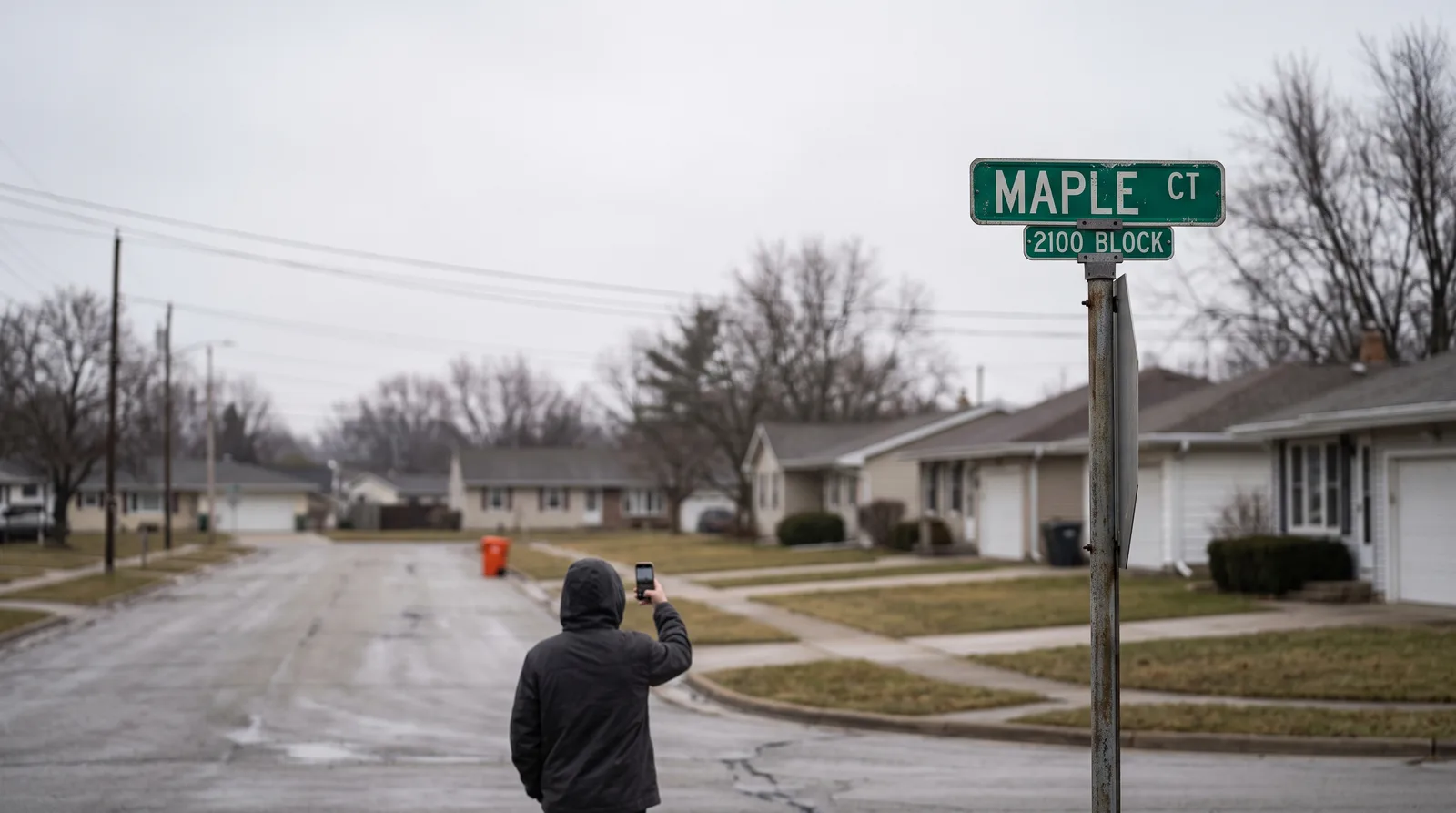
The video has to establish three things: where you operate, that the business exists, and that you manage it. For a service-area business, Google accepts professional tools, equipment or business cards as proof of existence. And for the home case specifically, it says you can record landmarks and signs in your immediate neighbourhood to establish the address.
So: get the street sign, get something with your name on it, keep filming for a full half minute, and do not stop and restart.
One profile per location, and the same-address problem
Google allows one profile per location: "Do not create more than one page for each location of your business, either in a single account or multiple accounts."
That sits awkwardly next to the practitioner rule, because an agent's profile and the brokerage's profile can share a street address. Google's duplicate detection lists "Same address: Multiple profiles have the same address" as a trigger, so the pair can get flagged automatically even when both are legitimate. The test Google applies on appeal is whether the businesses are "eligible and distinct from one another," not whether the addresses match.
There is no Google sentence anywhere that settles this in real estate terms. We looked. That is an honest gap rather than a secret.
What Google never says
Two silences are worth knowing about, because they will affect you and no amount of searching produces an answer.
There is no real estate section. Real estate agents appear exactly once in the guidelines, inside a list of practitioner examples. Everything else you have to derive from rules written for plumbers, doctors and insurance offices.
There is nothing about an agent leaving. Brokerages turn over agents constantly. Google's guidelines do not address what happens to a practitioner profile when the practitioner moves to another firm, who owns it, or what the old brokerage should do. If you are setting up profiles for your agents, decide the answer yourself in writing now, because Google will not decide it for you.
The short version
- Your brokerage gets a profile. So, probably, does each public-facing agent with their own clients.
- An agent's profile must not carry your brokerage name, unless they are your only agent.
- Working from home, clear the address and serve an area instead.
- That does not hide the address from the DRE, which publishes it.
- Video verification is live, 30 seconds, one take.
- Decide your own policy for when an agent leaves.
Everything above is quoted from Google's published guidelines and the DRE's own form, both linked so you can check them. Checked 19 September 2026.
If your brokerage does not have a website for that profile to point at, you are not unusual: we searched for one for all 74 brokerages licensed in Sacramento County since 2024 and 43 had nothing. Our free website teardown is where to start.