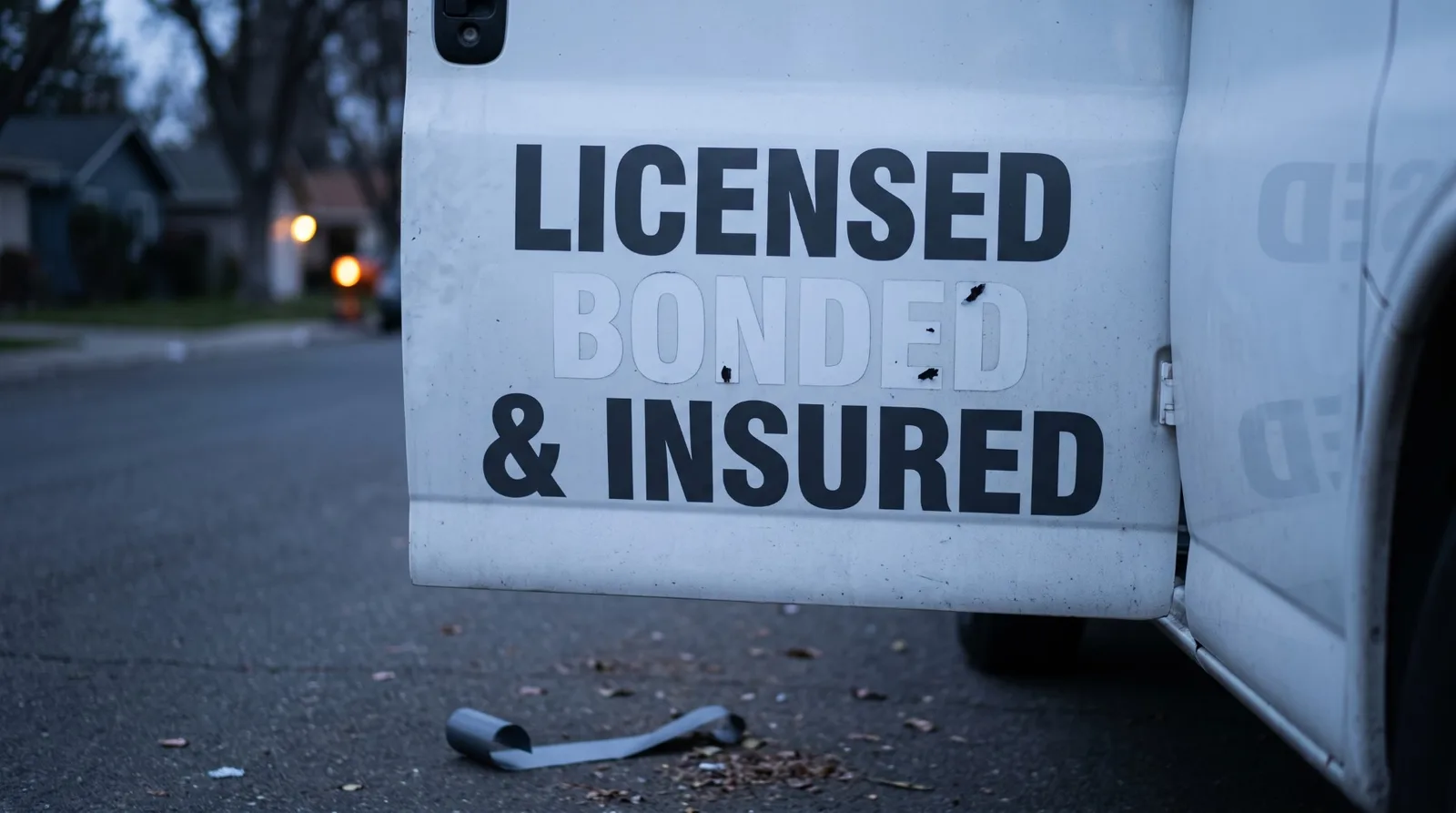
Licensed, bonded and insured is the most common line on a California contractor's website, and California has a rule for each of its three words. The license number has to appear in your advertising. "Bonded" is something you are not supposed to advertise, if you mean the license bond. "Insured" needs the type of insurance named beside it.
We checked how Sacramento-region contractors handle all three. We drew 42 licensed contractors at random from the state's public license file, found the 16 that have a website of their own, and read every page we could reach. As of 2026-09-30:
Licensed contractors drawn at random (plumbing, HVAC, electrical, roofing, low voltage, general building), four counties
A website of their own
Only a listing on someone else's site (BBB, BuildZoom, Yelp, Houzz)
Nothing we could find
A domain we could not settle
Of the 16 sites: trade contractors
Of the 12: show their own license number
Of the 12: say "licensed and insured" or "bonded"
Of the 16: name the type of insurance anywhere
Of the 16: print a price for any job
| What we found | Count |
|---|---|
| Licensed contractors drawn at random (plumbing, HVAC, electrical, roofing, low voltage, general building), four counties | 42 |
| A website of their own | 16 |
| Only a listing on someone else's site (BBB, BuildZoom, Yelp, Houzz) | 18 |
| Nothing we could find | 6 |
| A domain we could not settle | 2 |
| Of the 16 sites: trade contractors | 12 |
| Of the 12: show their own license number | 9 |
| Of the 12: say "licensed and insured" or "bonded" | 8 |
| Of the 16: name the type of insurance anywhere | 0 |
| Of the 16: print a price for any job | 0 |
We build websites for trade contractors, and this article ends at what we build. Weigh it accordingly. Everything above that section is measured, the method is at the end, and the two sites that got it right are named. The ones that did not are not, because the pattern is the point.
The three rules, in the statute's words
The license number. Business and Professions Code section 7030.5 (last amended in 1973) says a licensed contractor shall include the license number in "all forms of advertising, as prescribed by the registrar of contractors." The registrar's definition, 16 CCR 861, lists what counts and ends with "any electronic transmission." It never says the word website. The Contractors State License Board does, in its advertising guidelines: advertising includes "any website or post that solicits business on the Internet." The penalty schedule in 16 CCR 884 sets a civil penalty of $100 to $1,000 for a violation of 7030.5.
"Bonded." Section 7027.4(b), in force since January 1, 2004, says it is "cause for discipline for a contractor to advertise that he or she is 'bonded' if the reference is to a contractor's license bond." The bond it means is the $25,000 license bond the Board requires of licensees (section 7071.6). An older statute, section 7071.13, on the books since at least 1967, is blunter: any reference in advertising to a required bond is "a ground for the suspension of the license." The Board's stated reason is that the word could make a customer think the bond gives more protection than it does.
"Insured." Section 7027.4(a) makes it cause for discipline to advertise that you are "insured" without "identifying in the advertisement the type of insurance." Its own examples are "commercial general liability insurance" and "workers' compensation insurance," and you may abbreviate either.
Two limits on all of this. We build websites and we are not lawyers, and the statutes are short enough that you should read them. And we did not find a published count of how often the Board cites website wording, so we cannot tell you how likely a citation is. The rules are the rules either way.
What sixteen sites say
Twelve of the sixteen are plain trade contractors: plumbing, electrical, roofing, remodeling. The other four are IT or telephone firms that hold a low voltage license on the side. At least two of them advertise cabling and installation, which is licensed work, so we report them separately.
The license number: nine of twelve. Nine trade sites show their own number, eight of them on the homepage. The ninth shows it on inner pages only. One shows a number that belongs to a different licensee in the state's file, possibly a related company, which the public record cannot tell us. Two show no number on any page we reached, one of them a single-page site. None of the four IT or telephone firms shows a license number.
"Licensed and insured": seven of twelve. Seven say it, in a header, a footer, body copy or an FAQ question. Three say "bonded": two inside the same phrase ("licensed, bonded, insured and certified" on one services page, "Licensed bonded & Insured" across the top of another site) and one in a line about what a "licensed and bonded" electrician does. Eight of the twelve use one word or both. Not one of the sixteen names the type of insurance anywhere on the pages we read.
Prices: none. Across the 16 sites and up to 15 pages each, no site prints a price for any job. Five tell the reader the pricing is honest, transparent, fair or reasonable. Two pages contain a dollar figure at all: one is what an electrical failure costs a business, the other is a "$0 down" solar financing term. A promise of transparent pricing next to no number is something every competitor can also say, which makes it worth very little.
Two sites clear all three wording checks. Trujillo Plumbing has its number on the homepage, says nothing about bonds, and makes no insurance claim. M3 Service shows its number and makes no claim either. Neither prints a price, but on these three checks there is nothing to fix.
Who has no site at all
Twenty-four of the 42 have no website of their own that we could find: 18 exist only as a listing on BBB, BuildZoom, Yelp, Houzz or a similar directory, and six we found nothing for. Two more are a domain we could not settle: one resets every connection, in real Chrome and in curl, and the other is attributed to a roofer in directory listings but now shows a business with a different name and phone number.
Three patterns, all small samples:
- New licenses have almost no sites. Nine of the 42 were licensed in 2024 or later. One has a site of its own, and that one is an IT consultancy that has operated since 2017. Three of them were licensed in the ten weeks before we checked.
- Sole owners lag corporations. Five of 20 sole owners have a site, against eight of 16 corporations.
- HVAC is the thinnest trade in the draw. One of seven HVAC licensees has a site. Seven per trade is too few to call that a rate, so take it as a prompt to look, not a finding.
A Facebook or Google profile may exist for some of the 24. The discovery did not open them, and we did not count them as websites.
What to put on the page
It takes about ten minutes and none of it costs anything.
- The license number in the header or footer of every page, written as "CSLB License #" and the number. Put it on landing pages and profiles too, since they are advertising in their own right.
- Replace "licensed and insured" with the insurance named, for example "general liability and workers' compensation insurance," or drop the claim.
- Drop "bonded." If you want to tell customers something about protection, name the insurance instead.
- Put a range on your main job. Not a quote. A "from" price or a typical range for the work you most want. Nobody in this sample did it.
We did not test a fourth rule: advertising work outside your license classification, which the Board's guidance also covers. If your site sells anything your license does not cover, check that separately.
What we would build for a contractor
A trade site is a small piece of work if it leads with the job you want to be hired for and stops pretending to do everything. One specialty on the homepage. The license number where the statute expects it, on every page. The insurance named in plain words. A price range a homeowner can read before deciding whether to call. A tap-to-call phone number that works on a phone in a truck.
We build those for specialty contractors, and we will check your current site against the same list if you send us the address. Get in touch and say which trade you are in.
How we did this, so you can check it
- The sample. The Contractors State License Board's public data portal lets anyone download licensed contractors by classification, free, as a spreadsheet. We pulled six on 2026-09-30: plumbing (C-36), warm-air heating and air conditioning (C-20), electrical (C-10), roofing (C-39), low voltage (C-7) and general building (B). Every row in the download carried the status Clear. In Sacramento, Placer, El Dorado and Yolo counties the file held 1,019 plumbing, 965 HVAC, 1,943 electrical, 485 roofing, 327 low voltage and 7,584 general building license rows. One license can hold several classes, so those overlap.
- The draw. Seven per trade, chosen at random with a fixed seed (20260930), no license drawn twice. That is 42 firms: 20 sole owners, 16 corporations, five LLCs and one partnership, 24 in Sacramento County, seven in El Dorado, six in Yolo and five in Placer. A license with several classes is counted once, under the file it was drawn from.
- Finding the site. For each firm we searched its name with its city, its name with its phone number, and its license number. A site counted as theirs only if the page showed their phone number, their license number, or their address with their name. A same-named business in another state did not count. We re-searched six of the "no site" calls ourselves and all six held.
- Reading the sites. In real Chrome with a normal user agent, which we set on purpose because a default automation browser gets bot challenges that look exactly like a dead site. We read up to 15 pages per site and searched every page for the firm's own license number, any license-style number, "bonded," "insured," dollar figures and price language, then read every hit by hand. Nine sites had fewer than 15 pages, and we read all of them. It is the same method as our audits of new Sacramento brokerages and commercial brokers: a public license file and a real browser.
- The law. Every statute and regulation quoted here was read on the official California legislative site or the Legal Information Institute's copy of the California Code of Regulations on the same day.
- Limits. Forty-two is small, seven per trade is smaller, and nothing here is a rate for the state. A site that changed after 2026-09-30 will not match.