Real estate cold calling rules changed twice in fourteen months, and most of what is published about them predates both changes.
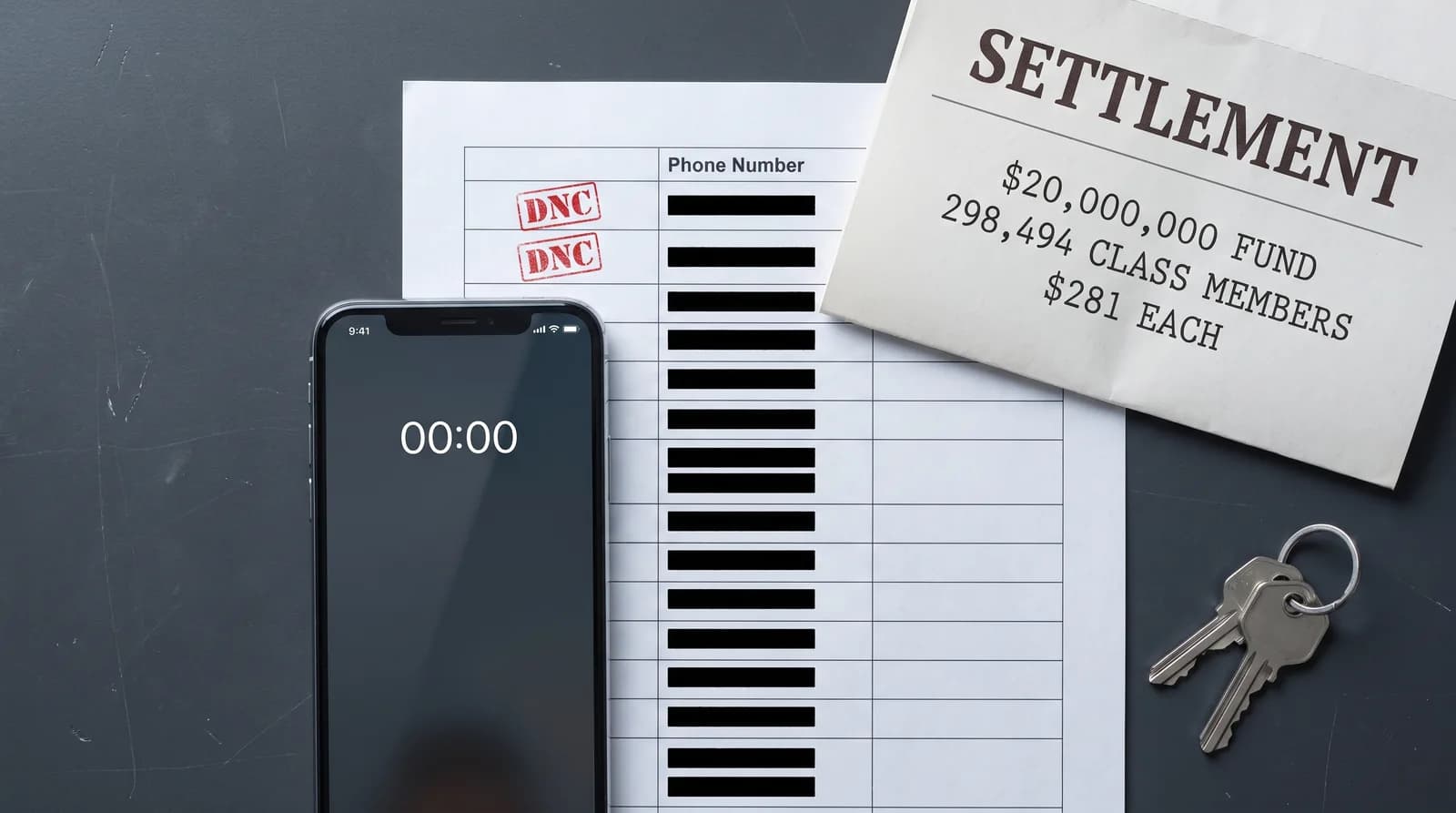
Here is the part that is not in doubt. In March 2026 a court gave final approval to a $20 million settlement of claims that agents affiliated with one national brokerage called homeowners whose numbers were on the National Do Not Call Registry, asking them to list. About 298,494 people were in the class. They received roughly $281 each.
Here is the part that is in doubt. In July 2026, a federal appeals court held that a text message is not a "telephone call," so homeowners in three states can no longer sue over a marketing text on the Do Not Call theory. The prohibition survived. The private lawsuit for it did not.
If you prospect by phone, the calls are settled law and expensive. If you prospect by text, the answer now depends on which circuit you are in and which subsection someone sues under.
Four rulebooks, and everyone blends them
We fetched fourteen pages that set out to explain this to agents. Three of them distinguished the autodialer rules from the Do Not Call rules. The National Association of REALTORS' own page is one of the eleven that does not.
That confusion is the whole problem, because the two rules answer to different tests and only one of them was narrowed.
TCPA autodialer rules, 47 U.S.C. 227(b)
TCPA Do Not Call rules, 47 U.S.C. 227(c)
FTC Telemarketing Sales Rule, 16 C.F.R. 310
State statutes
| Rulebook | What it governs | Who enforces |
|---|---|---|
| TCPA autodialer rules, 47 U.S.C. 227(b) | How you dialed, and prerecorded voices | Private suits, $500 to $1,500 per message |
| TCPA Do Not Call rules, 47 U.S.C. 227(c) | Who you contacted, regardless of how | Private suits, same amounts |
| FTC Telemarketing Sales Rule, 16 C.F.R. 310 | Overlapping duties, different numbers | The FTC and state AGs, no private suit |
| State statutes | Whatever the state decided | Varies, several with private suits |
What the Supreme Court actually narrowed in 2021
The case agents have heard of is Facebook, Inc. v. Duguid, 592 U.S. 395, decided April 1, 2021, unanimously. It held that to be an autodialer, equipment must have the capacity to store or produce numbers "using a random or sequential number generator." Storing a list and dialing it automatically is not enough. Justice Sotomayor wrote that reading it more broadly "would take a chainsaw to these nuanced problems when Congress meant to use a scalpel."
That decision is real and it matters. It is also about one of the four rulebooks.
Duguid says nothing about whether the number you dialed was on the registry. It says nothing about the internal do-not-call list you are required to keep. It says nothing about the FTC's rule or your state's statute. An agent who concluded "I dial manually, so the TCPA does not apply to me" has answered the wrong question correctly.
The rule that was never about how you dialed
47 C.F.R. 64.1200(c)(2) prohibits a telephone solicitation to a residential subscriber on the national registry, and registrations "must be honored indefinitely." There are three ways out, and they are narrower than agents assume:
- A demonstrable error, backed by written procedures, personnel training, and a registry version obtained "no more than 31 days prior to the date any call is made"
- A signed, written agreement with the consumer that names the seller and includes the number to be called
- A personal relationship with the recipient
That written-consent exception is the one people wave at. Read it again: signed, written, naming you, naming the number. A phone number printed in a classified advertisement is not that.
The established business relationship sits in the statute rather than in that list, because a call to someone you have an EBR with is not a "telephone solicitation" in the first place. The rule defines it at 64.1200(f)(5) with two clocks: eighteen months after the subscriber's purchase or transaction, and three months after their inquiry or application. A seller-specific do-not-call request ends the relationship even if the person keeps doing business with you.
And you are required to keep your own list. 64.1200(d) requires a written policy available on demand, trained personnel, and a record of every request. Two deadlines live in there and they get confused constantly: you must honor a request within a period that "may not exceed ten (10) business days," and the entry must be kept "for 5 years." The thirty-day figure circulating in compliance posts belongs to the FTC's rule and the old fax rule, not this one.
Almost no small brokerage we have looked at has the written policy. It is one page, and it is mandatory before the first call.
July 2026: a text is not a call
This is the change nothing published before this summer accounts for.
In Steidinger v. Blackstone Medical Services, No. 25-2398, decided July 14, 2026, the Seventh Circuit held:
Based on the ordinary public meaning of telephone call at the time of the TCPA's enactment, as well as the context provided by surrounding provisions of § 227, we find that texts are not calls, so § 227(c)(5) does not authorize the plaintiffs' suit.
The reasoning is a dictionary from the year the statute passed. In 1991 a telephone was "[a]n instrument for reproducing sounds at a distance," and to call meant "to get or try to get into communication by telephone." So, the court concluded, "in 1991, a 'telephone call' referred to communication via sound. Text messages do not reproduce sounds."
Now the part every summary of this case gets wrong. Steidinger did not abolish the Do Not Call rule for texts. It abolished the private lawsuit. The court drew the line itself:
the National Do-Not-Call Registry was implemented pursuant to § 227(c)(3), which refers to "telephone solicitations," so the FCC's interpretation doesn't inform our understanding of § 227(c)(5), which refers only to telephone calls.
Section 227(c)(3) is the registry. Section 227(c)(5) is the right to sue. The court construed the second and expressly left the first alone. So in Illinois, Indiana and Wisconsin, texting a registry number can still break the rule. The homeowner just cannot sue you for it on that theory.
The autodialer provision is untouched too. The panel distinguished its own earlier case law as being "about another provision of § 227." A text sent through equipment that qualifies as an autodialer is still exposed under 227(b), everywhere.
Why a court could do that at all
Because of a case fourteen months earlier that has nothing to do with real estate.
The FCC has said since 2003 that texts are calls. Courts used to treat that as binding. Then came McLaughlin Chiropractic Associates, Inc. v. McKesson Corp., 606 U.S. 146, decided June 20, 2025, 6 to 3, Justice Kavanaugh writing:
In an enforcement proceeding, a district court must independently determine for itself whether the agency's interpretation of a statute is correct. District courts are not bound by the agency's interpretation, but instead must determine the meaning of the law under ordinary principles of statutory interpretation, affording appropriate respect to the agency's interpretation.
Steidinger cites that page and takes the invitation. The practical effect for anyone marketing by phone is that thirty years of FCC interpretation is now arguable rather than settled, and the first appellate court to test one piece of it against the 1991 dictionary struck it down.
One honest caveat, because the trade coverage has been loose about it. This is not yet a clean circuit split. The Ninth Circuit held in Howard v. Republican National Committee, 164 F.4th 1119, decided January 13, 2026, that a text is a call, but it construed 227(b), a different subsection, and the Seventh Circuit expressly set those cases aside because they "concern claims brought under § 227(b), not § 227(c)(5)." Real tension over the same word, no direct disagreement on the same provision, and no appellate court has yet contradicted Steidinger on its own question.
What the calls actually cost
The text question is unsettled. The call question never was, and the numbers are not small.
In Bumpus v. Realogy Holdings Corp., No. 3:19-cv-03309 in the Northern District of California, homeowners alleged that agents affiliated with Coldwell Banker called numbers on the registry to solicit listings, using Mojo, PhoneBurner and Storm dialers, along with prerecorded messages. The settlement:
- $20,000,000 fund
- roughly 298,494 class members
- final approval March 18, 2026, payments beginning that June
- approximately $281 per claimant
The statute behind it sets $500 per violation, which a court may treble to $1,500 for a willful or knowing one. It is a private right of action, so it does not depend on a regulator deciding to care, and it aggregates into class actions in a way licence-law penalties never do.
For scale: we wrote last week about Utah citing agents $500 for leaving the brokerage name off an Instagram post. That is a regulator's citation against one licensee. This is four orders of magnitude larger and anyone can bring it.
We looked for other verified real estate cases and could confirm only this one against a court record. A widely reported $40 million settlement involving another national brand appears throughout the trade press, and we could not tie it to any court docket, so it is not in this post.
The call agents make most, and nobody has ruled on it
Expired listings and for-sale-by-owner sellers are the two lists agents work hardest, and the legal position is a blank.
Across two research passes using different search terms, we found no FCC ruling, no FTC ruling, and no reported court decision addressing whether advertising your property with a phone number amounts to prior express invitation or permission to be solicited about listing services.
NAR tells its members flatly: "you may not call a person who has advertised his property as FSBO" who is on the registry. We went looking for the authority behind that sentence and could not find one. The caution may well be sound. It is not sourced, and NAR's page is also one of the eleven we counted that never separates the autodialer rules from the Do Not Call rules.
What the rule text does settle is the expired listing. An established business relationship requires "a voluntary two-way communication" based on that person's transaction or inquiry with that entity. An agent who was never the listing broker has had no communication with the seller at all. Whatever the expired listing gives you, it is not an EBR, and the rule text is not ambiguous about it.
The other two rulebooks
The FTC runs its own. The Telemarketing Sales Rule covers any "seller" or "telemarketer" inducing the purchase of goods or services, which is real estate brokerage. It counts differently from the FCC on purpose: its established business relationship windows are 540 days and 90 days rather than eighteen months and three months, and its calling hours run 8:00 a.m. to 9:00 p.m. local. Civil penalties are inflation-adjusted annually and currently sit at $53,088 per violation under 16 C.F.R. 1.98, for penalties assessed after January 17, 2025. There is no private right of action, so this one arrives as an FTC or state attorney general action instead.
And the states are uneven, including on the exact question Steidinger just unsettled.
- Florida covers texts by name. Fla. Stat. 501.059(1)(j): "'Telephonic sales call' means a telephone call, text message, or voicemail transmission to a consumer for the purpose of soliciting a sale." Its 2023 amendment added a fifteen-day cure window after a recipient texts STOP before suit may be brought.
- Washington does not. RCW 80.36.400 reaches an "automatic dialing and announcing device," defined as a system that "transmits a recorded or artificial voice message once a connection is made," and bans its use "for purposes of commercial solicitation." A hand-sent text falls outside it. Damages are "actual damages or $1,000 per violation, whichever is greater."
- Oklahoma and Maryland both have statutes described as reaching automated contact, and we could not confirm from the statutory text itself whether either names text messages. We are not going to tell you they do based on a law firm's paraphrase.
What to actually do
Write the do-not-call policy before the first call. One page, available on demand, plus training and a record of every request. Ten business days to honor, five years to keep. It is the cheapest item on this list and the most commonly missing.
Scrub against the registry no more than 31 days before you dial. That number is in the safe harbor, and the safe harbor is what stands between an error and a violation.
Treat "I text manually" as an answer to one question out of four. Duguid narrowed the autodialer rule. It did not narrow the registry rule, your internal list, the FTC's rule, or Florida's statute.
Do not read Steidinger as permission. It removed a private lawsuit in three states. It did not remove the prohibition, it did not touch the autodialer provision, and it does not bind a court in your state unless you are in Illinois, Indiana or Wisconsin.
Get real consent when you want it. Signed, written, naming your brokerage and the number. Anything short of that is not the exception in 64.1200(c)(2), whatever a lead vendor's checkbox implies.
Ask what your ISA is doing. The rules reach calls made "on whose behalf" they occur. If someone else dials your list, the exposure is still yours, which is the same conclusion we reached about who posts on your social accounts.
That is the compliance half. The other half is having somewhere to send people who call you back, which is the part we build: websites and listing pages for new brokerages. If you are setting one up, tell us what you are opening. For the decisions next to this one, we have written up what your state requires of a brokerage site, recruiting agents, and whether to start your own firm at all.
Checked, and moving
Everything above was verified on August 28, 2026, and two things can change without warning.
Steidinger is six weeks old. We could not reach the docket to confirm whether a rehearing petition or a petition for certiorari has been filed. If either succeeds, the text answer changes again.
The FCC's consent revocation timeline is still shifting. The base rule took effect April 11, 2025; one component was delayed by a separate order to April 11, 2026. A further delay to 2027 circulated in one law firm alert and we could not match it to any FCC order, so it is not in this post.
Re-check both before relying on any of this.
The short version
Real estate cold calling rules now split three ways.
Calls are settled and expensive. One brokerage paid $20 million over agents calling registry numbers to ask for listings, about $281 to each of roughly 298,494 people. The statute is $500 per message, trebled to $1,500 for a willful one, brought by anyone.
Texts are genuinely unsettled. Facebook v. Duguid took most manual sending outside the autodialer rule in 2021. McLaughlin v. McKesson freed courts from the FCC's interpretations in June 2025. Steidinger used that freedom in July 2026 to hold that a text is not a telephone call under the provision that lets people sue. The registry rule itself survived, and so did the autodialer provision. What died, in three states, is the lawsuit.
And the boring rules did not move at all. The written do-not-call policy, the ten business days, the five-year record, the 31-day scrub, the eighteen and three month windows, the FTC's separate 540 and 90. None of that turned on any of these cases, and it is where most brokerages are actually out of compliance.