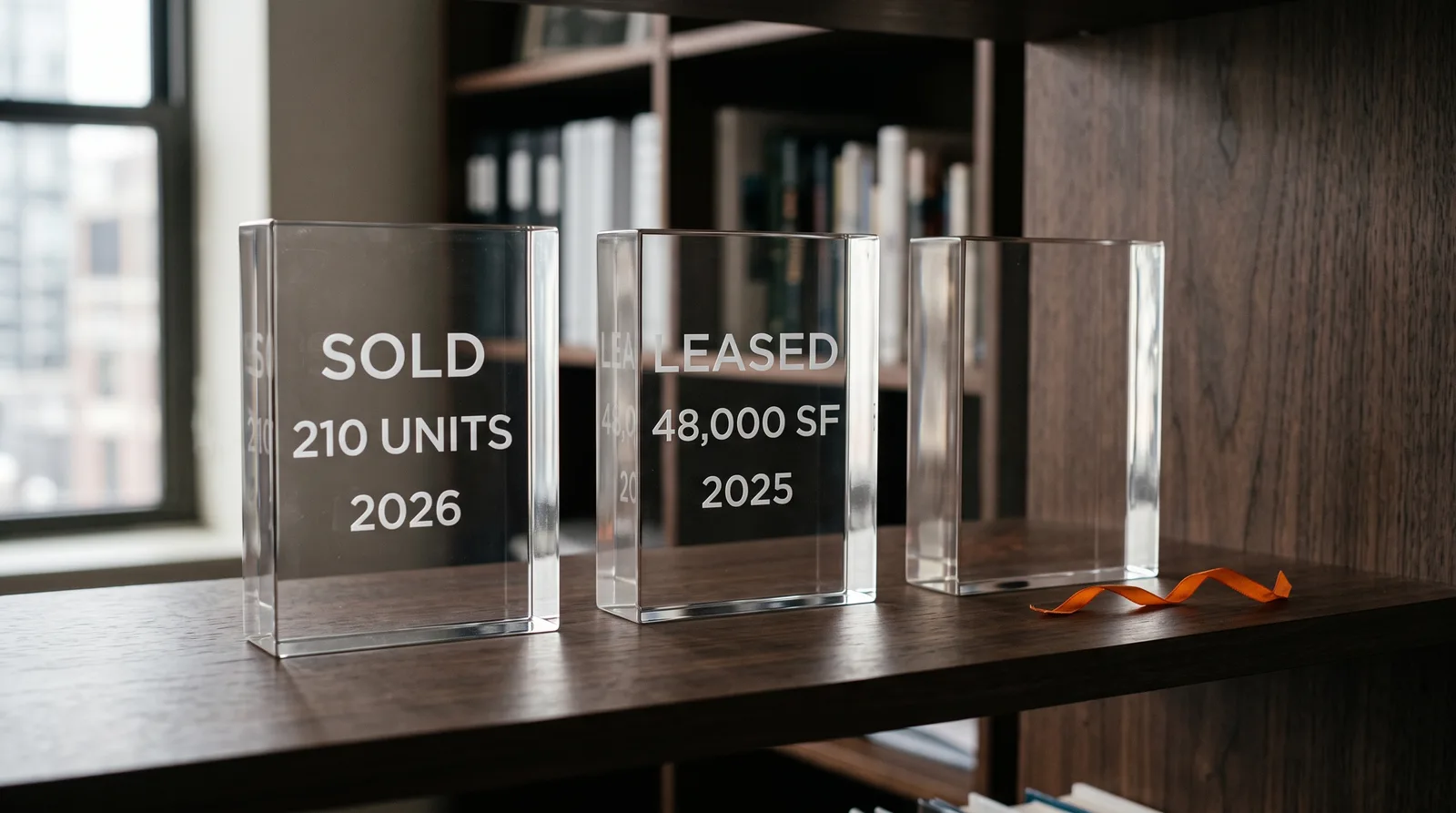
Commercial real estate website content is mostly a list of what the firm says about itself. What an owner wants is the answer to a short list of questions, and the commercial brokers' own trade association has published that list. We read every page linked from the homepages of 21 Sacramento-region commercial brokerage websites on October 9, 2026, and checked each one against it.
Almost every site says what it does. Few show that it has done it.
What it specializes in (a property type or a type of client)
How long the firm or its broker has been at it
Which cities or submarkets it works in
A total of past business ("over $500 million", "200 transactions")
At least one specific past deal, by address, property or tenant
A page or section listing several completed deals
A quoted client testimonial
Market research or articles a visitor can read
Anything dated 2026, other than a copyright line
| What a site answered, of 21 | Sites |
|---|---|
| What it specializes in (a property type or a type of client) | 19 |
| How long the firm or its broker has been at it | 17 |
| Which cities or submarkets it works in | 14 |
| A total of past business ("over $500 million", "200 transactions") | 12 |
| At least one specific past deal, by address, property or tenant | 9 |
| A page or section listing several completed deals | 6 |
| A quoted client testimonial | 8 |
| Market research or articles a visitor can read | 2 |
| Anything dated 2026, other than a copyright line | 2 |
These are the same 21 firms from our count of commercial broker websites two weeks ago, every DRE-licensed corporation in Sacramento, Placer, El Dorado and Yolo counties with Commercial or CRE in its name that has a working site of its own. That article covered listings and the licence number. This one covers everything else.
We build websites for brokerages, and this article ends at what we would build. The method is at the end, and the firms we name are named for doing something well.
The questions an owner is told to ask
In 2014, a commercial broker named Patrick O'Healy wrote a short guide for property owners on the blog of SIOR, the Society of Industrial and Office Realtors: How to Select a Commercial Real Estate Broker. It is a list of questions. Five of them are things a website could answer before the first call:
- "How long have you been selling and leasing commercial real estate?"
- "On what do you specialize?"
- "Can you provide a list for the past 3 years with a map showing their locations?"
- How many properties like this one have sold in the past 12 and 24 months in this submarket?
- "Can you give me ten references from property owners for whom you have sold/leased properties in the past few years?"
It is twelve years old, and written by a broker for other brokers' clients. We could not find anything newer that asks commercial owners or tenants what they look for on a broker's website. The nearest thing is a 2023 study LoopNet commissioned with Google, and LoopNet sells exposure to brokers, so weigh it accordingly. It found that "80% of tenants and 89% of investors who hired a broker" keep searching online on their own. They are looking. The question is what they find.
The easy questions get answered
Nineteen of the 21 sites name a property type or a type of client, and 17 say how long the firm or its principal has been in the business. Eighteen name at least one broker, and 17 have a team or bio page.
Where they work is weaker: 14 name a city, county or submarket beyond the address in the footer. "Northern California" does not tell a Roseville warehouse owner whether you have ever sold a warehouse in Roseville.
These are the questions that cost nothing to answer, because they are about the firm. The next three are about clients, and that is where the sample thins out.
Proof of deals: nine of 21
Nine sites name at least one specific deal they have done, by address, property name or tenant. Six give it a page or a section of its own:
- Cordano Commercial lists 22 leases by tenant and location on its Leasing Projects page, and 13 development projects on another.
- The Edwards Company keeps a Sold page with 13 properties and a Fully Leased page with 6.
- North Coast Commercial has a Sold Properties page that reads like an investor would want it to: "9100-9190 Tuolumne Dr., Sacramento, CA 95826 210 Units Sale Price: $19,375,000", eleven times over.
- Northwind Commercial has a Recently Sold page with nine named properties, each with its city, price and unit count.
- Two more list 22 and 3.
Twelve sites state a total instead: a dollar figure, a square footage, a number of transactions. Five of them name no deal anywhere on the site. A total is a claim; a named deal is evidence. "Over $500 million" invites the question the SIOR guide tells an owner to ask next, which is which ones.
Two smaller things we found that are worth checking on your own site. One firm's homepage link to "Client Success Stories" redirects to its news page. Another has a Projects page with fifteen pages of numbered links and no projects on any of them.
None of the deal lists we found carry a date. "Recently sold" with no year cannot tell a reader whether recently means this spring or 2016. Add the month and year to each entry. It is the difference between a track record and an archive.
References: eight of 21
Eight sites quote a client. The difference between them is who you can tell said it.
Gallaway Commercial does this better than anyone in the sample. Nine testimonials, each signed with a person's name, their title and their company, from a managing partner at a law firm to a company president, several noting how many locations the firm handled and the year the relationship began. Its client cards also name tenants with square footage, such as "EnvisionRx/Rite Aid 61,696 SF".
The catch is where it all sits: inside a slider. Our first automated read of the page missed every word of it, because text in a closed slide is not text on the screen, and a visitor has to click through to see each one. Put your best proof where it is visible without a click.
Others sign with a first name and an initial, or not at all. A quote from "Multifamily Purchaser" is better than nothing and much weaker than a name.
Jacks Commercial Real Estate takes a different route: its reviews page frames a review service holding 142 reviews, the newest dated September 24, 2026. That makes it one of only two sites in the sample showing anything dated 2026. One warning if you do this: a framed widget can load slowly, and for a few seconds in our browser the page showed an empty box. Check it on a phone on mobile data.
Before you publish anyone's name, get their permission in writing. For homes, we covered what Google and the FTC allow in asking for reviews. The same rules apply to an office lease.
Market knowledge: two of 21
This is the biggest gap. The SIOR guide's longest section is about the submarket: what has sold, at what price per square foot, to whom. It is the thing a broker knows that an owner does not.
Two sites have market content a visitor can actually read. The newest item on either is from October 2, 2024. The other is from 2012. A few more show article headlines with "Read More" links and teasers, or videos and podcasts, but no market writing. Nobody in the sample has published a market note in 2025 or 2026 that we could find.
That is an opening. A firm that posts a short note each quarter (what leased, what sold, what is sitting) would be the only one in this sample doing it, and it would answer the question owners are told to ask before they ask it.
Is anyone home?
Six of the 21 sites show a date anywhere other than the copyright line. Two are from 2026: Jacks' review feed and one firm's events page. The others are from 2024, 2023, 2016 and 2012. Fifteen show no date at all.
An undated site is not necessarily stale; it may have changed last week. But a reader cannot tell, and a site that shows nothing newer than 2016 tells them something whether it means to or not. In our first count, ten of these sites showed current listings, which is the best freshness signal a commercial site has. For firms without listings, a dated deal list or a quarterly note does the same job.
What to put on a commercial real estate website
This part is ours to sell, so read it as a checklist you can hold anyone to, including us.
The five answers, on pages a visitor can find from the homepage. Your specialty and submarkets in plain words on the first screen. A deal list with addresses, property types, sizes and the month and year of each one, on a page of its own. Testimonials with names, titles and companies, as text on the page and not only in a slider. A short dated market note, even quarterly. A team page with each broker's photo, direct line and licence number.
Listings, if you have them, on your own domain. We covered how in getting commercial listings onto your website. Tenant reps skip this and lean harder on the deal list.
Something a flyer cannot do. Our commercial property explorer is a fictional Sacramento office building you can walk through floor by floor, built to show what a property page can be when it is not a PDF. More on how we approach these sites is on the commercial real estate page.
The price, in the open: a launch site starting at $900 and live in 48 hours, a full multi-page site starting at $4,500 and live in about a week, and Flare Care after launch. What a brokerage website costs walks through which fits.
Our own site, against the same five
Fair is fair. Our site says what we specialize in and where we are, and this blog is our market content, dated. But we have no client case studies yet: our work page shows products we built and run ourselves and concept sites labelled as concepts. We have no published client testimonials. And our About page deliberately names no person, which costs us on exactly the question this article is about. Those are our gaps, in the order we intend to close them.
How we did this
Sample. The 21 Sacramento, Placer, El Dorado and Yolo county brokerages with a working site of their own from our September 23 count, drawn from the Department of Real Estate's licensee file: every licensed corporation with Commercial or CRE in its name.
Reading. On October 9, 2026, we opened each homepage in a normal Chrome browser and followed every link to the same site that the homepage carries, up to 30 pages per site, two seconds apart. Two sites turned out to be single pages. We submitted no forms and visited nothing a homepage did not link to. Every page was then read in full against eleven questions fixed before reading, and every yes was recorded with the exact words that earned it.
Two corrections we made to our own method. Our first read used only the text a visitor sees, which missed testimonials and deals sitting in closed sliders, so every page was read a second time including hidden text. And text inside a framed widget is in neither, so every page was scanned for frames, which is how we found the 142 reviews. Listings in frames were covered in the earlier article and not re-scored.
What this does not measure. Pages reachable only from a deeper page, accessibility, speed, and whether any of it is accurate. Dates are what the sites print. It is one day's snapshot.
If you run a commercial brokerage in the Sacramento region and want this checklist run on your site, tell us about your brokerage. If you would rather see the price first, build your package in about two minutes.