Should contractors put prices on their website? For the job you most want, yes: a typical range, plus what moves it. Not because a survey says homeowners want it, though several do. Because your customer is already reading a price for your job before they call you. It just is not yours.
We re-read every page we could reach on the websites of the 18 Sacramento-region contractors from our audit of licensed contractors. None shows a price for its own work. Four promise "transparent", "honest" or "upfront" pricing anyway.
We build websites for trade contractors, so weigh this accordingly. The numbers are measured, the method is at the end, and no contractor is named. The companies that publish prices and surveys are, because everything said about them below is their own words.
What 18 local contractor sites say instead of a price
On 2026-10-05 we read up to 25 pages on each site and checked every dollar figure and every price word by hand:
Show a price for their own work
Describe their prices with a word instead (affordable, fair, reasonable, competitive, transparent, honest)
Of those, call their pricing transparent, honest or upfront
Offer a free estimate, quote or consultation
Mention financing
| What the 18 sites do | Sites |
|---|---|
| Show a price for their own work | 0 |
| Describe their prices with a word instead (affordable, fair, reasonable, competitive, transparent, honest) | 9 |
| Of those, call their pricing transparent, honest or upfront | 4 |
| Offer a free estimate, quote or consultation | 10 |
| Mention financing | 5 |
The dollar signs we did find were never a price. One site lists its project sizes ("$2 million", "$35 Million") and the cost of an electrical failure. One offers a "$0-down" solar lease. One builder's blog answers what a chimney sweep costs in San Diego.
So a homeowner comparing these firms learns that the pricing is fair and transparent, and then has to call to find out what it is.
The price your customer finds instead
Search for your job and your city and the prices come from lead sellers: companies that publish cost guides and make their money connecting the homeowner who reads them to contractors. Every figure below was read on the company's own page on 2026-10-05:
Roof replacement, Sacramento
Roof replacement, Sacramento region
Heat pump, installed
Heat pump, installed
Panel upgrade to 200 amps
200-amp panel
| Job | Lead seller | Their published price |
|---|---|---|
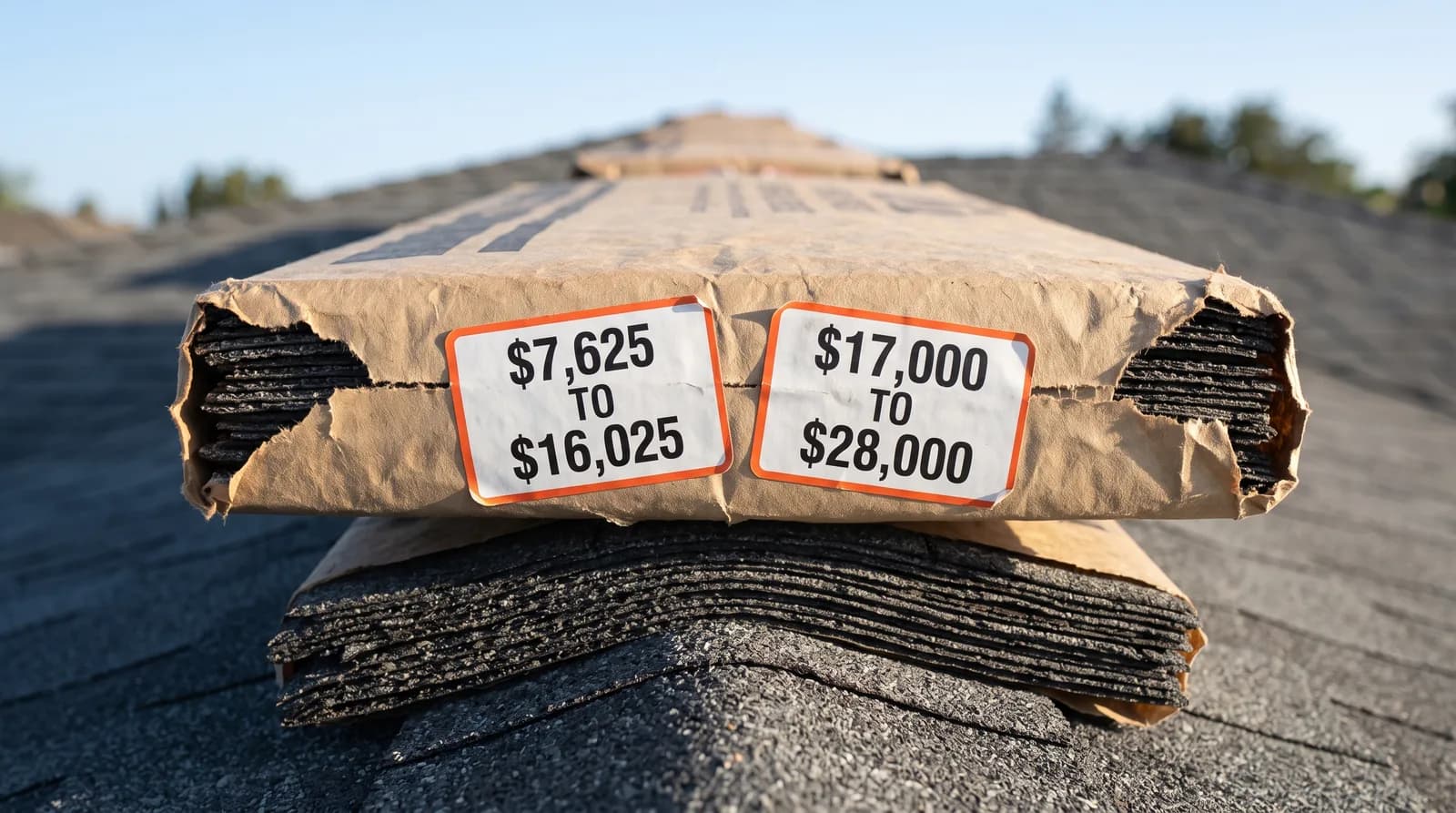
| Roof replacement, Sacramento | HomeAdvisor | $11,500 average, $7,625 to $16,025 |
| Roof replacement, Sacramento region | Modernize | $25,080 average, $17,000 to $28,000 |
| Heat pump, installed | Thumbtack (national) | $1,560 to $9,250 |
| Heat pump, installed | Modernize (California) | $8,500 to $15,000, typically about $11,500 |
| Panel upgrade to 200 amps | Thumbtack (national) | $1,250 to $3,000 |
| 200-amp panel | HomeAdvisor (national) | Around $1,500, in a range of $500 to $4,000 |
Look at the first two rows. HomeAdvisor's Sacramento range tops out at $16,025. Modernize's starts at $17,000. The two do not overlap, and Modernize's average is more than double HomeAdvisor's. A homeowner who lands on one walks into your estimate expecting a very different number from one who lands on the other.
None of these pages says how many jobs its figure is based on. Their method pages say this much:
- HomeAdvisor (its method note): "After a project is complete, we survey real customers about the costs to develop the pricing data you see," paired with research from the Bureau of Labor Statistics, journals and industry experts.
- Modernize: "Modernize uses advanced AI technology to power the cost information in our calculators and guides." Its method page adds: "This means the cost ranges on Modernize.com are national averages." The roof range above is labelled Sacramento-Stockton-Modesto.
- Thumbtack (its editorial standards): "Millions of verified cost estimates from local pros, combined with our own research before publishing."
- Fixr, whose California heat pump figure of about $10,250 "is derived from Fixr's national average of $8,350 adjusted for the report's estimated 15–30% California cost premium."
That last one is from Fixr's California HVAC report, written for contractors, and it explains the business plainly. The best lead, it says, is a homeowner who has "used a cost calculator" first: "A planned replacement lead arrives pre-educated. The homeowner is not asking what a heat pump costs. They are asking when you can install it."
That is the whole case for publishing your own price, made in three sentences by a company that sells those leads.
"Homeowners want prices": who actually measured that
You will see the same statistics on every article about this. Here is where they come from:
- 78% of homeowners are more likely to call a roofer with prices on its website. From Roofing Contractor magazine's 2025 homeowner survey, run by its publisher's own research arm and "Sponsored by Roofle Technologies and Owens Corning." Roofle sells RoofQuote PRO, which gives roofers' websites "Instant Online Quotes." The article prints no sample size; the publisher's results page does: 126 homeowners. The often-quoted 85% among millennials comes from 20 of them, a group that page itself marks "small sample size."
- 65%, a year later. The next wave, sponsored by Owens Corning, asked 127 homeowners, each paid a $10 gift card, and found 65% more likely to call, with 34% saying it made no difference. The full report sells for $3,250, so the study about publishing prices does publish its own.
- 70% of HVAC customers. From ACHR News's 2024 survey of 400 homeowners, also run by its publisher's research arm.
Roofing Contractor and ACHR News belong to the same publisher, BNP Media, and its research arm ran all three surveys. None of this makes the finding wrong. Three surveys pointing the same way, two of them small, is a real signal. But it is a stated preference from a few hundred people, partly paid for by a company that sells online pricing, and no one has tested it on real contractor calls. Our research searched Google Scholar, SSRN, NBER and seven marketing and economics journals, and found no study measuring what happens to a home-service company's inquiries after it posts prices. The nearest randomized trial is in medicine, where New York put outpatient providers' charges online and the researchers found "no evidence of quantity effects." Different market, different buyer.
One more number from the same roofing survey is worth a look. Its contractor panel, drawn from the magazine's subscribers and survey panels, says 37% list starting prices or ranges and another 30% list prices for specific services. Our random draw of licensed firms from the state's own file found none. A magazine's survey of its readers is not the trade.
Prices and AI search
There is one large controlled test, and it points the same way. A study published for SIGIR 2026, a major search research conference, by three researchers at the software company Sprinklr, ran 252,000 trials across six AI models, each time giving the model two near-identical sources that differed in one respect. Stating a price was one of only four factors that made a large difference to which source got cited first in all six models.
The caveat matters: the test pages were reviews of consumer products, not contractor services. Nobody has run it on a page about panel upgrades. But if an AI tool answering "how much does a panel upgrade cost in Sacramento" favours pages that state a price, then today the pages in your trade that state one belong to the lead sellers.
"They'll anchor to the low number"
This is the usual objection, and it has actually been tested. Daniel Ames and Malia Mason of Columbia Business School ran five studies of range offers in negotiations, and found that the person receiving a range is "often influenced by both endpoints", not just the attractive one. They also identified "boundaries to their impact, including range width and extremity."
Those were negotiations ("I want $7,200 to $7,600 for my car"), not prices on a website. The practical reading: a range helps when it is honest and narrow enough to mean something. A spread from one number to triple it tells the homeowner nothing, and they will go back to the lead seller's page.
How to put prices on your website without boxing yourself in
- Price the job you want more of, not everything you do. One range for your main job beats a full price list you have to keep current.
- Give a range and what moves it. "Most of our 200-amp panel upgrades run between X and Y. Moving the panel, a utility service upgrade or patching drywall puts it higher." Use your own last twenty jobs, not a lead seller's guide.
- Say what is included: permit, haul-away, cleanup, warranty.
- Date it. "Typical prices as of October 2026" tells the reader it is real and tells you when to check it.
- Keep the free estimate. The range sets the expectation; the visit sets the price.
- Remember the written contract governs. In California, Business and Professions Code 7159 requires a written home improvement contract once the price "exceeds five hundred dollars ($500)", and the contract must say "THE DOWNPAYMENT MAY NOT EXCEED $1,000 OR 10 PERCENT OF THE CONTRACT PRICE, WHICHEVER IS LESS." Never post a number you would not put in that contract.
- Put it in the page text, not in an image or a PDF, so search engines and AI tools can read it.
What we would build for a contractor
A page for the job you want more of: what it costs, what moves it, who has hired you for it, and a phone number that rings your phone. It is the one thing none of the 18 sites we checked has, and it is the thing a lead seller's page cannot copy, because it is your number. What a site like that costs is in our contractor website cost guide. Get in touch and we will sketch the page for your main job.
How we did this, so you can check it
- The contractors. The same 42 as our audit of licensed contractors and our Google profile check: seven each in plumbing, HVAC, electrical, roofing, low voltage and general building, drawn at random from the Contractors State License Board's public file for Sacramento, Placer, El Dorado and Yolo counties. Eighteen have a website of their own.
- Reading the sites. On 2026-10-05, in real Chrome with an ordinary desktop browser identity, up to 25 pages per site, following each site's own links. Every dollar figure and every price word was classified by hand, and phrases inside customer reviews were not counted. Three sites yielded only their homepage because the crawler found no further pages to follow.
- Lead seller prices and methods. Read on each company's own pages on 2026-10-05. Cost guides change often, so check before you rely on one.
- Surveys. Read on the publishers' own pages, including the sample sizes the magazine articles leave out.
- Limits. Eighteen sites in one region. Nothing here is a rate for California or for the trades as a whole.