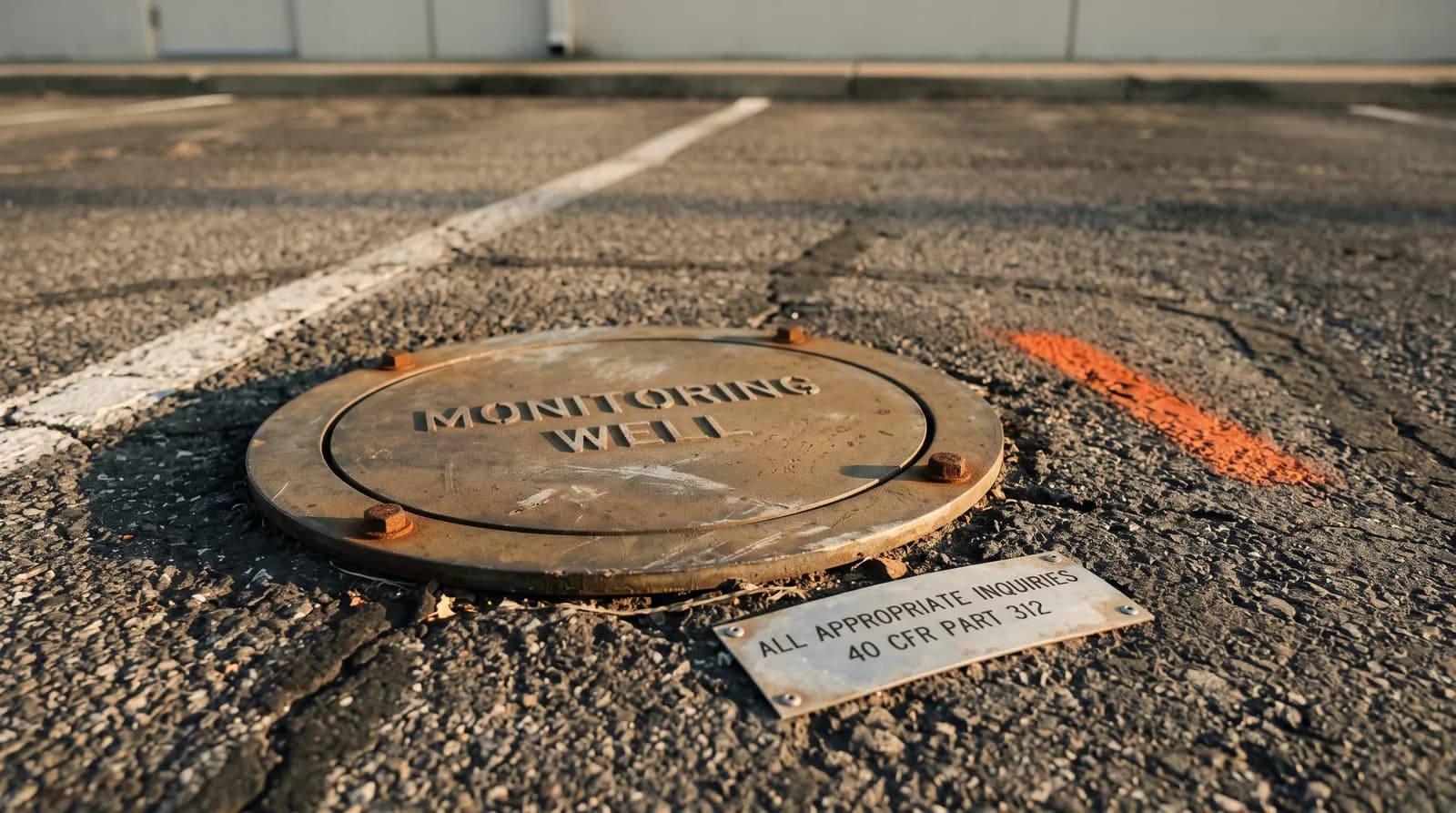
A Phase I environmental site assessment does not buy you the federal liability defense. It buys evidence for one element of it, and buyers lose the other elements on things that have nothing to do with what the report found.
That is not a technicality. A company called Major Holdings bought three properties in Indianapolis, commissioned assessments, and lost its protection on two of them. Not because the reports missed contamination. Because one was done too early, and the other was missing two sentences.
If you are advising a client on a commercial deal, this is the part worth knowing, because it is the part the report itself will not tell them. It is also a reminder that commercial runs on different rails from residential, and the rules written for houses often do not reach it.
What a Phase I environmental site assessment actually buys
One element of a defense, and information.
Under CERCLA, a buyer who wants the bona fide prospective purchaser protection has to satisfy eight criteria. One of them is having made "all appropriate inquiries into the previous ownership and uses of the facility in accordance with generally accepted good commercial and customary standards." The Phase I is how you satisfy that one.
The other seven are still waiting. And the standard itself is candid that it is not purely a liability instrument: ASTM includes petroleum products in scope for commercial reasons, not because CERCLA necessarily reaches them.
A finding here also travels: whatever the report identifies becomes something your offering memorandum has to reckon with rather than quietly omit. So a broker who describes a Phase I as "the environmental protection" is overselling it, and a broker who describes it as "a box to tick" is underselling it. It is one required element, and the rules around it are unusually unforgiving.
The case where the buyer did everything and lost anyway
Von Duprin LLC v. Major Holdings, LLC, decided by the Seventh Circuit on 3 September 2021, is the clearest illustration in the reported case law, because the same buyer got three different results on three properties in one opinion.
On the Moran Property, it worked. The court found Major "completed the necessary inquiries in a complete and timely fashion."
On the Zimmer Paper Facility, the paperwork sank it. This passage is the one to read twice:
To be sure, Major did complete a Phase 1 Environmental Assessment according to the provisions of ASTM International Standard E1527-05, and, complying with that standard, did at the time satisfy parts of the "all appropriate inquiries" requirements set forth in portions of CERCLA's implementing regulations. But CERCLA's regulations, in particular 40 C.F.R. §§ 312.21 and 312.22, required more, and that more is where Major fell short. Those provisions include requiring certain attestations about the professional qualifications of the environmental professionals conducting the inquiry for the prospective purchase. These required attestations appear nowhere in Major's Phase 1 Environmental Assessment, however.
The report complied with the ASTM standard. The standard and the regulation are not the same thing. The court added that Major could not rescue it by pointing to agency guidance: "Try as Major does to point to non-binding agency guidance, it cannot show full compliance with all requirements in the 'all appropriate inquiries' regulation."
On the Ertel Property, the calendar sank it. Major took a 99-year lease in November 2007, which made it an owner or operator. The court:
Major therefore had to complete the required inquiries by performing or updating an environmental assessment within 180 days of becoming an owner or operator. The company failed to do so, for the only environmental assessment that could satisfy the BFPP's substantive requirements comes from September 6, 2006, a date not within 180 days of the commencement of the lease in November 2007.
Note what triggered the clock. Not a deed, a lease. If you handle ground leases, early possession, or lease-to-purchase structures, the acquisition date your client is thinking of may not be the one the statute counts.
The two clocks nobody explains
40 CFR 312.20 runs two timers at once, and most summaries mention only one.
The outer clock is one year. All appropriate inquiries "must be conducted within one year prior to the date of acquisition of the subject property."
The inner clock is 180 days, and it applies to five named components, which must be "conducted or updated within 180 days of and prior to the date of acquisition":
- Interviews with past and present owners, operators, and occupants
- Searches for recorded environmental cleanup liens
- Reviews of federal, tribal, state, and local government records
- Visual inspections of the facility and of adjoining properties
- The declaration by the environmental professional
That last one catches people. The 180 day clock attaches to the components, including the sign-off, not to the date printed on the cover of the report.
What that means in practice on a slow deal: between day 181 and one year, the rule singles out those five items for updating. Past one year, refreshing only those five cannot help, because the rest of the inquiry now sits outside the outer window. We could not find EPA guidance specifying whether an update is an addendum or a replacement report, so treat the mechanics as a question for the consultant and the two deadlines as the part that is not negotiable.
The paperwork that is not in the standard
40 CFR 312.21 requires the report to contain an opinion on whether the inquiry identified conditions indicative of releases, an identification of data gaps and their significance, and the qualifications of the environmental professional. Then it requires two declarations, signed:
I ... meet the definition of Environmental Professional as defined in § 312.10
I ... have developed and performed the all appropriate inquiries in conformance with the standards and practices set forth in 40 CFR Part 312
Those two sentences are what was missing in Von Duprin.
And 312.10 defines who may sign. Four routes: a professional engineer or geologist licence plus three years of relevant full-time experience; another qualifying licence or certification plus three years; a relevant bachelor's degree plus five years; or ten years of relevant experience. Someone without those may work on it only "under the supervision or responsible charge of" someone who qualifies.
This is the one page of a Phase I a broker can usefully check without being an environmental professional. Is the declaration there, is it signed, and is it dated inside the window.
The defense does not end at closing
The other way buyers lose it is by stopping.
In PCS Nitrogen Inc. v. Ashley II of Charleston LLC, 714 F.3d 161 (4th Cir. 2013), the purchaser had done its pre-acquisition work and still failed, because the bona fide prospective purchaser criteria include exercising appropriate care afterwards: taking reasonable steps to stop a continuing release, prevent a threatened future release, and prevent or limit exposure to a previously released hazardous substance.
The purchaser had left contaminated sumps unaddressed. Its own expert conceded they should have been filled a year earlier than they were. The Fourth Circuit's conclusion was that its "inactions clearly show that it failed to exercise 'appropriate care'," and it read that standard as at least as demanding as the due care required elsewhere in the statute.
A separate 2025 federal decision, Old Gate Partners, LLC v. Paddock Enterprises, LLC, denied the defense on a different footing again: the purchaser could not prove that no disposal occurred after it acquired the property.
Three cases, three different failure points, none of them "the report missed something."
What your state actually asks of you
Here is the part written for the person reading this rather than for their buyer. No state we checked requires a broker to recommend a Phase I. What the states do require varies more than you would expect, and the commercial answer is often different from the residential one.
Florida
California
New York
Illinois
New Jersey
| State | What it asks in a commercial deal |
|---|---|
| Florida | The disclosure statute expressly does not apply to nonresidential transactions |
| California | The statutory inspection and disclosure duty is limited to residential property of one to four units |
| New York | The agency disclosure section "shall apply only to transactions involving residential real property" |
| Illinois | Disclose material facts actually known, and latent adverse physical condition facts a diligent buyer inspection would not find. Not limited to residential |
| New Jersey | The broadest. Disclose information material to physical condition that you know or that a reasonable effort to ascertain would have revealed |
Florida's is the bluntest, at 475.278: the licensee disclosure requirements "do not apply to ... nonresidential transactions." That is not permission to mislead anyone, because the general grounds for discipline still reach fraud, concealment and culpable negligence in any business transaction. It does mean the specific enumerated duty is off.
New Jersey sits at the other end. Its rule reaches information "which a reasonable effort to ascertain such information would have revealed," which is an affirmative investigation duty rather than a pass-along duty.
We cut Texas from this table rather than guess. The only version of its disciplinary statute we could retrieve carried text effective before 2016, and a dateable current version did not come back. This blog does not print a statute it cannot date.
Colorado shows what a regulator looks like when it does engage: the state commission's own commercial contract gives the buyer the right to obtain "a Phase I Environmental Site Assessment" and names the ASTM E1527 standard by number, with a path to a Phase II if the Phase I recommends one.
PFAS moved into scope without the standard changing
Worth knowing because it happened quietly.
ASTM's standard excludes emerging contaminants from scope while they are "not hazardous substances under CERCLA." EPA then designated PFOA and PFOS, including their salts and structural isomers, as CERCLA hazardous substances, effective 8 July 2024.
So those two compounds moved into scope by operation of the designation, without ASTM amending anything. The rest of the PFAS family did not. A broker repeating "PFAS is now covered" is overstating it.
The designation survived its challenge. On 18 August 2026 the D.C. Circuit denied the industry petitions in Chamber of Commerce of the United States v. EPA, No. 24-1193, holding that "the plain language of Section 9602 allows EPA to designate as hazardous substances chemicals like PFOA and PFOS." As of 12 September 2026 we found no petition for rehearing or certiorari, though a filing three weeks after a decision would not necessarily be visible yet.
EPA also has an enforcement discretion policy, dated 19 April 2024, saying it will focus on "parties that have manufactured PFAS or used PFAS in the manufacturing process" and does not intend to pursue farmers, municipal landfills, water utilities, municipal airports and local fire departments. Read that for what it is. An enforcement policy governs what EPA chooses to do. It does not bind a private plaintiff seeking cost recovery, and it is not a defense.
What to tell a client
Five things, none of which require you to be an environmental professional.
The date on the cover is not the date that counts. Ask when the interviews, the records review, the site visit and the declaration were done, and compare that to the expected closing.
Ask whether the acquisition date is the one they think it is. A long ground lease started the clock in Von Duprin.
Check that the declarations are present and signed. Two sentences, one page. Their absence ended the defense on an otherwise compliant report.
Say plainly that closing is not the finish line. If the report identifies something, the reasonable steps obligation starts immediately, and Ashley II turned on a delay the buyer's own expert could not defend.
Do not quote a cost. We looked for a cost or turnaround range published by anyone who does not sell the assessment, and did not find one where we could look. Every figure in circulation appears to come from firms that perform them, so send your client to two or three consultants for real quotes rather than repeating a number. That is the same pattern we found when we went looking for evidence that 3D tours do anything, and it is worth recognising on sight.
And the honest limit of all of the above: this is what the statute, the regulation and the reported cases say. It is not legal advice, and the moment a deal has a real environmental question in it, your client needs a lawyer and an environmental professional rather than a broker with a good blog post.
We build websites for commercial brokerages, which is a commercial interest of the kind this post has been flagging throughout, so everything here is sourced to a document you can open.
Checked 12 September 2026. Two items on this page can move. The D.C. Circuit's PFAS decision is three weeks old and its rehearing and certiorari status was not retrievable, and EPA's enforcement discretion policy is guidance that the agency can revise. Re-check both before relying on this section.