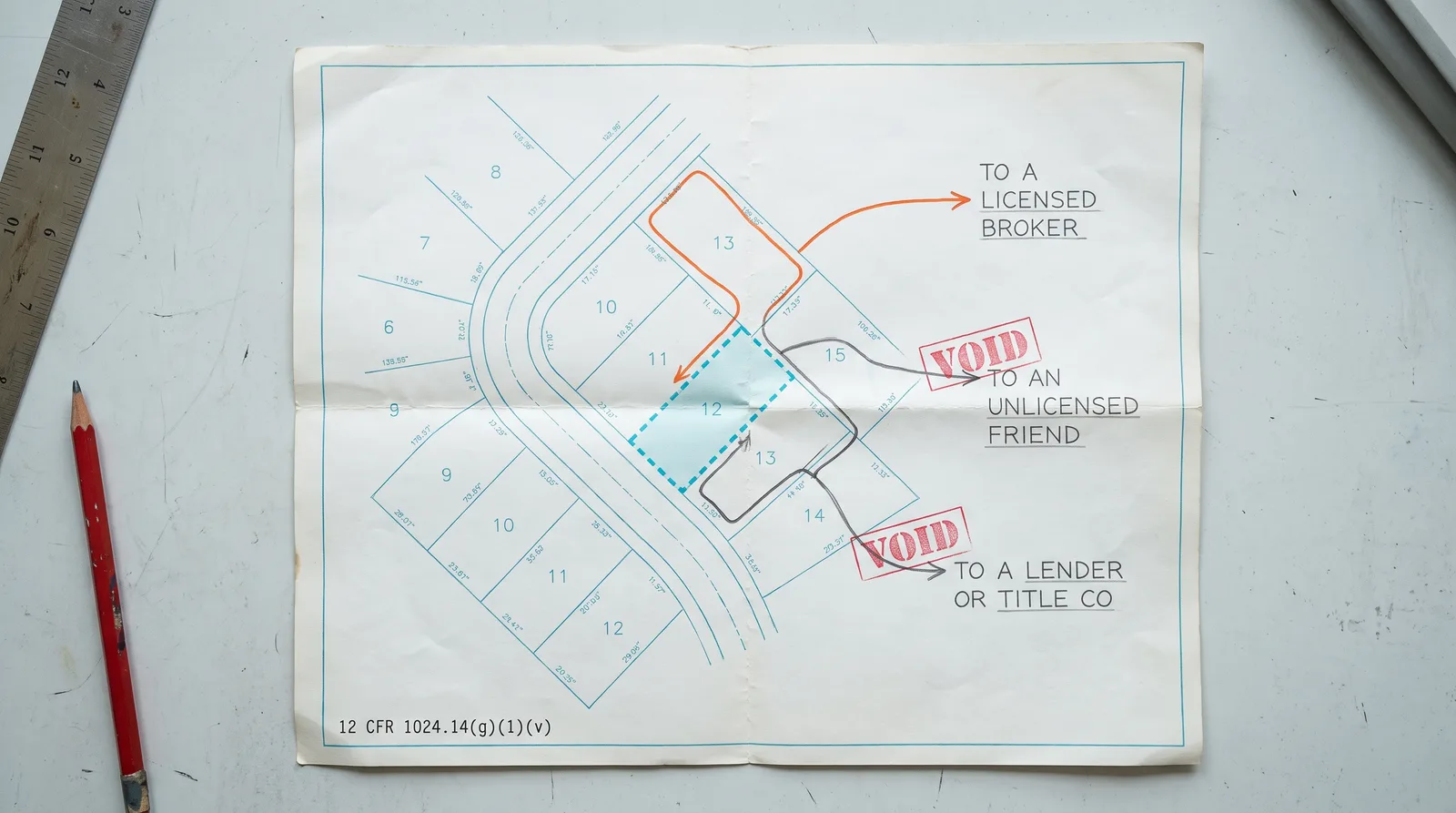
Real estate referral fee rules turn on who you are paying, not how much you are paying them. Three separate bodies of law reach three different answers, and the one most brokers worry about is the one least likely to catch them.
The short version:
Another licensed broker, both acting as brokers
Someone with no license
A lender, title company or mortgage broker
| Who you pay | Answer | The rule that governs it |
|---|---|---|
| Another licensed broker, both acting as brokers | Permitted | 12 CFR 1024.14(g)(1)(v) expressly exempts it |
| Someone with no license | Barred in most states | Your state's license act, not RESPA |
| A lender, title company or mortgage broker | Barred | RESPA Section 8, and the brokerage exemption expressly does not reach it |
Most of the writing on this topic is about RESPA, because RESPA is federal, carries a prison term, and makes for a better article. But RESPA reaches settlement services on federally related mortgage loans, it expressly exempts the broker to broker referral, and the agency that enforces it has gone quiet.
The rule that will actually get a new broker disciplined is the state one. It has no exemption for you, no federal enforcement politics attached to it, and it did not change.
The exempt lane: broker to broker
Federal law carves this out by name. 12 CFR 1024.14(g)(1)(v) permits:
A payment pursuant to cooperative brokerage and referral arrangements or agreements between real estate agents and real estate brokers.
Read the parenthetical that follows it, because it is the whole limit:
(The statutory exemption restated in this paragraph refers only to fee divisions within real estate brokerage arrangements when all parties are acting in a real estate brokerage capacity, and has no applicability to any fee arrangements between real estate brokers and mortgage brokers or between mortgage brokers.)
So the exemption is about capacity, not job title. Two brokers splitting a referral are covered. The same two people, one of them wearing a mortgage broker hat for that transaction, are not.
State law then adds its own conditions on the interstate version, and they are not uniform:
- Arizona permits it outright. A.R.S. 32-2163(A) says a licensed broker "may pay compensation to and receive compensation from a broker who is lawfully operating in another state." But if that out-of-state broker will do anything in Arizona that would otherwise need a license, subsection (C)(1) requires a written cooperation agreement signed first, listing the activities, and stating that the Arizona broker "understands and accepts responsibility for the acts of the out-of-state broker."
- Ohio permits it "only when done in accordance with rules adopted by the Ohio real estate commission" (Ohio Rev. Code 4735.20(B)).
- Michigan permits it only if the nonresident broker "does not conduct in this state a negotiation for which a commission is paid" (MCL 339.2512(1)(h)).
- Illinois requires the recipient to hold an Illinois license or "an equivalent license of another state or country of domicile" (68 Ill. Adm. Code 1450.780(a)).
Arizona goes further than most and is worth reading if you plan to work referrals across a state line. The same section says offering brokerage services on real property in Arizona through a website is itself activity requiring an Arizona license, and it bars an out-of-state broker from putting a sign on Arizona property.
The trap: paying someone with no license
This is the one that catches new brokerages, and it has nothing to do with RESPA.
Every state license act we read bars compensating an unlicensed person for acts requiring a license. The wording differs; the outcome does not.
Virginia
Michigan
Illinois
| State | The operative language | Citation |
|---|---|---|
| Arizona | Unlawful to pay "anyone compensation for performing any of the acts specified by this chapter, as a broker, who is not licensed at the time the service is rendered" | A.R.S. 32-2155(C) |
| Ohio | No broker "shall pay a commission, fee, or other compensation for performing any of the acts specified in section 4735.01" to an unlicensed person | Ohio Rev. Code 4735.20(A) |
| Virginia | "Offering to pay, paying, or providing valuable consideration to any person not licensed in this or any jurisdiction for services that require a real estate license" | 18VAC135-20-280(A)(1) |
| Michigan | Bars sharing or paying valuable consideration to an unlicensed person, "including payment to any person that provides the name of, or any other information regarding, a potential seller or purchaser" | MCL 339.2512(1)(h) |
| California | Unlawful for a broker to "retain, compensate, directly or indirectly, any person for performing any of the acts within the scope of this chapter" who is not licensed | Bus. & Prof. Code 10137 |
| Illinois | "No licensee may pay a referral fee to an unlicensed person who is not a principal to the transaction" | 68 Ill. Adm. Code 1450.780(a) |
Two details in that table are worth pulling out.
Michigan names the thing you were going to do. Paying "any person that provides the name of, or any other information regarding, a potential seller or purchaser" is barred by its terms. Buying a list of names is a different matter: Michigan expressly excludes "payment for the purchase of a commercially prepared list of names." So the same money is lawful for a commercial list and unlawful for your neighbor's tip.
Illinois protects the principal. A party to the transaction can be paid a referral fee without a license, which is the mechanism behind lawful client rebates in states that allow them.
Virginia's version was amended effective April 1, 2026, so anything written about Virginia before that date should be re-read against the current rule.
Texas draws a line at $50, and it is not a permission
Texas is the state most often cited for a gift allowance, and the way it works is more precise than the way it gets described. 22 TAC 535.20 does not grant permission to give a $50 gift. It defines the term that triggers licensing:
Referring a prospective buyer, seller, landlord, or tenant to another person in connection with a proposed real estate transaction is an act requiring the person making the referral to be licensed if the referral is made with the expectation of receiving valuable consideration. For the purposes of this section, the term "valuable consideration" includes but is not limited to: (1) money; (2) gifts of merchandise having a retail value greater than $50; (3) rent bonuses; and (4) discounts.
So $50 is the ceiling of what escapes the definition, not a safe harbour anybody granted. Cross it and the person you paid needed a license. TREC's own guidance answers the practical cases the same way: asked whether a license holder can pay cash to an unlicensed person for referring a potential lessee or buyer, the answer is "No." Asked about entering an unlicensed person in a drawing to win a cruise, the answer is "No. Since the cruise would have a value greater than $50, it is defined as valuable consideration."
Ohio has a dollar exception too, and it is narrower than it first looks. 4735.20(G) lets an owner of foreign real estate refer a buyer to the person who sold it to them, capped at "one thousand dollars" in any twelve consecutive months, and only if the owner does not do it as a regular business practice and does not show the property or participate in negotiations. It is not a general thank-you-gift rule for residential brokerage.
What RESPA is actually aimed at
RESPA Section 8 exists for the lane the brokerage exemption does not cover: money moving between a brokerage and the lenders, title companies and other settlement service providers that want its business.
Two definitions do most of the work, and both are broader than people expect.
"Thing of value" is not about cash. 12 CFR 1024.14(d) lists, among others, discounts, "services of all types at special or free rates," "trips and payment of another person's expenses," and "the opportunity to participate in a money-making program." The rule then says the word payment "does not require transfer of money."
An agreement does not have to be an agreement. Under 1024.14(e), an understanding "need not be written or verbalized but may be established by a practice, pattern or course of conduct."
Both of those were the basis of a real penalty against a real brokerage.
The $200,000 case, and the part of it that should worry you
In CFPB consent order 2023-CFPB-0009, filed August 17, 2023, a Long Island brokerage paid a $200,000 civil money penalty for accepting kickbacks from a lender. No cash changed hands in the first count.
The thing of value was a data subscription. The order records that the service provided "property reports, sales comparables, and foreclosure data," retailed "at least $300 per month" if an agent bought their own, and that more than 100 of the brokerage's agents took it through the lender's account. The lender required them to be paired with one of its loan officers first. They made more than 400 mortgage referrals.
The second count is the one worth reading twice if you are about to sign a marketing agreement. The brokerage had a marketing services agreement paying it $6,000 per month from January 2017 through at least December 2022, totalling $432,000. What it owed in return, and did not deliver:
- 15,000 marketing emails per month. It sent zero.
- Three physical locations showing video loop or kiosk advertising. It had none.
- An average of 75 property websites per month displaying the lender's content. It never created any.
That is not a technical foot-fault. Being paid for marketing you never performed is the definition of an unearned fee, and the CFPB's current guidance says so directly. Its RESPA Section 8 FAQs, issued October 2020 when the Bureau rescinded its 2015 marketing services bulletin, state that "entering into, performing services under, and making payments under MSAs are not, by themselves, prohibited acts," and that "a lawful MSA is an agreement for the performance of marketing services where the payments under the MSA are reasonably related to the value of services actually performed."
The FAQs also draw the cleanest line anyone has drawn between the two activities:
Referrals include any oral or written action directed to a person where the action has the effect of affirmatively influencing the selection of a particular provider of settlement services. In contrast, a marketing service is not directed to a person; rather, it is generally targeted at a wide audience.
If you want the safe version of that test: a billboard is marketing, and an introduction is a referral.
The enforcement picture, as of today
Here is the part no compliance vendor will lead with.
On December 23, 2024 the CFPB sued Rocket Homes, a 45 affiliate brokerage network and its owner over an alleged referral steering scheme. It was the largest RESPA Section 8 action against real estate brokerages in years.
The Bureau then dropped it. Its own case page records that "on February 27, 2025, the Bureau filed a notice of dismissal voluntarily dismissing the action against all defendants with prejudice, and on February 28, 2025, the court dismissed the case with prejudice." With prejudice means it cannot be refiled.
No new RESPA Section 8 enforcement action appears in the CFPB's public enforcement database for 2025 or 2026 as of this writing.
Three things follow, and the third is the point of this article:
- The statute did not change. 12 U.S.C. 2607 still carries a fine up to $10,000, up to one year of imprisonment, and joint and several liability for three times the amount of any charge paid for the settlement service involved.
- The private action survives. The treble damages provision runs to the person charged for the settlement service, not to the government, so it does not depend on any agency's appetite.
- State license law was never federal. Nothing about the CFPB's posture touches Arizona's statute, Ohio's, Virginia's, Michigan's or California's. If you pay an unlicensed person for a referral, the body that disciplines you is your own commission.
State discipline for this is real but hard to see, because commission disciplinary databases are name-lookup tools and cannot be searched by violation. Digging through Illinois's published discipline archive turns up the shape of it: on January 26, 2004, a broker's license was reprimanded, extra education was required, and a $1,000 fine was assessed "for aiding and abetting the unlicensed practice of real estate by paying a referral fee to an unlicensed person." That is one case, and an old one, which is the honest description of what the public record holds.
Two things almost nobody mentions
You can pay an unlicensed entity, in Ohio, under five conditions
The blanket "never pay the unlicensed" rule has an exception in Ohio that matters if your agents have formed their own companies, which many have after reading about licensing a brokerage entity.
Ohio Rev. Code 4735.20(C) lets a broker pay an affiliated licensee's earned commission to "a partnership, association, limited liability company, limited liability partnership, or corporation that is not licensed as a real estate broker," provided all five conditions hold: at least one owner holds an active license, at least one owner is the licensee who earned it, the entity does none of the acts requiring a license, the broker verifies both facts and keeps that verification three years, and the broker keeps a per-transaction record of the licensee, the amount and the entity for three years.
That is a real accommodation with real paperwork attached. Compliance with it does not relieve the broker of supervision duties, and the statute says so.
Your own unlicensed employee is an unresolved conflict
This is the sharpest open question we found, and we are printing it as open.
Federal law permits it. 12 CFR 1024.14(g)(1)(vii) lists, among the payments Section 8 allows, "an employer's payment to its own employees for any referral activities."
State license law generally does not, and two regulators say so in writing. Louisiana's commission tells brokerages that unlicensed assistants may not "be paid on the basis of real estate activity, such as a percentage of commission, or any amount based on listings, sales, etc." South Dakota's uses the same formulation.
Neither is a state we cover, and we could not find a commission advisory, declaratory ruling or disciplinary case in any of our priority states that squarely answers whether a brokerage may pay its own unlicensed assistant a bonus tied to a referral or a closed transaction, as distinct from a salary. Two research passes and our own retrieval failed to produce one.
The safe reading is that the federal permission does not cure a state prohibition, because the two rules answer different questions. But if you are structuring assistant pay around this, that is a question for your commission before it is a question for your bookkeeper.
What we could not answer
- Georgia. Its rules sit behind a click-through wall on the Secretary of State's site that has now defeated three separate research passes on this blog. Georgia's commission publishes guidance stating that paying a commission to an unlicensed person violates its license law, but we will not summarise a state's rule from a newsletter, so Georgia is omitted rather than guessed.
- North Carolina. Its commission's bulletins state that Rule 58A .0109 "prohibits a broker from paying an unlicensed person or entity compensation for brokerage services." The rule text we could retrieve addresses brokers receiving compensation. We could not reconcile the two from an official host, so we cite the bulletin as agency guidance and not the rule as text.
- Whether any regulator has applied referral rules to agent-matching platforms. The CFPB's February 2023 advisory opinion sets a three-part test for digital mortgage comparison-shopping platforms: non-neutral presentation, that presentation steering or "affirmatively influencing the selection," and a payment "at least in part, for that referral activity." It adds that receiving "a higher fee for including one settlement service provider compared to what it receives for including other settlement service providers" can be evidence of an illegal arrangement. The test maps onto commission-percentage agent matching, but the opinion is written about mortgage platforms and does not say so. No commission ruling or court decision applying it that way surfaced.
The practical version
Before you pay anyone for sending you business, answer three questions in order.
- Does the person hold a real estate license, and are they acting in that capacity? If yes, you are in the lane federal law protects, and you need to check only your state's conditions on out-of-state payment.
- Are they unlicensed? Then assume no, in every state, unless they are a principal to the transaction or the thing you are giving falls under a specific state threshold you have read yourself.
- Are they a lender, title company or other settlement service provider? Then RESPA is live, the brokerage exemption does not reach you, and any money flowing must be for services actually performed at a value reasonably related to what was paid. Write down what was delivered, every month, because the brokerage that could not produce that record paid $200,000.
The recurring theme across all three is that the paperwork is the defence. A written cooperation agreement in Arizona, a three-year verification record in Ohio, delivered-and-documented marketing under an MSA anywhere. In every case the rule is satisfied by evidence, and the party that loses is the one that cannot produce it.
Rules cited here were read from the primary sources linked above and verified on August 31, 2026. Virginia's rule was amended effective April 1, 2026, and federal enforcement posture is unsettled, so confirm current text before acting on any of it. This is not legal advice.