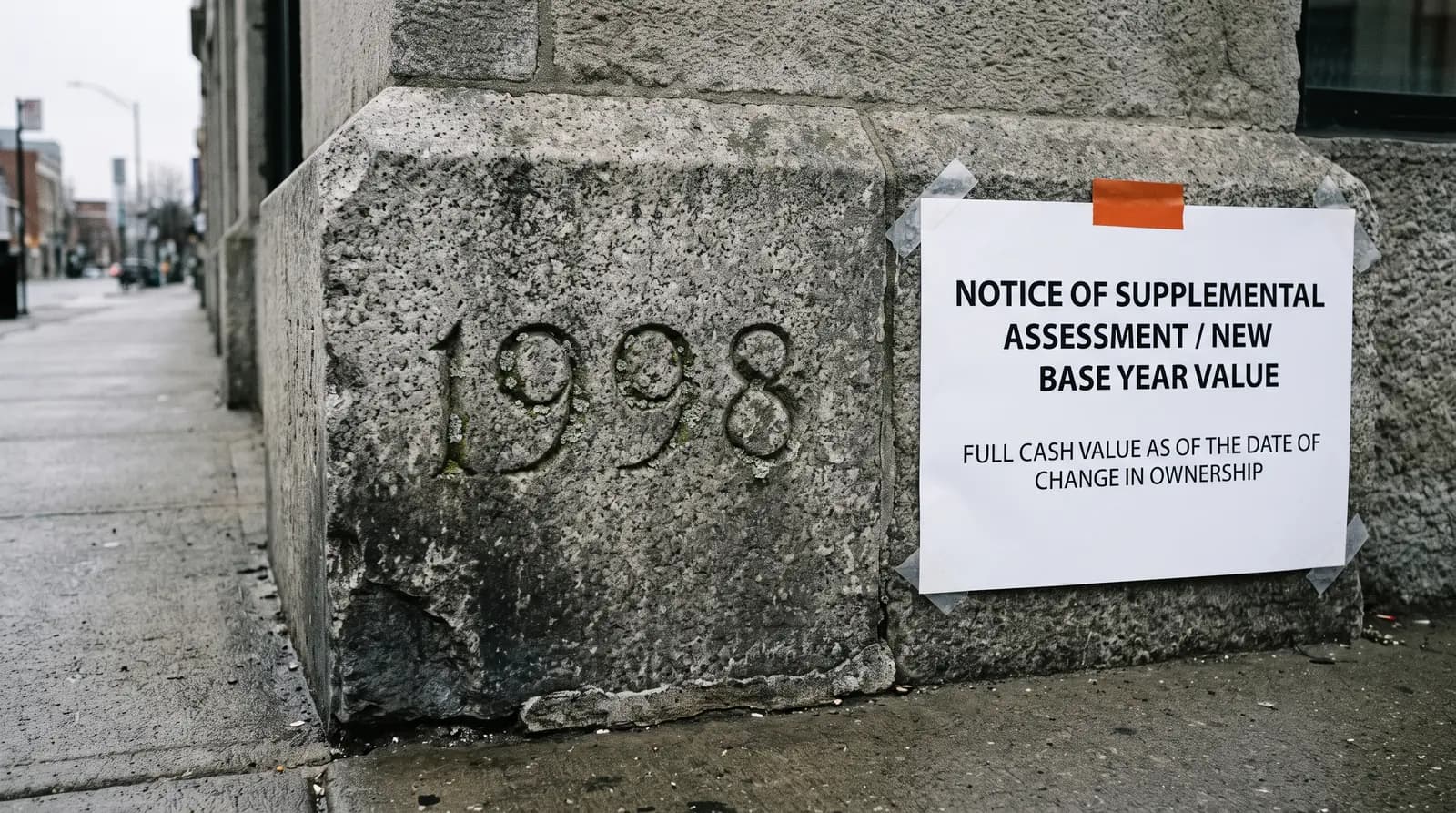
Commercial property tax reassessment in California turns on a single line in a single statute, and the line is 50 percent. Buy the building and the assessed value resets to what the building is worth now. Buy the company that owns the building and it may not reset at all, unless one buyer ends up holding more than half.
That matters before the offer, not after closing. The tax figure printed on an offering memorandum is the seller's tax bill, and on a property held since the 1990s the buyer's bill can be several times larger. Nothing about the building changes. The assessment does.
What follows is the machinery, read from the statutes themselves, including the part that almost nobody mentions when the entity structure gets suggested: skipping one filing removes the limitations period entirely.
What triggers commercial property tax reassessment
The trigger has three parts, and all three have to be present. Revenue and Taxation Code section 60, added in 1979 to implement Proposition 13, is one sentence:
A "change in ownership" means a transfer of a present interest in real property, including the beneficial use thereof, the value of which is substantially equal to the value of the fee interest.
A present interest, the beneficial use, and value substantially equal to the fee. Miss any one and there is no change in ownership, which is why leases of certain lengths, security interests and a number of other transfers sit outside it.
When the trigger is met, section 75.10(a) tells the assessor what to do: appraise the property "at its full cash value ... on the date the change in ownership occurs." Not the date it is discovered. The date it happened.
Buy the building and it resets. Buy the company and it may not.
Section 64(a) is the provision the whole structuring conversation rests on:
the purchase or transfer of ownership interests in legal entities, such as corporate stock or partnership or limited liability company interests, shall not be deemed to constitute a transfer of the real property of the legal entity
Read alone, that is an open door. The building does not move, so the building is not reassessed. But the subsection opens with an exception for subdivisions (c) and (d) of the same section, and those two subdivisions are where the post actually lives.
Section 64(c)(1) reassesses the property when any person or entity:
obtains control through direct or indirect ownership or control of more than 50 percent of the voting stock of any corporation, or obtains a majority ownership interest in any partnership, limited liability company, or other legal entity
So the arithmetic is unforgiving and simple. Two unrelated buyers taking an LLC 50/50 trigger nothing, because neither crosses the line. One buyer taking 51 percent triggers a reassessment of the entire property, not 51 percent of it.
The slice that crosses the line
Here is the detail that catches people who think they have counted correctly. Section 64(c)(1) reaches:
including any purchase or transfer of 50 percent or less of the ownership interest through which control or a majority ownership interest is obtained
The size of the purchase is irrelevant. What matters is where it lands you. A member already holding 49 percent who buys another 2 percent has bought a 2 percent interest and triggered a full reassessment of the property, because that 2 percent is the slice through which control was obtained.
Section 64(c)(2) then carves out one move in the other direction. Since 1 January 1996, a majority partner who buys the remaining interests and becomes sole partner has not caused a change in ownership. That exclusion carries its own warning, which is examined below: it applies "subject to the appropriate application of the step-transaction doctrine."
The ledger that has been running since 1975
Section 64(d) is the one that surprises people, because it does not care when the transfers happen or whether they happen together.
When owners contribute property into an entity and keep the same proportional interests, section 62(a)(2) excludes that from change in ownership, provided the "proportional ownership interests of the transferors and transferees ... in each and every piece of real property transferred, remain the same after the transfer." That is the ordinary, sensible move of putting a building you already own into an LLC.
Section 64(d) attaches a permanent consequence to it. Anyone holding an interest immediately after such a transfer, made on or after 1 March 1975, becomes an "original coowner." And then:
Whenever shares or other ownership interests representing cumulatively more than 50 percent of the total interests in the entity are transferred by any of the original coowners in one or more transactions, a change in ownership of that real property owned by the legal entity shall have occurred
Cumulatively. In one or more transactions. By any of the original coowners. There is no time limit in the sentence, and the clock started in 1975. A family that put a building into an LLC in 1988 and has been selling small pieces to cousins and buyers ever since is running a ledger, and the transfer that pushes the running total past half reassesses the building. The statute even fixes the reappraisal date as the date of that transfer.
A buyer taking a minority interest can therefore be the event, without owning anything close to control, and without necessarily knowing the entity's history. That is a diligence problem rather than a title problem, because none of it appears in the recorded chain.
No deed is recorded, and they find out anyway
The reason the entity route feels invisible is that it genuinely leaves no recorded trace of a real estate transfer. The Board of Equalization says so plainly in describing why its Legal Entity Ownership Program exists: transfers of ownership interests in legal entities "do not involve a recorded deed or other notice."
So the state built three other routes to the same information.
The tax return asks you directly. Section 64(e) requires the Franchise Tax Board to put a question on returns for partnerships, banks and corporations asking whether the entity owns California real property and whether more than 50 percent has been transferred or acquired. If the answer is yes, the FTB "shall furnish the names and addresses of that entity and of the stock or partnership or limited liability company ownership interest transferees to the State Board of Equalization."
The entity has an affirmative duty to report. Section 480.2(a) requires a signed change in ownership statement to be filed "with the board at its office in Sacramento within 90 days from the date of the change in ownership." The form is BOE-100-B.
The Board can simply ask. And that is where the arithmetic turns against anyone who decided the filing was optional.
Skip the filing and the limitations period disappears
Two sections combine here, and the second is the one worth the whole article.
Section 482(b) adds a penalty of 10 percent of the taxes on the new base year value where a change occurred. Then it adds this:
or 10 percent of the current year's taxes on that property if no change in control or change in ownership occurred
The 90 day clock runs from the earlier of the event or "the date of a written request by the State Board of Equalization." So once the Board writes and asks, failing to answer costs 10 percent even if the honest answer is that nothing happened.
Section 532 normally limits how far back an assessor can reach with an escape assessment. Subsection (b)(3), as amended effective 1 January 2020, removes that limit in one specific circumstance:
in the case where property has escaped taxation, in whole or in part, or has been underassessed, following a change in ownership or change in control and either the penalty provided for in Section 503 must be added or a change in ownership statement, as required by Section 480.1 or 480.2 was not filed with respect to the event giving rise to the escape assessment or underassessment, an escape assessment shall be made for each year in which the property escaped taxation or was underassessed
For each year. Not for the last four. The entity structure that looked like a clean way to hold an old assessed value becomes, if the filing is skipped, an open-ended liability that grows with every year it goes unnoticed, and it is discoverable at any point by a question on a tax return.
That is the honest shape of this: the workaround is real and it is written into the statute. The reporting duty attached to it is also real, and it is the part that gets left out of the conversation.
What happens if you try to engineer around it
The Board of Equalization has told county assessors, in writing, that structures built to manufacture or avoid a change in ownership can be collapsed.
Letter to Assessors No. 2009/041, dated 14 September 2009 and titled "Application of the Step Transaction Doctrine," addresses owners who transferred property to a second party and then took it back, often the same day, in order to reset a base year value downward in a falling market. The letter asks whether the doctrine can apply to those transactions and answers in four words: "The answer is yes."
It then sets out the general principle, that "whether a transaction is a change in ownership depends upon the substance of a transaction rather than its form," and takes three alternative tests from Shuwa Investments Corp. v. County of Los Angeles, 1 Cal. App. 4th 1635 (Ct. App. 1991): the end result test, the interdependence test, and the binding commitment test. Satisfying one can be enough.
Two more decisions are worth knowing. McMillin-BCED/Miramar Ranch North v. County of San Diego, 31 Cal. App. 4th 545 (Ct. App. 1995), is cited by the Board for the proposition that a genuine business purpose does not by itself defeat step transaction treatment. And Zapara v. County of Orange, 26 Cal. App. 4th 464 (Ct. App. 1994), applied the doctrine, looking to the substance of what was done rather than the sequence of instruments used to do it.
This is the context for section 64(c)(2)'s safe harbour. A majority partner buying out the minority is not a change in ownership, but the statute conditions that on the step transaction doctrine by name. A sequence assembled to land inside the exclusion is exactly what the doctrine exists to look through.
The entity deal does not dodge the transfer tax either
There is a second assumption bundled into the entity route, which is that if no deed is recorded there is no documentary transfer tax. The California Supreme Court closed that in 926 N. Ardmore Ave., LLC v. County of Los Angeles, 3 Cal. 5th 319, 219 Cal. Rptr. 3d 695, 396 P.3d 1036, decided 29 June 2017.
The court held that:
the critical factor in determining whether the documentary transfer tax may be imposed is whether there was a sale that resulted in a transfer of beneficial ownership of real property
Not whether a deed to the real estate was recorded. Whether beneficial ownership moved. Where a transfer of entity interests produces a change in ownership under section 64, the transfer tax can follow it, subject to the local ordinance imposing the tax. The Court of Appeal applied the same reasoning in 731 Market Street Owner, LLC v. City and County of San Francisco in 2020.
So the entity structure does not make a transaction invisible to either the assessor or the recorder's revenue.
What Proposition 19 did, and what it did not
Proposition 19 did not amend section 64. The control rules, the original coowner rules and the reporting duties are all unchanged by it.
It did take something away from commercial owners, which is worth knowing because the measure is usually described as being about homeowners. Article XIII A, section 2.1 of the California Constitution now limits the parent to child and grandparent to grandchild exclusion to a "family home" and a "family farm," a family home carrying the same meaning as a principal residence. The old exclusion for other real property, which reached ordinary commercial and investment property, is gone. These provisions are operative for transfers on and after 16 February 2021.
An intergenerational transfer of an office building, a retail strip or a rental portfolio is therefore a reassessment event today where before it may not have been. That is the opposite of the direction most people assume Proposition 19 ran.
California is not alone, it is just the most consequential
This is worth saying because it is easy to assume Proposition 13 makes California unique, and the assumption is wrong.
Michigan caps taxable value during ownership and uncaps it on transfer. MCL 211.27a(3) resets the taxable value to state equalized valuation in the year following a transfer, and subsection (6)(h) treats "a conveyance of an ownership interest in a corporation, partnership, sole proprietorship, limited liability company, limited liability partnership, or other legal entity if the ownership interest conveyed is more than 50%" as a transfer of ownership.
Florida does the same thing with different plumbing. Section 193.1554(5) defines a change of ownership or control to include "the cumulative transfer of control or of more than 50 percent of the ownership of the legal entity that owned the property when it was most recently assessed at just value."
Three states, three statutes, and all three land on the same number. What makes California distinctive is not the concept but the size of the gap, because a base year value can sit for decades while market value runs away from it.
What this does to a pro forma
The practical consequence is short.
The tax line on the offering memorandum is the seller's number. It reflects a base year value set whenever the seller acquired the property. If that was 1998, it is not a forecast of anything. Underwriting to it overstates net operating income by whatever the reassessment will cost, every year, permanently.
The structure decides the answer, not the economics. The same building, the same money, the same people can produce a reassessment or not depending on who ends up holding what. That is a question to raise early, not at signing, and it belongs with the buyer's tax counsel rather than with the broker.
Ask what is already on the entity's ledger. If the property went into the entity under section 62(a)(2), the original coowner count matters and it is not in the public record. A buyer taking a minority slice needs to know how much of that 50 percent has already been used.
Treat the 90 day filing as part of closing. It is the cheapest item in this entire article and the only one whose absence removes the limitations period.
Getting this wrong is expensive in the same quiet way that the environmental report and the commission agreement are: the document nobody read closely at the start decides the outcome years later. The same discipline that keeps an offering memorandum honest applies to the tax line printed on it.
Every statute quoted here was read from leginfo.legislature.ca.gov on 14 September 2026, the Board of Equalization materials from boe.ca.gov, and the cases from the courts' own text. This is general information about how the rules work, not tax or legal advice, and the structuring questions in it genuinely need a California tax professional on the specific facts.