A commercial real estate broker lien is the right to record a claim against a property when an owner refuses to pay an earned commission, and most states have some version of it. Two things about it tend to surprise the brokers who need it.
The first is that in several states it does not attach to the property at all. The second is that by the time the argument starts, the lien is usually already gone, because the statutes condition it on a sentence that had to be sitting in the listing agreement months before anyone stopped paying.
This is the part worth knowing before you sign the next agreement rather than after. Commercial runs on different rails from residential here as everywhere else, and the rules were written separately.
What a commercial real estate broker lien actually attaches to
Two different answers, and the difference decides whether you can stop a closing.
Texas attaches it to the real estate. Section 62.021(a) gives the broker "a lien on a seller's or lessor's commercial real estate interest in the amount specified by the commission agreement," and section 62.026(e) is the teeth: once the escrow agent receives the notice, "the escrow agent and other parties to the sale or lease may not close the transaction unless the lien is released," the buyer takes subject to it, the funds go into escrow, or a bond is filed. Illinois is the same shape: the lien "shall attach to the commercial real estate, or any interest in the commercial real estate." So is North Carolina, whose broker gets "a lien upon commercial real estate in the amount that the broker is due."
Washington does the opposite, and says so in its first sentence:
The lien created under this chapter is a lien upon personal property, not upon real property.
What it reaches instead is the money: "a lien upon the owner's net proceeds from the disposition of commercial real estate and a lien upon the net rental proceeds from the lease of commercial real estate." That is not nothing. Subsection (8) requires the escrow closing agent to pay the claimant out of the owner's net proceeds up to the amount claimed. But it never clouds title, so it cannot stop a sale, and a buyer taking the property is untouched by it.
One remedy, one name, two completely different amounts of leverage.
Florida passed both versions on the same day
The cleanest illustration is a single state. Florida's two acts were created by the same session law, chapter 2005-275, and they do not match.
The sales act, section 475.703(1):
The lien upon the owner's net proceeds pursuant to this part for a broker's commission is a lien upon personal property, attaches to the owner's net proceeds only, and does not attach to any interest in real property.
The leasing act, section 475.803(1):
A broker has a lien upon the owner's interest in commercial real estate for any commission earned by the broker pursuant to a brokerage agreement with respect to a lease of the commercial real estate.
Same state, same legislature, same day. Sell the building and your lien can never touch it. Lease the building and it can. The leasing act then splits again by who owes the money: if the landlord owes, the lien "attaches to the landlord's interest in the commercial real estate identified in the brokerage agreement but not to the tenant's leasehold estate," and if the tenant owes, it attaches to the leasehold and not to the landlord's interest.
Arizona gives you nothing on a sale
Arizona's statute looks like a general commercial broker lien until you read what it covers. Section 33-1071(A) creates a lien for the compensation owed "for the broker's services in the lease or rental of the real property," and subsection (A)(2) requires the broker to have produced someone "ready, willing and able to lease or rent" it.
There is no sale in that sentence. An Arizona broker who sells a commercial building and does not get paid has a contract claim and no lien at all.
The clause you needed in the listing agreement a year ago
This is the one that quietly disqualifies the most brokers, and it has nothing to do with the merits of the dispute.
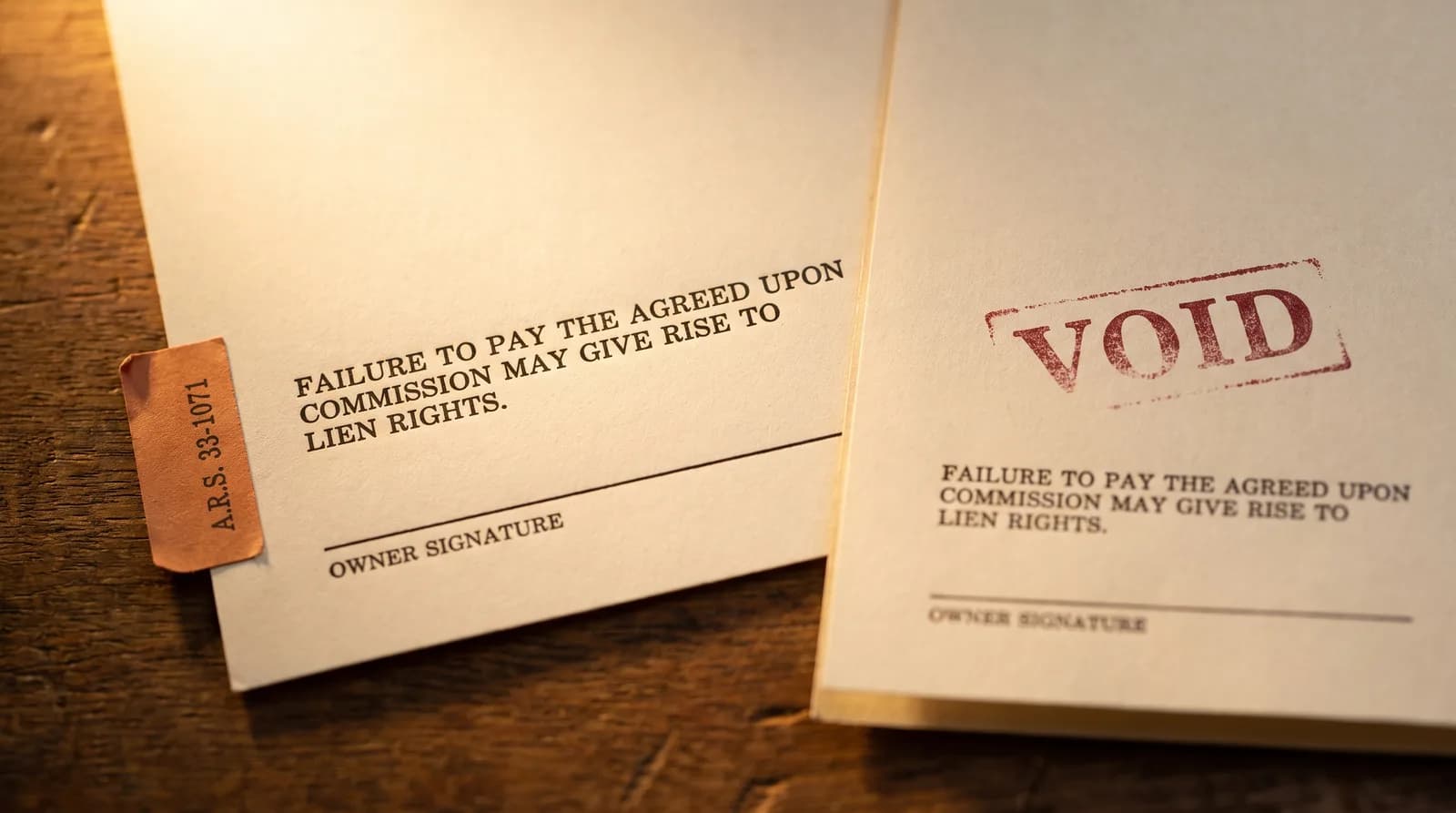
Arizona requires the commission agreement to disclose the lien right, and it specifies the typography:
that agreement discloses in the same size type as the majority of the remainder of the agreement above the portion of the agreement calling for the signature of the owner of the real property that the failure to pay the agreed upon commission or compensation may give rise to lien rights as provided by this article
So a disclosure in small print, or below the signature line, fails. Texas section 62.021(e) requires that "the broker's right to claim a lien based on the commission agreement must be disclosed in the commission agreement." Florida is the most explicit about the consequence: under section 475.703(5), "a broker may not enforce a lien under this part for a commission earned under a brokerage agreement for which the disclosure required by this subsection was not made," and the statute prints the exact language that will do the job.
None of this is curable later. The lien either was written into the agreement the owner signed, or it never existed.
Whether you can be asked to give it up, and two states that flatly disagree
Having established the lien, can an owner make you sign it away as a condition of the listing? Two states answer in opposite directions.
Delaware, 25 Del. C. section 2614:
An agreement by a broker to waive its right to a broker's lien without having first received full payment is against public policy, void, and unenforceable.
Washington, RCW 60.42.010(9):
An owner of commercial real estate may request that a broker waive the rights to a lien under this chapter, and such a waiver contained in the commission agreement signed by the broker is effective to waive the broker's rights to a lien under this chapter.
One legislature calls the request void as a matter of public policy. The other writes the owner a procedure for making it. Washington does soften the landing: a broker who waived, then sued and won, gets costs, statutory interest and legal costs shifted. But the lien itself is gone for the asking.
Florida sits with Delaware, more narrowly: the lien "cannot be waived before the commission is earned," and cannot be waived by anyone other than the broker regardless of who else can bind the brokerage. Texas section 62.022(a) voids waivers too, then carves out a trap worth reading twice. Under 62.022(b) the lien is automatically waived where the commission is earned on a lease transaction and "the commission agreement is included as a provision of the lease agreement." Putting your commission clause inside the lease, which is exactly where it is convenient to put it, destroys the lien in Texas by operation of the statute.
The deadlines that void it
Short, and in one case close to unusable.
Washington section 60.42.010(4) requires that on a sale the lien "is not effective unless it is recorded at least thirty days prior to the date a deed conveying the commercial real estate is recorded." Read that as a practical instruction and it says: file thirty days before a closing that nobody has told you about. On a lease, ninety days after the tenant takes possession.
Washington adds a second trap in subsection (5): the lien is "null and void" unless the broker delivers a copy of the notice to the owner within ten days of recording it.
Texas gives lease commissions until before the 91st day after the event that makes the commission payable, and section 62.041(d) is blunt about what happens next: "if a notice of lien is not filed within the time required by this section, the lien is void." Section 62.026(f) voids it again for a broker who files on time but misses the notice requirements. Foreclosure must follow within two years, or within thirty days if the owner serves a written demand to sue.
It belongs to the brokerage, not the person who did the work
Every statute we read says this, and it is the answer to a question agents ask constantly.
Texas section 62.021(d): the lien "is not available to an employee or independent contractor of the broker." Florida section 475.703(4)(a): it "belongs to the broker named in the brokerage agreement and not to an employee or independent contractor of the broker." Illinois section 15/10(a): "available to the broker named in the instrument signed by the owner, buyer, or tenant and not to an employee or independent contractor of the broker." Michigan casts the widest net, excluding "an employee, agent, subagent, or independent contractor of a licensed real estate broker."
Delaware handles it in the definitions instead, and the result is the same: "'Broker' does not include any associate broker, real estate salesperson, or appraiser."
If you sourced the deal, worked it, and were not paid your split, the lien is not a remedy available to you. It belongs to the entity named on the agreement.
Which side of the deal you are on changes the answer
Texas section 62.021 gives a lien to the broker on the seller or lessor side, to the broker on the buyer side, and to the broker on the tenant side, each against the corresponding interest. A Texas tenant rep who is stiffed can attach the leasehold.
Florida's sales act says the opposite. Section 475.719 provides that a written contract between a buyer and a buyer's broker for the buyer's payment for licensed services on a commercial purchase "is not a brokerage agreement with the owner under this part," and the buyer's broker gets no lien under it.
New York, as it turns out, agrees with Florida, and a court had to say so.
New York does not have one of these statutes at all
New York never passed a commercial broker lien act. It amended the mechanics lien law instead, folding brokerage into the definition of an "improvement" to real property. Lien Law section 2(4) covers:
the performance of real estate brokerage services in obtaining a lessee for a term of more than three years of all or any part of real property to be used for other than residential purposes pursuant to a written contract of brokerage employment or compensation
Every word there is a condition. Not a sale, a lease. Not any lease, one longer than three years. Not residential. In writing. And section 10 adds that the notice "may be filed only after the performance of the brokerage services and execution of lease by both lessor and lessee and only if a copy of the alleged written agreement of employment or compensation is annexed to the notice of lien."
In Robert Plan Corp. v. Greiner-Maltz Co., 229 A.D.2d 122, 655 N.Y.S.2d 648, decided by the Second Department on 31 March 1997, a tenant hired a broker to find space, the tenant signed a lease, and the broker recorded a mechanics lien against the landlord's building. The court read one word and ended it. The legislature's "use of the word 'lessee' reflects its intention to restrict application of the provision to brokerage" contracts with the owner side, and had it meant otherwise "it would have used the word 'lease' rather than 'lessee'." The result: "Greiner-Maltz does not have a valid lien."
The broker had performed. The client was real, the lease was signed, the work was done. The statute protected a broker engaged to find a tenant, not a tenant's broker engaged to find space, and that was the whole case.
What happens in a state with no statute
Here the answer stops being about liens and starts being about exposure.
No California commercial broker lien statute surfaced in the statutes, agency materials, cases and secondary sources we could reach. We are not asserting that none exists, because we could not find an authority that affirmatively says so, and on legal-adjacent material that distinction matters. What we can report is that California's courts have twice closed the obvious workaround.
In Deane v. Superior Court, 164 Cal. App. 3d 292, decided 30 January 1985, a commission claimant pleaded a constructive trust and recorded a lis pendens. The Court of Appeal expunged it, with a sentence that has been quoted ever since: "A lis pendens is not a shortcut method of attachment for unsecured creditors." An unpaid commission is a debt, and a debt is not a claim to real property.
The second case is the one that turns this from a losing tactic into a liability. It is also where research nearly led us wrong: Earp v. Nobmann (1981) held that recording a lis pendens is absolutely privileged and cannot support damages, and that proposition is no longer good law. In Palmer v. Zaklama, 109 Cal. App. 4th 1367, decided 23 June 2003, the Fifth District explained that the 1992 amendment to Civil Code section 47 partially abrogated it:
if the pleading filed by the claimant in the underlying action does not allege a real property claim, or the alleged claim lacks evidentiary merit, the lis pendens, in addition to being subject to expungement, is not privileged
And then: "It follows the lis pendens in that situation may be the basis for an action for slander of title." The court did hold that recordation alone, "even if done for an improper purpose, is not a valid basis for a cause of action for abuse of process," so the exposure is slander of title rather than abuse of process. That is cold comfort for a broker who recorded one to apply pressure.
Put Deane and Palmer together and a California broker who records a lis pendens over an unpaid commission will lose it and can be sued for having recorded it.
The states that do have statutes are not risk-free either. Delaware section 2611 provides that where "a court or arbitrator determines that no lien should have been filed under this chapter," it "shall order the broker to pay the prevailing defendant's expenses of all proceedings under this chapter, including reasonable attorneys' fees actually incurred, and costs."
Nobody can tell you how many states have this
We tried to print a number and could not stand one up.
The counts in circulation disagree, and the sources that would settle it are closed. NAR maintains a state-by-state broker lien tracker behind a member login. A published figure of 34 jurisdictions circulated in 2015, and a figure of 36 has been attributed to NAR in 2023, but neither the higher number nor the list behind it appeared on any page we were able to retrieve, and we are not going to print a statistic we could not open.
That is worth saying out loud rather than papering over, because the counts cannot be reconciled anyway without a definition. Does a proceeds-only statute like Washington's count? Does New York, which has no broker lien act but reaches some brokers through the mechanics lien law? Does Arizona, which covers leases and not sales? Depending on the answers, the same map yields different totals.
It also tells you something about the remedy. This is a right brokers are widely told they have, sold in continuing education and summarized in listing agreement addenda, and there is no accessible public inventory of where it exists or what it covers.
What to do about it
The pattern across nine states is consistent enough to act on.
Fix the listing agreement, not the dispute. The lien is conditioned on language the owner signs at the start. Arizona dictates the type size and its position relative to the signature. Texas requires it in the commission agreement. Florida prints the sentence for you. This is the single highest-value change available, and it costs nothing.
Find out what your state's lien attaches to before you rely on it. If it reaches only proceeds, it is a claim on a closing, not leverage over an owner who can simply not close.
Keep the commission clause out of the lease in Texas. It waives the lien automatically.
Diarise the deadline the day the commission is earned. Thirty days before a deed you have not been told about is not a deadline you meet by reacting.
In a state with no statute, do not improvise. Recording something to create pressure is how a collection problem becomes a slander of title claim.
And if the deal itself is the thing at risk, the paperwork that precedes it deserves the same scrutiny: who owns the photographs on the listing, and what the environmental report does and does not buy, fail the same way. The document you did not read closely at the start is the one that decides the outcome at the end.
One bill to watch
New York Assembly bill A10348, sponsored by Assemblymember Wieder, would change the installment filing window in Lien Law section 10 from eight months to eighteen months after the final payment is due, leaving the five-year outer limit intact. As of 13 September 2026 it sits in the Assembly judiciary committee with no recorded action beyond its referral. It has not passed. If it moves, the New York timing above changes; nothing else in this post does.
Every statute quoted here was read from the state's own site on 13 September 2026, and every case from the court's own text or the official reporter. State law changes. Confirm the current text before acting on any of it, and this is general information rather than legal advice.