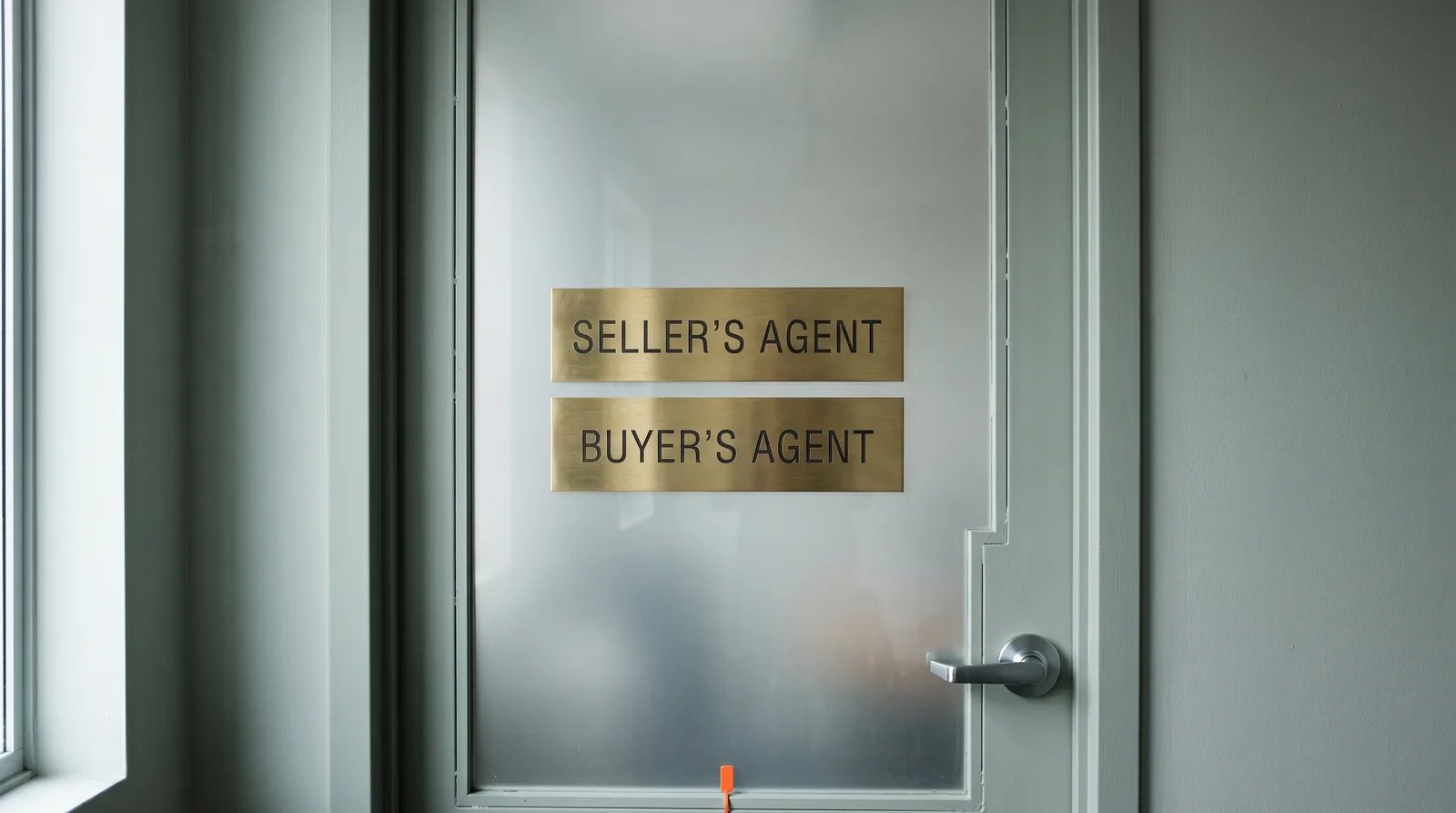
California's commercial real estate agency disclosure duty is real, it is statutory, and it has applied to commercial transactions since 1 January 2015. If you are a commercial broker in this state who has never handed a client the agency disclosure form, the gap is eleven years wide.
What makes this worth writing down is not that the rule is obscure. It is that the rule is invisible from the only document most brokers ever see. The legislature extended the duty by editing a definitions section and a heading, and left the form itself untouched. So the page you hand across the table still reads as though it were built for a house, because it was, and nothing on it tells you otherwise.
Commercial runs on separate rails from residential almost everywhere. This is the one place it quietly does not.
The word the legislature deleted in 2014
Senate Bill 1171 was chaptered on 15 August 2014 as Stats. 2014, ch. 200, and took effect the following January. Its full title is short: an act to amend Section 2079.13 of, and to amend the heading of Article 2 of Chapter 3 of Title 6 of Part 4 of Division 3 of, the Civil Code.
Two things. A definitions section, and a heading.
The Legislative Counsel's Digest states the effect without hedging:
Existing law requires listing and selling agents, as defined, to provide the seller and buyer in a residential real property transaction, including a leasehold interest, with a disclosure form, as prescribed, containing general information on real estate agency relationships. [...] This bill would extend these disclosure requirements to include transactions involving commercial real property, as defined, including a leasehold interest.
The heading amendment is the part that tells the story. Article 2 is now called "Duty to Prospective Purchaser of Real Property." Before 2015 it was called "Duty to Prospective Purchaser of Residential Property."
You can watch the change happen in the case reporters. California courts quoting that heading before 2015 quote it with the word in place, in Robinson v. Grossman (1997) 57 Cal.App.4th 634 and in Coldwell Banker Residential Brokerage Co. v. Superior Court (2004) 117 Cal.App.4th 158. Search the published California opinions for the current heading and you get nothing at all. One word came out, and the scope of an entire article changed with it.
Why the commercial real estate agency disclosure form never says so
Here is the mechanical reason this stays hidden.
Civil Code section 2079.16 does not describe a form. It prints one. The statute sets out the words that must appear on the front of the page, headed "DISCLOSURE REGARDING REAL ESTATE AGENCY RELATIONSHIP," and then requires sections 2079.13 to 2079.24 to be printed on the back.
SB 1171 did not touch section 2079.16. It did not touch section 2079.14, which sets the delivery timing, and it did not touch section 2079.17, which requires the relationship to be confirmed. It changed the definitions those sections run on and stopped.
So the prescribed text still speaks in Seller and Buyer throughout, still talks about "facts known to the agent materially affecting the value or desirability of the property," and still carries the line about how a real estate agent is a person qualified to advise about real estate. Nothing on the front of the page says commercial. The definition that makes it apply to your office building is on the back, in section 2079.13, in a block of statutory text that exists to be printed and not to be read.
A broker who learned this job on the form has no route to the rule.
A lease longer than a year is a sale
This is the provision most likely to catch a leasing broker, and it is one sentence.
Section 2079.13(m) says that "sell," "sale," or "sold" refers to a transaction for the transfer of real property from the seller to the buyer, and includes exchanges, real property sales contracts within the meaning of section 2985, and "transactions for the creation of a leasehold exceeding one year's duration."
A five year lease on an industrial suite is a sale for the purposes of this article. The tenant is a buyer, because section 2079.13(b) says buyer includes a lessee, and the landlord is a seller, because 2079.13(n) says seller includes a lessor.
A lease of a year or less falls outside that definition. Almost no commercial lease worth a broker's time is a year or less.
Two duties, and people tend to satisfy one
Section 2079.14 and section 2079.17 are frequently treated as the same obligation. They are not, and the statute says so out loud.
Section 2079.14 is delivery of the form, at two fixed moments:
- The seller's agent provides it to the seller before entering into the listing agreement.
- The buyer's agent provides it to the buyer as soon as practicable before execution of a buyer-broker representation agreement and execution of the buyer's offer to purchase. If the buyer's agent did not prepare the offer, delivery is due no later than the next business day after receiving it.
The agent must then obtain a signed acknowledgment of receipt.
Section 2079.17 is something else: an actual statement of who represents whom in this deal, confirmed in the purchase contract or in a separate writing, in a prescribed block naming each brokerage firm and licence number. Subdivision (d) closes the gap directly. The disclosures and confirmation required by that section "shall be in addition to the disclosure required by Section 2079.14."
The practical consequence is that an agency confirmation paragraph inside a purchase agreement, which most commercial contracts have, proves nothing about the form. And a signed form proves nothing about the confirmation. If a file only contains one of them, it only satisfies one of them.
What a court did with this two weeks ago
On 4 September 2026 the Third Appellate District published Urban Sunrise LLC v. Vogt, case number C103199, out of El Dorado County. Searching the published opinions for citations to section 2079.14 filed since 2015 returns three cases, and this is the newest of them. Three in eleven years, on a duty that governs every brokered sale in the state.
The facts are commercial from end to end. A broker trading as Tahoe Investment Properties and an agent acted as dual agents for the buyer and the sellers across five commercial properties in South Lake Tahoe. The buyer, an LLC whose managing member was an experienced investor working with a team that included an attorney, could not obtain loans because of the cost of fire insurance. The purchases collapsed. The buyer had already released $1,184,000 to the sellers on a nonrefundable basis, and lost the benefit of a 1031 exchange on top of it. It sued the brokers for breach of fiduciary duty, professional negligence, constructive fraud and rescission.
The brokers won summary judgment. The broker then won summary judgment on his own cross-complaint for the commission. The Court of Appeal affirmed all of it, with costs.
Here is how the court described the statutory layer:
Statutorily, a dual agent must provide the buyer and seller with the disclosure form set forth in Civil Code section 2079.16 at the times specified in Civil Code section 2079.14. [...] It is undisputed that defendants provided and plaintiffs signed the dual agency disclosure form in section 2079.16 of the Civil Code.
Two things are worth noticing, and the second is the useful one.
The first is that the word "residential" does not appear anywhere in the opinion's twenty-eight pages, while "commercial" appears four times. The court never cites section 2079.13, never pauses over whether a residential-looking form governs a commercial deal, and never treats it as a question. That is a stronger signal than an opinion arguing the point would be. It reads as settled.
The second is what compliance bought. Because delivery was undisputed, the statutory question was closed on page one of the analysis and the case moved to common law dual agency duties, where the brokers won. The broker who handed over a form that looks like it belongs to a house sale kept his commission after a $1.18 million loss.
A note on timing, because this matters more than usual. Urban Sunrise was filed on 4 September 2026 and, as at 17 September 2026, is not yet final. A California Court of Appeal opinion ordinarily becomes final in that court thirty days after filing, and a petition for review to the Supreme Court may follow within ten days of that. Until those windows close the opinion can be modified, reheard, depublished, or taken up. Everything above it in this article rests on the statute and stands whatever happens to this case. Check the docket before relying on the case itself.
What happens if you skip it
Less than you might assume, and the honest answer is that nobody really knows.
Section 2079.14 states no penalty on its face. It says what to deliver and when, and it requires a signed acknowledgment. It does not say the contract is void, it does not say the commission is forfeited, and it does not create a cause of action.
The nearest thing to an answer is Brown v. FSR Brokerage, Inc. (1998) 62 Cal.App.4th 766, which is now twenty-eight years old. Brown reversed a summary judgment for the brokers where a dual agency disclosure had arguably arrived buried in escrow papers, after the broker had already influenced the seller's price. Three things came out of it. The seller did not have to rescind the sale before suing for damages. Breach of the underlying fiduciary duties may result in loss of the right to compensation, which makes commission forfeiture possible rather than automatic. And the court expressly declined to decide whether nondisclosure on its own, without proof of a monetary loss, entitles anyone to damages.
That last point has never been resolved. Twenty-eight years on, the question of what a bare delivery failure is worth remains open.
We could not locate a published California disciplinary decision resting specifically on section 2079.14 or section 2079.17, and we are saying that as a limit on what we found rather than as a finding that none exists. What can be said with confidence is the shape of the risk: the exposure here is not a tidy statutory penalty. It is that a missing form becomes one of the facts in a fiduciary duty case you are already losing for other reasons. Urban Sunrise is the mirror image of that, and it is why the form is worth the ninety seconds.
Four states, four different answers
The temptation is to assume a national practice. There is not one. These four states have explicitly decided the question and explicitly disagreed.
California
New York
Florida
Washington
| State | Does the agency disclosure statute reach commercial? |
|---|---|
| California | Yes, expressly. Civil Code 2079.13(c) and (j). A leasehold over one year counts as a sale. |
| New York | No, expressly. Real Property Law 443(2): "This section shall apply only to transactions involving residential real property." |
| Florida | No, expressly. Fla. Stat. 475.278 lists "nonresidential transactions" first among the exclusions, and separately bans dual agency outright. |
| Washington | Yes, but with a carve-out. RCW 18.86.020(3) excuses a commercial buyer's agent from the written services agreement otherwise required. |
New York's section 443 defines residential real property as property improved by a one-to-four family dwelling or a condominium or cooperative apartment, and stops there.
Florida's section 475.278 is the clean inverse of California. Its disclosure requirements "do not apply to: nonresidential transactions," and a Florida licensee "may not operate as a disclosed or nondisclosed dual agent" in any event. California swept commercial in; Florida wrote it out.
Washington's position is the most interesting of the three, because RCW 18.86.020(3) says a services agreement "is not required when a broker performs real estate brokerage services as a buyer's agent solely for commercial real estate," while RCW 18.86.060(1) says limited dual agency needs written consent "set forth in the services agreement." We are not going to tell you how those two fit together, because we have not read enough of the chapter to say.
If you work across state lines, the lesson is only that you cannot carry an answer over a border.
What to actually do about it
None of this is expensive to fix. It is expensive to have not fixed, once.
- Put the form in the listing packet, not the closing packet. For a seller's agent the deadline is before the listing agreement is signed, which is earlier than most people's instinct.
- Treat a lease over a year as a sale. If the term runs past twelve months, the article applies.
- Get the acknowledgment signed, and keep the whole document. Not a signature page. Section 2079.15 covers what to do if someone refuses to sign, and it requires you to prepare a signed and dated declaration of the refusal.
- Confirm the relationship separately. Section 2079.17 is its own duty and its own writing.
- Keep proof of when. Both deadlines are timing deadlines, so a dated email or an e-signature audit trail is the evidence, not the form itself.
If your firm publishes a commercial listing or an offering memorandum before any of this is in place, the marketing is running ahead of the file. That ordering is the same mistake we described in the piece on property microsites, where the page went public before the rule governing it had been checked.
Everything in this article was read from the statutes and the opinions themselves, and every source is linked above so you can check it. Rules as at 17 September 2026.
If you want the same treatment applied to your own site, our free website teardown is where to start.