To update your commercial real estate website in a way anyone notices, change what a reader acts on: the listings, the deals you closed, the people, and a dated note on the market. The copyright year in the footer is not an update. Google says so in writing, and one of the sites below proves why: its footer prints the current year by itself.
We wanted to know how current the sites of Sacramento-area commercial brokerages really are. So we took the 21 firms from our audit of their websites that have a working site of their own, read every page their homepages link to, and then looked up each homepage in the Internet Archive, which keeps dated copies of public pages, to see when its words last changed. As of 2026-10-23:
Commercial brokerages with a working website of their own
Footer says 2026
Homepage words the same as an Archive copy from 2024 or earlier
Of those, the same as a copy from 2022 or earlier
Homepage words changed since January 2025
Changed after July 2024, year unknown
Could not tell from the Archive
A dated item a reader can see, apart from the footer and legal pages
Listings pages kept by hand that match a copy from 2024 or earlier
| What we found | Count |
|---|---|
| Commercial brokerages with a working website of their own | 21 |
| Footer says 2026 | 7 |
| Homepage words the same as an Archive copy from 2024 or earlier | 11 |
| Of those, the same as a copy from 2022 or earlier | 7 |
| Homepage words changed since January 2025 | 6 |
| Changed after July 2024, year unknown | 1 |
| Could not tell from the Archive | 3 |
| A dated item a reader can see, apart from the footer and legal pages | 7 |
| Listings pages kept by hand that match a copy from 2024 or earlier | 4 of 6 |
We build websites for commercial brokers, so weigh this accordingly. Everything above is measured, the method is at the end, and no firm is named for a gap.
The footer year is not an update
Seven of the 21 footers say 2026. That sounds current until you look at how one of them gets there. Its footer is a small script that asks the visitor's browser for the year and prints it:
var currentTime = new Date()
var year = currentTime.getFullYear()
document.write(year)
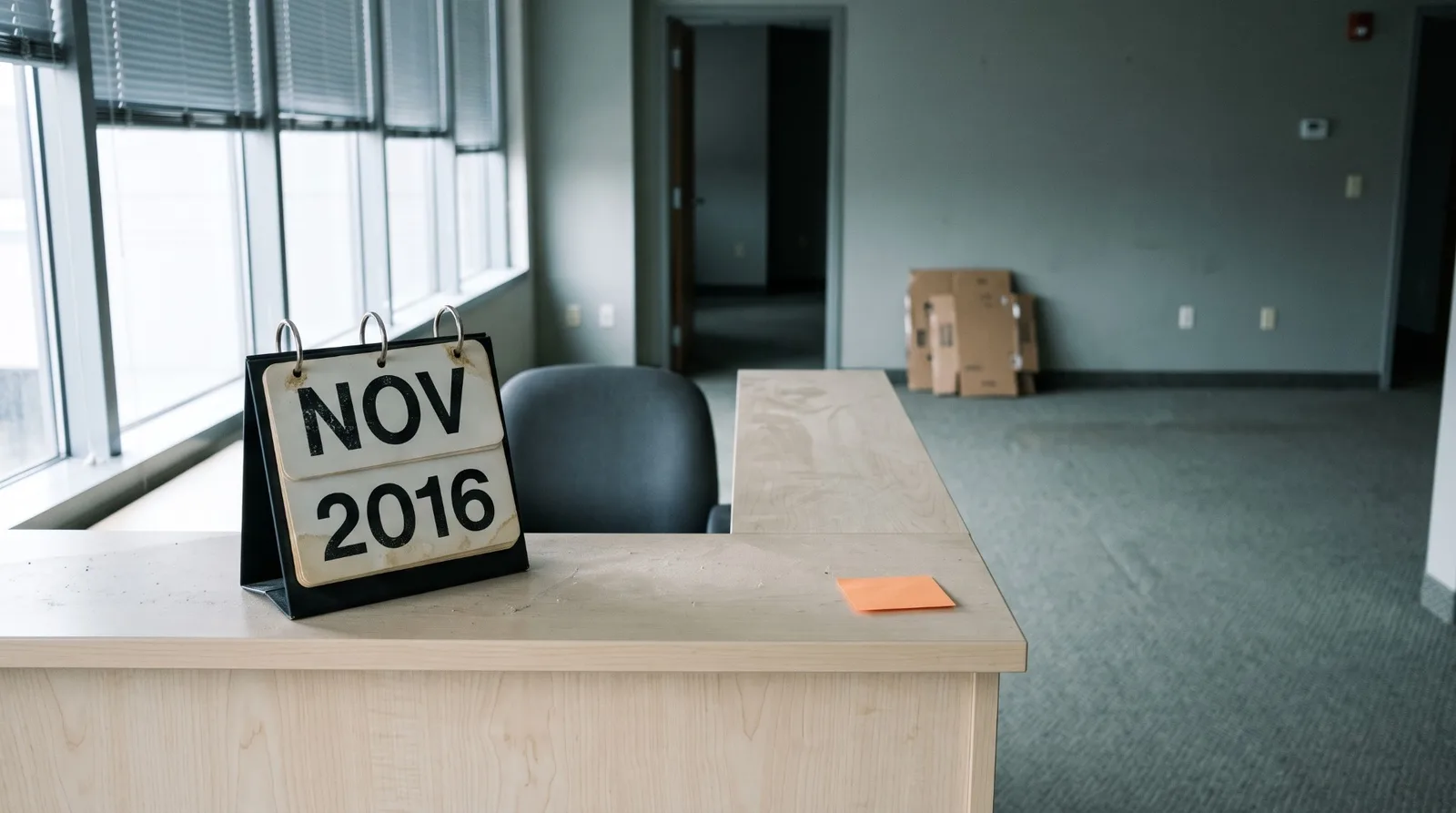
So the footer says 2026 today and will say 2027 on January 1, whatever happens to the site. That firm's newest news item is dated October 18, 2016, and the Internet Archive's copies show its homepage words have been the same since at least November 2016. Plenty of website builders and themes fill in the year the same way on the server, where nobody outside can see it, so a current year in a footer tells you very little.
Google does not count it either. Its sitemap documentation (last updated 2026-07-08) says the last-modified date should reflect "the last significant update to the page," and that "an update to the main content, the structured data, or links on the page is generally considered significant, however an update to the copyright date is not." Its guide to helpful content (last updated 2026-10-05) goes further and lists, as a warning sign, "changing the date of pages to make them seem fresh when the content has not substantially changed."
The other footers are a spread: one says 2025, seven say 2024 or earlier (the oldest 2017), one says 2035, which is the placeholder from a website template, and five show no year at all. Neither end of that spread says much about the site above it.
When the homepage words last changed
The Internet Archive's Wayback Machine has been saving copies of public web pages for decades. Most of these homepages have been saved several times, some dozens, so we compared the words on each homepage today with every earlier copy, working backwards, until we found one that read differently. We counted only words a reader reads. A menu that moved, a cookie notice, a contact form and a new footer link did not count.
2016
2017
2021
2022
2024
Changed since January 2025
Changed after July 2024, year unknown
Could not tell
| Today's homepage words were already there in a copy from | Firms |
|---|---|
| 2016 | 1 |
| 2017 | 2 |
| 2021 | 1 |
| 2022 | 3 |
| 2024 | 4 |
| Changed since January 2025 | 6 |
| Changed after July 2024, year unknown | 1 |
| Could not tell | 3 |
Eleven of 21 homepages say what they said two years ago or more. Seven say what they said in 2022 or earlier. The oldest is the one with the scripted footer: its homepage reads the same as the Archive's copy from November 2016, and the news item at the top of its news page is from the same autumn. Two more have read the same since 2017.
Some of the eleven are not neglected so much as finished. A homepage that says who you are, what you do and where, and says it well, does not need rewriting every year. The trouble is that nothing else on these sites tells a reader the firm is still busy. None of the eleven shows a dated item newer than June 2023 anywhere on the site, and eight show no dated item at all.
Six changed since January 2025. One rewrote its opening lines in May or June 2026. One rebuilt its site between August and December 2025. One changed "serving the Sacramento area for over 25 years" to "over 30 years" sometime after July 2026, which is a small edit and exactly the right kind. Three were rewritten after the Archive's last copy in 2025.
Three we could not read. Two are built on a platform that draws the page with JavaScript, and the Archive's copies of those hold almost no text. The third has no copies at all, which usually means a new site.
The dates a reader can see
A visitor cannot open the Internet Archive. What they can see is a date on the page, and most of these sites give them none.
Seven of the 21 show a dated item anywhere apart from the footer and the legal pages. Two are from 2026: one firm's media page lists videos and podcasts from June 2026, and another's framed reviews feed shows a review from September 24, 2026. The rest are a market post from October 2024, a completed lease marked 6/2023, a broker bio noting a hire in April 2022, a news item from October 2016 and a press release from November 2012. Fourteen show no date at all. That is close to what we found when we read these sites for owners' questions two weeks ago, and the newest market post in the sample is still the one from October 2024.
An undated page is not necessarily stale. It might have changed last week. But a reader cannot tell, and Google says the same thing about itself in its guide to byline dates (last updated 2025-12-10): "Google doesn't depend on a single date factor because all factors can be prone to issues." Its advice is to "add a user-visible date to the page and feature it prominently," labelled "Published" or "Last updated."
Listings are where staleness costs you
A commercial site's listings are the one part a tenant or an investor acts on, so they are where an old page does real harm. Here is what the 21 show today:
A live listings feed (CREXi, Buildout or RealNex)
A page of listings typed in by hand
A listings page with nothing real on it
No listings page
| Listings on the site | Firms |
|---|---|
| A live listings feed (CREXi, Buildout or RealNex) | 5 |
| A page of listings typed in by hand | 6 |
| A listings page with nothing real on it | 2 |
| No listings page | 8 |
The feeds look after themselves. A CREXi, Buildout or RealNex widget shows whatever is on the platform, so when a listing goes under contract or closes there, the website changes with it. None of the five feeds in our sample showed a listing date, but none showed anything obviously out of date either, with one exception: one firm's featured-listing slot shows a single property, and its status reads "Closed."
The pages typed by hand only change when someone changes them. We ran the same Archive check on the six. One changed in 2026 and one had no Archive copies. The other four read the same as copies from 2024, 2022, 2021 and 2016. The 2016 page still lists its properties with "Status: Available" beside a price and a cap rate, exactly as it did in November 2016. We cannot tell from outside whether those buildings are still for sale. Neither can a buyer, and that is the problem. Another of the four has carried one lease listing, the same building at the same rate, since at least June 2021.
Empty pages are worse than none. One firm's listings page says "There are no current listings." Another's still shows the website template's sample boxes: "Project Name" and "This is your Project description." Two more firms with real listings elsewhere on the site have a lease page or a for-sale page that comes up empty, one through a search widget that finds no results and one that says "Sorry No Results Found." A visitor who clicks Listings and finds that learns something, just not what the firm intended.
The industry's own survey points the same way. Buildout's 2026 DNA of CRE survey of brokers and marketers found that "nearly half of listing distribution (45%) is still handled through manual administrative entry." Buildout sells listing software, so it has a reason to say that, but a listing typed in by hand in one place is a listing someone has to remember to change in every other place.
If you are a REALTOR, it is also an ethics question. Standard of Practice 12-8 in NAR's 2026 Code of Ethics says: "REALTORS® shall use reasonable efforts to ensure that information on their websites is current. When it becomes apparent that information on a REALTOR®'s website is no longer current or accurate, REALTORS® shall promptly take corrective action." It binds NAR members, not every licensee, and we do not know which firms in this sample are members. We did not find a California rule on how fast a closed listing must come down.
Why it matters more in 2026
People say it. In a 2026 survey by DreamHost of 1,201 American adults, run in November 2025, "34% of consumers cited outdated or inaccurate information as the top problem" with business websites, "more than any other issue," and 60% said an outdated-looking site hurts their view of a business. DreamHost sells web hosting, and these were consumers, not commercial clients, so treat it as a direction, not a measurement of your market. The same survey found that after an AI tool recommends a business, another 34% "go directly to the business website."
AI assistants lean recent. Ahrefs (July 28, 2025) looked at about 17 million citations and found that "AI assistants prefer citing fresher content": cited pages were on average 1,064 days old, against 1,432 for pages in Google's organic results. The exception was Google's own AI Overviews, which cited pages slightly older than the organic results. Seer Interactive (July 24, 2026) found that "75% of the pages LLMs cite were updated in the last year" across ChatGPT, Gemini and Perplexity. Most of those were older pages someone had updated, not new ones: 72% looked fresh by their last update, against 42% by the date they were first published. SE Ranking (November 24, 2025) found pages updated in the past three months averaged 6.0 ChatGPT citations against 3.6. All three sell SEO or AI-visibility services, all three measured correlation rather than cause, and none looked at real estate. But they agree on direction, and none of them found that an untouched page does better.
Small businesses think they already do it. In a LocalImpact survey of 400 local business owners and managers (September 2025), "Nearly 35% update their websites monthly, and 31% update them weekly." A Clutch survey of 406 small business owners (August 2025) put weekly updates at 61%. Both are self-reported and both firms sell marketing services. Set beside what the Archive shows for the sites above, the gap between what owners say and what the page shows is the whole story.
Our own site
Fair is fair. Our footer year is typed in by hand, which is fine as long as someone changes it in January, and it would tell you nothing either way. Our sitemap gives each page the date it last really changed, not the build date. This blog is dated, and corrected posts carry a dated note. But our posts show readers only the date they were published, while the page tells search engines a separate "updated" date. Google's guidance is that the two should match and be visible, so that is a gap, and we will fix it. And the words on our own commercial real estate page have not changed since early September, which is the kind of thing this post is about.
How to update your commercial real estate website, step by step
- Put your listings on a feed. If you use CREXi, Buildout or RealNex, embed their widget so a status change on the platform changes your site. (Which domain those listing pages live on is a separate question, and we tested it here.) If you keep listings by hand, put a "Last updated" date on the page and change it only when the listings change.
- Move closed deals, do not leave them. A sold or leased page with the month and year of each deal is proof. A closed deal in a "featured" slot is a dead end.
- Remove any page that says there is nothing. No listings this month? Point the menu at your closed deals instead.
- Write one dated note a quarter. What leased or sold nearby, in a few paragraphs, with the date on it. It is the cheapest proof you know the submarket, and almost nobody in this sample does it.
- Check the people. Anyone who left comes off; anyone new goes on.
- Ignore the footer year. It is not an update, to Google or to a reader.
- Look yourself up in the Internet Archive. Paste your homepage into web.archive.org and compare a copy from last year with today. If they read the same, so does your site to everyone else.
What we would build for a commercial brokerage
A site where the parts that change are wired to change: your listings from your listing platform, on your own domain; a closed deals page you add to in a minute; dated notes; a team page that is easy to edit. Then a short monthly check that it still says what is true. We build those for commercial firms, and if you send us your site we will tell you what the Internet Archive says about it. Get in touch.
How we did this, so you can check it
- The sample. The 21 firms with a working website of their own from our website audit: corporations in the California Department of Real Estate's licensee file of 2026-09-23 with a mailing address in Sacramento, Placer, El Dorado or Yolo county and Commercial or CRE in the name. It is a sample of firms that call themselves commercial, so it misses commercial brokerages with other names.
- The live read. On 2026-10-23 we loaded each homepage in Chrome with a normal desktop browser identity, then every same-site page the homepage links to, up to 30 per site, two seconds apart, and read the text, including text inside sliders and tabs. A second pass read the text inside listing and review widgets, which never appears in the page's own text. No forms, no logins, nothing the homepage does not link to.
- The dates. Every calendar date written on those pages was pulled out with its context and read by a person. Copyright lines, privacy policies and terms pages were set aside; what is counted is a dated post, deal, review, event or listing.
- The Internet Archive. For each homepage we read the Archive's public index of saved copies, then compared the visible words of each copy with the next newer one, starting from today's page and working back, with the footer year masked so a new year did not count as an edit. Each edit was read by a person, and a menu moved, a cookie notice, a contact form, a link label or an email address hidden from spam bots did not count as new words. Where a homepage had more than 30 saved copies we compared the newest 30. The same check ran on the six listings pages kept by hand. One firm's sampled address is an inner page with no Archive copies, so its homepage was checked instead.
- Limits. Twenty-one firms, one kind of name, four counties, one day. The Archive saves pages irregularly, so every "since" date is "since at least": a page could have changed and changed back between copies. Nothing here is a rate for commercial brokers in general.