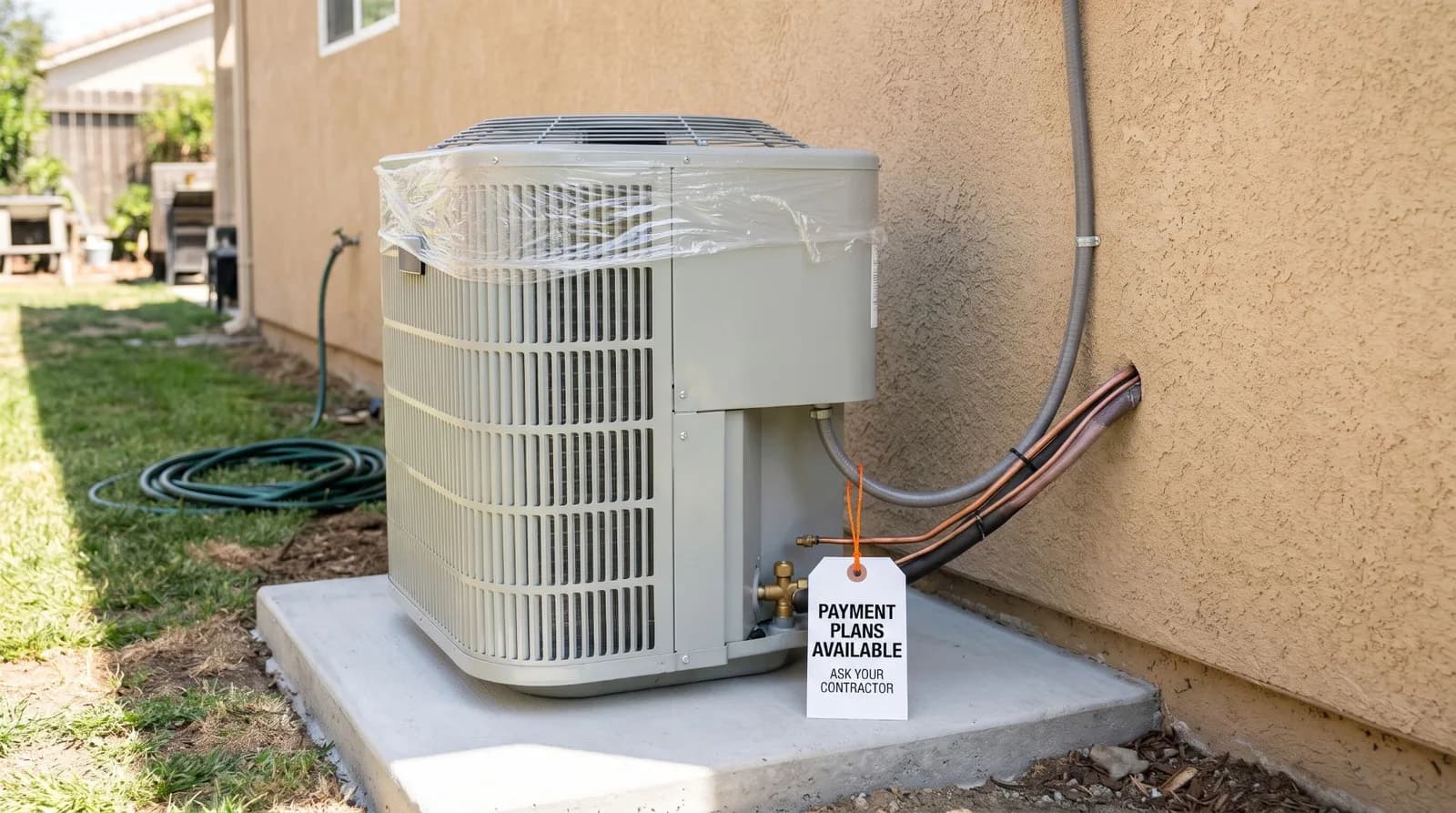
A homeowner looking at a new roof or a replaced furnace wants to know one thing before they call: can I pay for this over time? Contractor financing answers that, but only if the customer can find it on your website.
We opened the websites of the 18 Sacramento-region contractors from our audit of licensed contractors and read every page we could reach for financing, payment plans and lender names. Five of the 18 mention financing. None says it on the first screen of the homepage. None names a lender a homeowner could borrow from, none states a rate or a payment, and none lets the customer check terms or apply.
We build websites for trade contractors, so weigh this accordingly. The check was done on 2026-10-25, the method is at the end, and the only firm named is named for something done well.
Contractor financing: what 18 sites show
Mention financing or payment plans anywhere
Mention it on the first screen of the homepage
Have a page about financing
Name the lender
Name a lender a homeowner can use
State a rate, a monthly amount or a number of months
Let a customer apply or check terms from the site
Say nothing about financing
| What we found on 2026-10-25 | Sites |
|---|---|
| Mention financing or payment plans anywhere | 5 |
| Mention it on the first screen of the homepage | 0 |
| Have a page about financing | 2 (plus 1 blog post) |
| Name the lender | 1 (a commercial program) |
| Name a lender a homeowner can use | 0 |
| State a rate, a monthly amount or a number of months | 0 |
| Let a customer apply or check terms from the site | 0 |
| Say nothing about financing | 13 |
The five that mention it use phrases like "affordable financing", "payment plan options", "excellent financing options" and "flexible financing". One plumber mentions it on five pages, and its homepage adds "Be sure to ask about our payment plans!" One roofer gives it a single sentence halfway down the homepage. Two solar and remodeling firms have a financing page. One commercial mechanical, electrical and plumbing firm has a blog post about its lender.
In every case the customer still has to call to learn who lends, what kind of loan it is, and whether they would qualify.
Why it matters for a big job
The numbers on this come mostly from companies that sell financing, so read them that way.
- Regions Bank sells home improvement loans through contractors. Its 2026 white paper surveyed 367 contractors and 665 homeowners online and found that "a minority of homeowners are using cash only (36%)". It also reports that "According to 74% of homeowners surveyed, having access to contractor financing enabled homeowners to do more work than they had originally planned." The authors note the findings "are self-reported and describe observed relationships rather than proven causal effects." Their definition of financing is broad: it includes credit cards and home equity loans, many of which look like cash to the contractor.
- ServiceTitan sells software to contractors. Its report with Synchrony (a lender) and Visa, released on September 30, 2025, says "41% of consumers actively seek financing options" and that "80% of homeowners begin their search online, yet many report dissatisfaction with the availability of trustworthy reviews, financing info, and digital checkout."
- The same Regions paper says financing "appears most effective when introduced early in the sales process rather than presented only after the homeowner has selected a project."
That last point is the website's job. The homepage and the service pages are the earliest part of your sales process. If the first time a customer hears about payment plans is when you hand them the estimate, they may have already decided the job is too big.
We found no independent survey from 2025 or 2026 on how many homeowners finance a repair. In the searches we ran, every current number came from a lender or a company that sells to contractors.
What a good financing mention looks like
One site in the sample does most of this well. M3 Service, a commercial mechanical, electrical and plumbing firm in McClellan, has a post dated March 26, 2025 that names its lender (the National Energy Improvement Fund), says who it is for ("commercial, non-profit, and municipal properties"), gives the minimum project size ("projects $2,000 and up") and lists what can be financed. A building owner reading it knows whether it applies to them before they call.
For a homeowner-facing contractor, the same idea looks like this:
- Who lends. Name the company. A customer is more likely to apply with a lender they can look up.
- What kind of loan. A fixed monthly loan, a deferred-interest promotion, or a lease. They work very differently.
- Which jobs. If financing only makes sense above a certain size, say so.
- How to apply. A link to your lender's application or prequalification page, if your lender offers one. None of the 18 sites had one.
- Where. One line on the first screen or next to the quote button, a sentence on the service pages for the big jobs, and the full detail on one financing page.
Be careful with numbers
A general phrase like "financing available" is safe ground. A number is not. Under the federal Truth in Lending rules, 12 CFR 1026.24(d), an ad that states "the amount or percentage of any downpayment", "the number of payments or period of repayment", "the amount of any payment" or "the amount of any finance charge" must also state the down payment, the full terms of repayment, and "the "annual percentage rate," using that term" (eCFR, up to date as of 2026-10-22). The definition of an ad covers a website: "a commercial message in any medium that promotes, directly or indirectly, a credit transaction."
The official commentary gives examples on both sides. "48-month payment terms" and "$25 weekly" trigger the extra disclosures. "Monthly payment terms arranged", "regular monthly payments" and "no downpayment" do not. None of the 18 sites used a phrase that triggers them. Before you put a monthly price on your site, ask your lender for wording it has approved. This is not legal advice.
Keep the financing page current
A financing page gets written once and forgotten. One page in this sample, last changed in December 2020 according to its sitemap, still tells customers that "If you install and own a solar system by the end of 2020, there is a 26 percent federal tax credit available". The IRS page for that credit, last updated July 4, 2026, now says "The credit is not available for any property placed in service after December 31, 2025" (IRS). A customer who reads the old page and then talks to their tax preparer finds out the hard way.
Lender programs change too: promotions end, minimums move, lenders leave the market. Put a date on the page and check it whenever your lender changes its terms.
What to do this week
- Ask your lender for its website materials. Some lenders build this for contractors; Wisetack's homepage, for one, offers to "Add Wisetack to your website". Use their approved wording and link instead of writing your own numbers.
- Add one line near your phone number or quote button. "Payment plans available through [lender]. Ask us or apply online."
- Write one financing page. Who lends, what kind of loan, which jobs, how to apply, and the date you last checked it.
- Mention it on the service pages for your biggest jobs. A water heater or a panel upgrade is where a customer hesitates at the total.
- Read your page on a phone. Make sure the line and the link show up without opening a menu.
The other checks on this same set of sites are whether a customer can call you in one tap, whether you show a price at all, and whether your reviews show a date.
Our own site
We checked flarebuilt.com the same way. We do not offer financing through a lender, but we do take payment plans: builds start with a deposit and are split across milestones. That answer lives in the questions section near the bottom of our pricing page, not next to the prices, so a reader comparing tiers has to scroll past them to find it. Moving a short line up beside the prices is our version of step 2.
What we would build for a contractor
A site that says you offer financing on the first screen and on the service pages for your big jobs, with one financing page that names your lender and links to its application, all in the lender's approved wording. What a site like that costs is in our contractor website cost guide. Get in touch and we will check your site the way we checked these 18.
How we did this, so you can check it
- The contractors. The same 18 websites as our email check, drawn from the 42 licensed contractors in the original audit. Plumbing, HVAC, electrical, roofing, solar, low voltage and general building, in Sacramento, Placer, El Dorado and Yolo counties.
- The look. On 2026-10-25, up to 10 pages per site from its sitemap, in a desktop Chrome browser at 1366 by 900 pixels. Where the sitemap listed only one page, we followed the homepage links instead. Two sites are single pages. One site's inner pages load blank when the address is typed in, so we clicked through six of its pages by hand. We searched all page text, including text hidden in sliders and animated blocks, for financing words, payment plan words, APR and the names of common contractor lenders, then removed false matches (a "10% discount", a "Chief Financial Officer") by reading each one. We then opened every mention in a browser to see where it sat on the page. Nothing was submitted and no login was used.
- The outside sources. The Regions white paper (PDF, 2026), the ServiceTitan press release (September 30, 2025), the eCFR text of 12 CFR 1026.24 and its official commentary, and the IRS credit page, all read on 2026-10-25. Regions, ServiceTitan and Synchrony all sell to contractors or lend to their customers.
- Limits. Eighteen sites in one region, on one day. A page beyond the first 10 may mention financing, and a contractor may well offer it on the phone without saying so online. We did not ask any lender what it allows on a website.